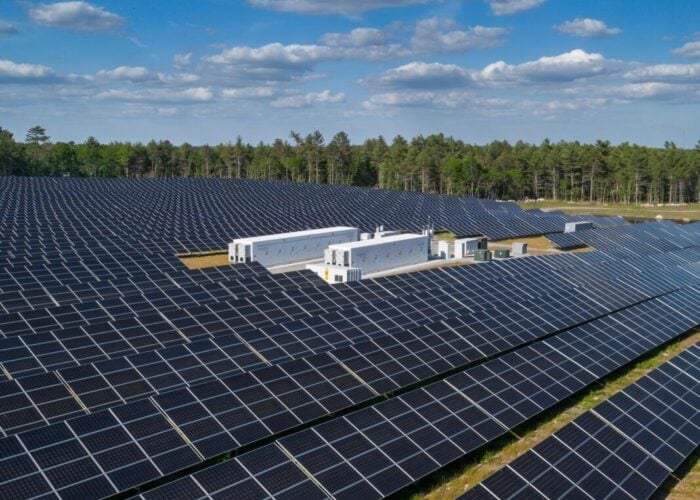
Four days, five announcements, and more than $2.66 billion later, it’s time to catch one’s breath and reflect on the recent flurry of US Department of Energy conditional loan guarantee awards. As the program approaches its sell-by date of Sept. 30, with the future of the amply-distributed Section 1703 plan in doubt, the latest winners have one thing in common—they all play for Team Solar.
I first heard about Applied Materials’ exit from its SunFab amorphous-silicon turnkey-line business from Xunming Deng, head of Xunlight, whose Toledo, OH-area company I was visiting that July day. That a silicon thin-film guy delivered the news (and one running an outfit having its own “issues,” to boot) made the moment memorable and poignant. The following evening, when I had time to reflect and some liquid solace in my system, I realized that not only did I have a journalistic response to AMAT’s expensive failed endeavor—it was a HUGE story—but I had an emotional reaction as well: it felt like a gut-punch from a company I’d been covering for 20-plus years, which made me sad, disappointed, and yes, angry. Nearly a year later, recent announcements by AMAT thin-film customers T-Solar, Masdar PV, and Best Solar, companies actually manufacturing and deploying those almost six-meter-square modules, have compelled a fresh look at a technology and toolset that I’d given up for comatose, but is apparently conscious.
The intersection of Southern California Edison’s efforts to come up with smarter electrical distribution circuit technologies and its ongoing neighborhood commercial-rooftop solar power push could be seen symbolically in the guts of an open Satcon inverter box at the utility’s testing labs in Pomona, an eastern suburb of Los Angeles. The inverter is one of twenty-some units of various makes, types, and sizes being run through their paces with grid-simulation gear, addressing low-voltage ride-through, fault current, transient overvoltages, and other challenges that must be dealt with in order for inverters to become more than just passive components and help regulate voltage on the future, more renewably powered grid. Satcon is also the brand of choice so far for SCE’s deployment of small utility-scale, distributed PV generators mostly on top of warehouses in the Inland Empire of Southern California.
Although many have championed the potential transferability of production technologies developed and refined in semiconductor chipmaking to photovoltaic manufacturing, the two may have less in common than originally thought. To be sure, there are many lessons to be learned by the PV crowd from their uptown second cousins—they are both semiconductor-type processes, after all—yet most of the integrated circuiteers expertise doesn’t easily segue from chip fab to cell line. But one clutch of core competencies may have a legit shot at making the move as solar manufacturing goes gigawatt scale: process control and yield management. Enter KLA-Tencor’s FabVision Solar, a high-speed data-collection and analysis platform with roots in the company’s years of experience in the bare-wafer and IC sectors. It provides cell producers with a way to improve their understanding and control of their own processes and the defectivity that lurks therein, and thus increase their yields and factory productivity.
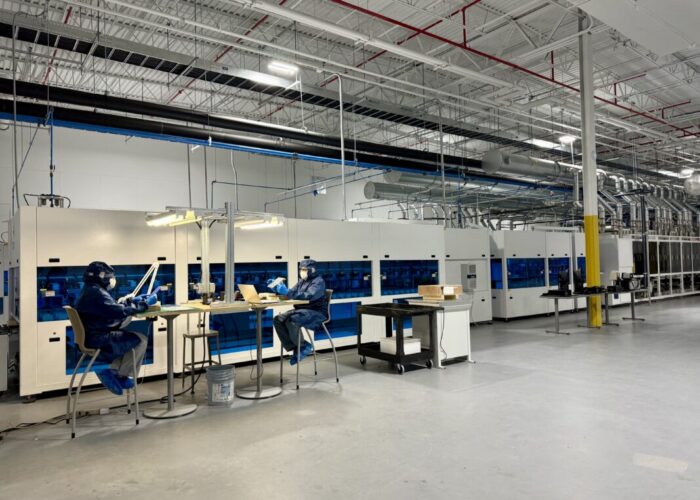
The high level of automation becomes quickly apparent when you walk through Astronergy’s tandem-junction production factory floor. Train-like AGVs run along a central chase area and big-armed material-handling robots glide back and forth, slinging the hefty, glass panels in and out of the cassette carriers and various process tools with little or no human intervention on most of the line. The layout is a serial-batch stocker configuration not unlike that seen in modern semiconductor and flat-panel display fabs. “The systems are all built around the stocker, so they’re pretty flexible. If an individual tool is down, the rest of the process can operate,” CEO Liyou Yang explained.
Liyou Yang started in the thin-film game in 1985 with BP Solar, where he eventually ran the company’s amorphous-silicon research efforts. “Once you get into it,” he smiled, “you get hooked.” During the course of our conversation at Astronergy’s headquarters in Hangzhou, the Rutgers-educated president/CEO would often reference his time at the old company, using his early experiences as reminders of just how far the technology and the solar industry in general have come since those pioneering days in the 1980s and ‘90s. Now running one of China’s fast-growing photovoltaics enterprises, Yang and his team have aggressive plans to bring Astronergy to gigawatt production scale and beyond over the next few years.
Siliken has by no means given up on the US solar market, but it has certainly given up on manufacturing its modules in the USA. After ramping a small panel factory in Otay Mesa in south San Diego County to 30MW and staffing it with 130 employees as of late September 2010, the subsidiary of the vertically integrated Spanish PV company reassessed its situation and quickly decided to make a cost-saving short-distance move across the border to maquiladora-friendly Tijuana—signing a lease in February and rolling its first multicrystalline products off the new, soon-to-be 60MW Mexican production line in April. While the economics of the relocation may make sense in a time of shrinking module ASPs, when I visited Siliken then-expanding San Diego facility last May, the company was touting its long-term commitment to the city. Why the firm changed course and the quiet way in which it did so provide a cautionary solar tale and a lesson in marketing—or the lack of it.
When I first heard that Sulfurcell was ditching the element embedded in its name in its CIGS thin-film PV process and going to a selenium-based approach, I wondered how long it would take the Berlin-based firm to change its outmoded brand. Although it took awhile for the transformation to happen—and the 10-year-old company does still make some of its modules using the less-efficient sulfurized Gen-1 process—rebranding has finally taken place: say goodbye to Sulfurcell, hello Soltecture.
(Updated) While a 50MW PV module line may seem like a drop in the capacity bucket of a firm with some 2GW of production capability, the importance of Suntech’s Goodyear, AZ, goes beyond the modest percentage of the enterprise-wide nameplate it represents. In addition to being the company’s first major facility outside of China, the site will be a prime example of the concept of distributed manufacturing—the idea of making panels close to where they will be deployed—when the US plant starts shipping its products 30 miles (~50km) west to the Mesquite Solar 1 project for installation in the initial 150MW of the utility-scale solar power farm. For the parent company, the Goodyear plant also will be a testbed of sorts, since it features a higher level of automation than the more manually oriented modcos operating back on the company’s Middle Kingdom campuses.
The first Solar Short Takes blog of the spring finds SoloPower moving the Oregon site of its planned factory from Wilsonville to north Portland, fellow CIGS manufacturer Solibro increasing its production output, REC Solar banking on big business in the Northeast US and likely adding thin film to its portfolio soon, First Solar still in the running for more DOE loan guarantees and Cogentrix copping one for CPV but other projects seeking the federal incentive now in doubt, ECD Uni-Solar singing the blues, and Canadian Solar returning as a good-luck-charm sponsor for the reigning World Series champs.