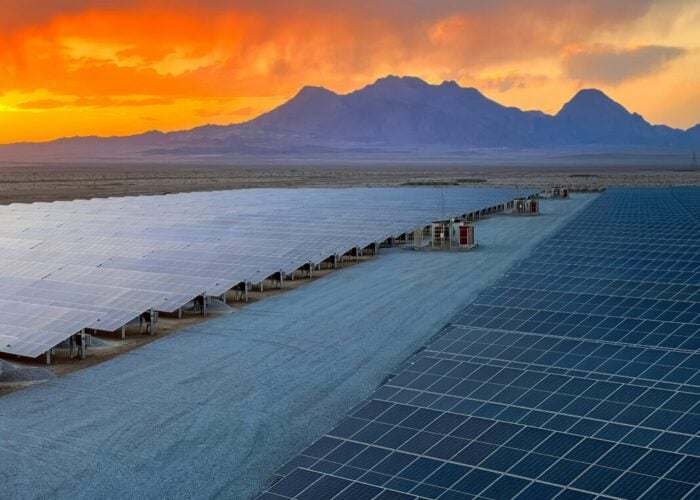
According to Greentech Media’s report, it seems that First Solar has managed to achieve grid parity with its 12.6MW system in the Nevada desert, installed for Sempra Generation. Mark Bachman, a senior research analyst with Pacific Crest and a specialist in cleantech energy, has aggregated the numbers in the Greentech Media report.
Mr. Bachman claims that the Nevada desert system costs $0.075 per kilowatt-hour to install without any subsidies, compared to costs incurred by ‘conventional’ power of $0.09 per kilowatt-hour. Looking solely at these figures, it would seem that this is an achievement that should have the solar energy industry rubbing its hands together in joy.
Try Premium for just $1
- Full premium access for the first month at only $1
- Converts to an annual rate after 30 days unless cancelled
- Cancel anytime during the trial period
Premium Benefits
- Expert industry analysis and interviews
- Digital access to PV Tech Power journal
- Exclusive event discounts
Or get the full Premium subscription right away
Or continue reading this article for free
However, naysayers will always challenge such claims. Bachman’s cost calculations are based on one particular location and one particular panel type; different results may have resulted from use of the same panels in a different location, or using different technology in conditions similar to those found in the Nevada desert.
“In our view, the industry leaders will be those companies that can deliver electricity at or below grid parity pricing without the aid of subsidies while also delivering superior return to shareholders,” said Mr. Bachman. “Currently, only First Solar can claim these achievements, in our view.”
First Solar has managed to produce large numbers of panels at a low cost for the past few years, claiming recently that it had lowered the cost-per-watt of production of its modules to $1.08 per watt. According to Greentech Media, this figure is an amalgamated average of the individual costs of production in each of the company’s manufacturing facilities, although First Solar has reached a low cost of 75 cents per watt in its Malaysia-based plants.
Bachman noted that while the installation for Sempra cost around $3.17 per watt, this price incorporated the cost of frames and installation as well as the cost of the modules themselves. He also pointed out that the solar industry spends too much time focussing on the cost of production and installation of panels, and not enough time looking at the overall cost of the entire project in terms of kilowatt-hours.
“By focusing on the cost/kWh calculation, we can compare competing business models on a defined metric that is independent of technologies,” he said.
This report also highlighted the potential competitors First Solar may encounter in the next few years in the race for grid parity. Cypress Semiconductor’s CEO T.J. Rodgers was reported as saying that power produced by crystalline silicon solar panels will be cheaper than that produced by coal by 2012.
SunPower is another potential runner: the company’s 14.2MW system at the Nellis Air Force base in Nevada features crystalline silicon panels that cost $7.04 per watt to install. In terms of kilowatt-hour cost, Bachman figured that it worked out at $0.164 per kilowatt-hour. For SunPower to rival First Solar’s kilowatt-hour rate of electricity generation, however, Bachman reckons that SunPower’s panels, despite the fact that they boast a much higher conversion efficiency rate, would have to be sold at 52% less, or $3.4 per watt.
So whether or not First Solar has achieved the much-coveted grid parity is unclear, but the numbers do add up.