Having already announced that it will ship approximately 12MW of its a-Si thin-film modules for use in Japan-based projects this year, NexPower Technology Corporation has said that the first project in Kansai, Japan has started construction. The 200kW power system is the first to use its 160W modules in the country, according to the company. NexPower’s Japanese distributor is Marubun Corporation.
Taiwan-based NexPower Technology has announced that it will ship approximately 12MW of its a-Si thin-film modules for use in Japan-based projects. The company plans for these shipments to be spread across three promotional channels: local distributions, EPCs and construction developers.
The coalition of Masdar PV and Gehrlicher Solar has completed a 7.7kWp roof-top installation in Belgium, claimed to be the second of its kind, for French company InnoVent.
Few should be surprised that Energy Conversion Devices (ECD) and its wholly owned subsidiary, United Solar Ovonic (USO), have entered Chapter 11 proceedings in the US Bankruptcy Court for the Eastern District of Michigan. ECD announced separately the sale of another subsidiary, Ovonic Battery Company, to BASF for US$58 million in cash. ECD says that it will also sell USO, while Solar Integrated Technologies also filed for bankruptcy under Chapter 7 rules in separate proceedings.
Nanotechnology-based thin-film materials specialist, Cambrios Technologies has received a US$5 million, Series D-3 financing round from Samsung Venture Investment Corporation as part of a prelude to further business collaborations on coating materials, which could include transparent electrodes for touch screens, liquid crystal displays, e-paper, OLED devices, OLED lighting and thin film photovoltaics.
Citing growing world demand for environmentally-friendly production equipment cleaning gases within the flat panel display and silicon thin-film photovoltaic industries, Solvay and Air Liquide have formed a joint venture to provide onsite fluorine production. The partners claim to be able to offer significant economic benefits based on Solvay’s modular fluorine production technology.
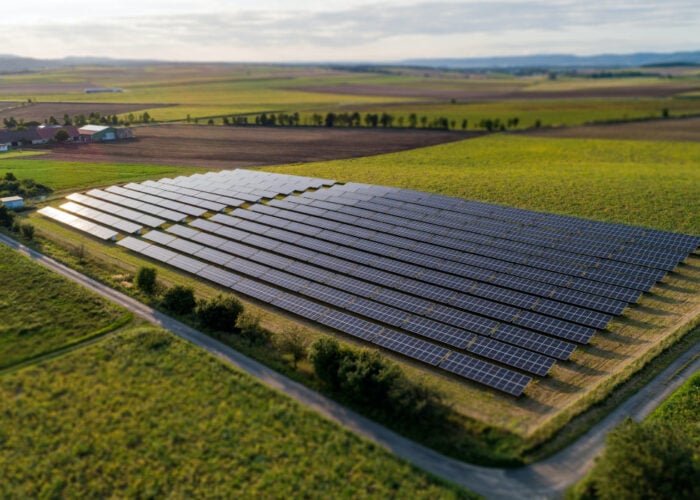
A 11.7 MWp PV power plant, completed late last year by Masdar PV in Thuringia, Germany, used dual-junction ‘micromorph’ silicon technology and amorphous technology with over half being full sized modules.
The rapid decline in conventional crystalline silicon module production costs has wiped-out a significant part of the cost advantage once benefiting thin film module producers. As falling polysilicon prices continue to find their way through to volume producers in 2012, the pressure on thin film cost reduction intensifies. To compete, Oerlikon Solar is prepping the launch of its 2nd generation ‘ThinFab’ line that claims a module cost of around US$0.5/Wp (€0.35/Wp), compared to its previously claimed cost of US$0.64 (€0.50/Wp) of the original turnkey system launched in September, 2010 at EU PVSEC.
Troubled thin film veteran, Energy Conversion Devices has deferred interest payments to note holders of its Senior Convertible Notes due 2013 as it continues talks with some of the holders over restructuring debt and raising funds to continue operations.
Oerlikon Solar has teamed up with the International Cooperation Center for China Renewable Energy Society (CRES) to further the company’s research and strategic development of thin-film silicon technology in China. The companies signed a Memorandum of Understanding that will involve a collaborative joint effort toward the promotion of Oerlikon’s products, technology and research in China.