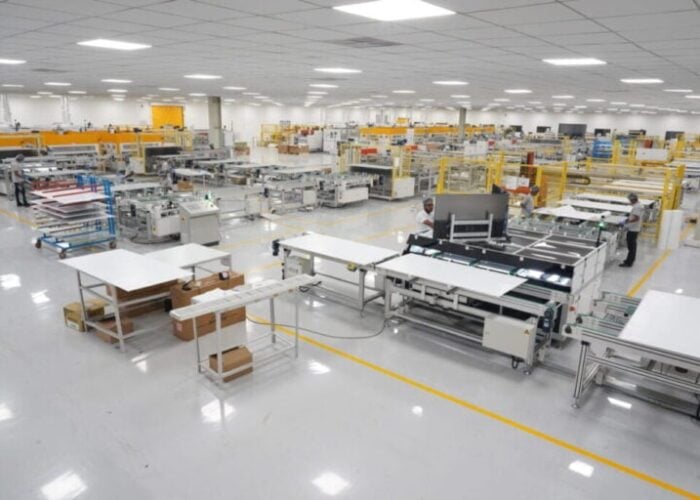
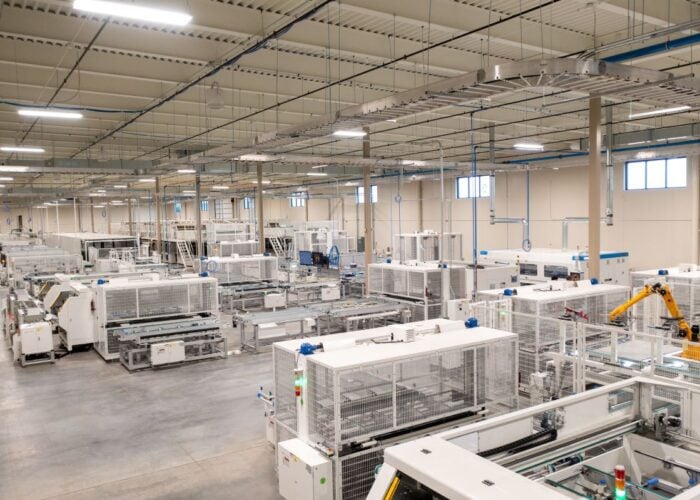
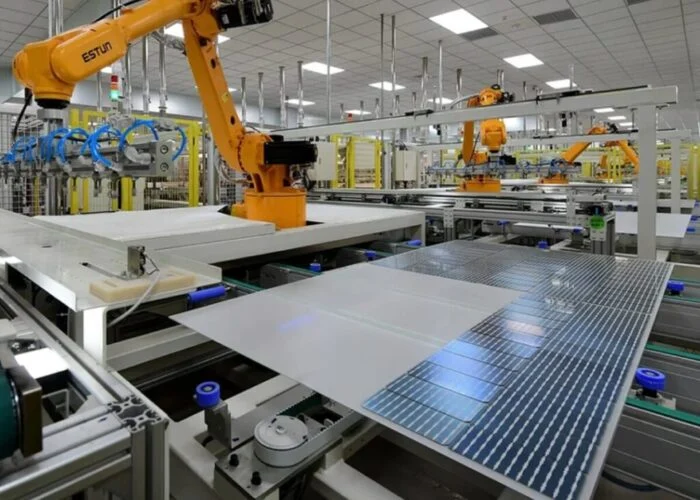
Xunlight and Trina Solar’s 220kW solar demonstration project in China has reached completion. Xunlight, through its subsidiary in Kunshan, China, provided Trina Solar with 220kW of its flexible thin-film silicon solar modules, which had been assembled using its triple-junction thin-film solar cells manufactured at its 25MW solar cell facility in Ohio.
As part of its long-term cost reduction goals for its turnkey Micromorph thin film silicon ‘ThinFab’ production lines, Oerlikon Solar has teamed with gas suppliers Air Liquide and Linde to provide more than a 20% reduction in total cost of all gases and precursors. As a result, its ThinFab (120MWp) lines going into full production by end of 2012 can reduce module production costs by up to 5%. The total gas budget was said to be less than €8.50 per panel.
The former Edgeboro Landfill in East Brunswick, New Jersey has been converted into a solar power generating facility with the completion of a 4.3MW solar project by ENN Solar Energy and National Renewable Energy Corporation (NERC). ENN used 9,000 of its thin-film silicon solar modules for the project, which is anticipated to be able to produce 100 million kWh of electricity over its lifetime.
A sharing of management responsibilities at struggling Energy Conversion Devices (ECD) has been announced with ex-Abound Solar executive, Julian Hawkins joining the firm as Chief Executive Officer and President and a member of the Board of Directors, effective December 5, 2011. Current Interim President since May 2011, Jay Knoll will become Executive Vice President and Chief Restructuring Officer at the same time.
Having stopped all production at various plants to preserve cash and help draw down inventory, Energy Conversion Devices (ECD) posted a net loss from continuing operations of US$57.5 million, which includes a non-cash impairment charge of US$34.3 million for its financial Q1 results. Revenue was reported at US$22.0 million, which compares to US$65.3 million in the first quarter of fiscal year 2011, and US$70.5 million in the fourth quarter of fiscal year 2011. ECD previously cancelled its conference call and refrained from providing information on whether a call would be organised.
In another sign of trouble in the US domestic PV manufacturing sector, flexible thin-film silicon laminate maker Energy Conversion Devices has taken several restructuring actions, including the suspension of all manufacturing operations in what the company calls “an inventory control measure.” Other moves taken by the Auburn Hills, MI-based firm include various cost reduction efforts, continued R&D on next-generation technologies, and the expansion of addressable markets. In addition, ECD management has started discussions with representatives of certain holders of the company’s outstanding Senior Convertible Notes due 2013. As a result of the actions, it has postponed the quarterly financial conference call until further notice.
Next Energy, the independent EWE Research Centre for Energy Technology has asked Leybold Optics to provide its Phoebus lab tool by the beginning of 2012 for Next Energy’s R&D purposes involving thin-film solar cells. As Next Energy is concerned with silicon thin-film technology, its scientists are looking to increase the efficiency of the cells, which they state would then lead to a reduction in the cost of the technology.
Astronergy, a unit of Chint Group, advised that Munich RE had selected its thin-film amorphous microcrystalline silicon PV panels for a 1.65MW solar project in Thailand. The plant was commissioned on October 28 with Astronergy noting that various Chint subsidiary components were being used for including inverters and BOS system elements.
The T-Solar Group, which has 230MW of solar projects under construction in Spain, Italy, India and Peru, advised that it is continuing its international development with the addition of 61MW of solar power in Peru and India. The company recently brought its 5MW PV power plant in India online, which uses thin-film amorphous silicon panels that were fabricated at its Galicia, Spain factory.
Thin-film technologies are a favoured manufacturing alternative to conventional crystalline solar modules in the US. The R&D history goes way back and of course the US is home to First Solar, which stamped thin-film technology firmly on the PV industry map. That said, announcements at Solar Power International 2011 relating to thin-film technologies have been rather thin on the ground these first few days of the show.