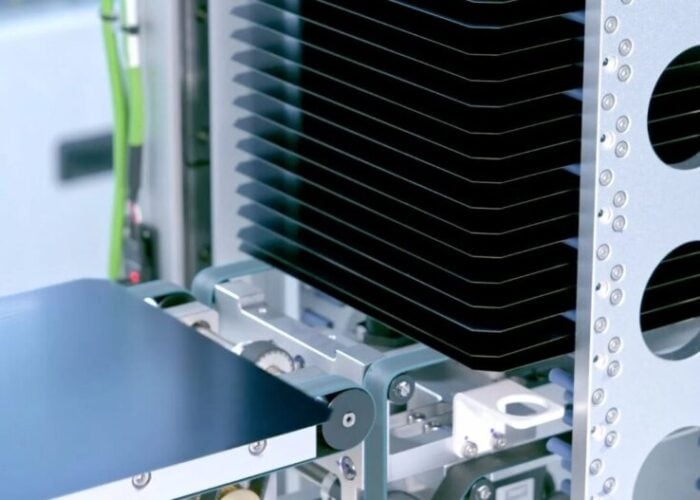
From the heart of its R&D centre in Rochester, New York, Natcore Technology scientists have developed what they call the “first black silicon solar cell”.
Using scalable liquid phase deposition (LPD), scientists developed the technology from wafer to cell. The silicon wafer is said to have a near-zero reflectivity; however, Natcore stresses that the wafers are only components of a solar cell and are not able to produce electricity until formed into solar cells.
Try Premium for just $1
- Full premium access for the first month at only $1
- Converts to an annual rate after 30 days unless cancelled
- Cancel anytime during the trial period
Premium Benefits
- Expert industry analysis and interviews
- Digital access to PV Tech Power journal
- Exclusive event discounts
Or get the full Premium subscription right away
Or continue reading this article for free
The company noted that prior to its US$2.5 million financing, which was completed this past July, it would have normally outsourced the production steps and tests for its latest technology to other labs. However, portions of its proceeds from this summer, led to it using its in-house technology in order to develop what it marks as the “blackest” silicon solar cell surface to date.
The company plans to partner with the National Renewable Energy Lab (NREL) under a cooperative research and development agreement (CRADA). The NREL and Natcore will work on using Natcore’s LPD technology and the NREL’s technologies in order to reach, or exceed, record efficiency with the black silicon solar cells.
Hao-Chih Yuan, NREL research scientist, noted, “We have a good synergy with Natcore on black silicon technology. A silicon surface, without proper coating, is detrimental to the energy conversion efficiency of the solar cell. It is not unusual to grow silicon dioxide coatings on black silicon surfaces for this purpose, but the growth is typically at very high temperatures. Natcore's coating uses chemistry. They are the ones who can passivate a black silicon surface cheaply.”