An ambitious plan, which hasn’t been without implementation issues and which has stretched the financial structure of REC Group, is finally bearing fruit according to key executives of the company. At a lengthy investor and analyst seminar being held in Singapore, coinciding with the grand opening of the company's €1.3 billion plus integrated module production facility, enigmatic CEO Ole Enger claimed REC was on track to deliver a companywide all inclusive cost of €0.97/watt by the fourth quarter 2011. Excluding equipment and building depreciation at the new plant, the cash cost target for next year would be €0.74/watt.
Part of the €3 billion plus capital expenditure program is the polysilicon and silane capacity expansions involved in the the buildout and ramp of its low-cost, fluidized bed reactor (FBR) technology in North America. The company's polysilicon achieved a fully inclusive cost of US$42/kg in the third quarter and has a target of US$31/kg by the fourth-quarter 2011, as production reaches 16,000MT per annum, according to REC.
Try Premium for just $1
- Full premium access for the first month at only $1
- Converts to an annual rate after 30 days unless cancelled
- Cancel anytime during the trial period
Premium Benefits
- Expert industry analysis and interviews
- Digital access to PV Tech Power journal
- Exclusive event discounts
Or get the full Premium subscription right away
Or continue reading this article for free
Enger noted in the seminar that REC had demonstrated a cash manufacturing cost for the FBR-processed polysilicon of US$18/kg.
With the ramps under way and a period of optimization and debottlenecking planned for 2011, REC is confident that it has the manufacturing cost structure to compete with anyone in the PV industry, not least the low-cost Tier 1 producers in China.
Rather than just claim such cost competitiveness or leave out key costs such as raw materials, a series of presentations gave one of the most detailed and transparent analyses of REC’s manufacturing cost structure ever. The company highlighted further capacity expansion plans and operational goals that were intended to show its longer-term cost competitiveness to investors, financial analysts, and skeptics alike.
REC plans to further leverage investments in infrastructure at the Singapore site to increase module production to 800MW by 2012, exceeding the nameplate capacity by approximately 35%. Importantly, this was claimed to be achievable without further significant capital cost.
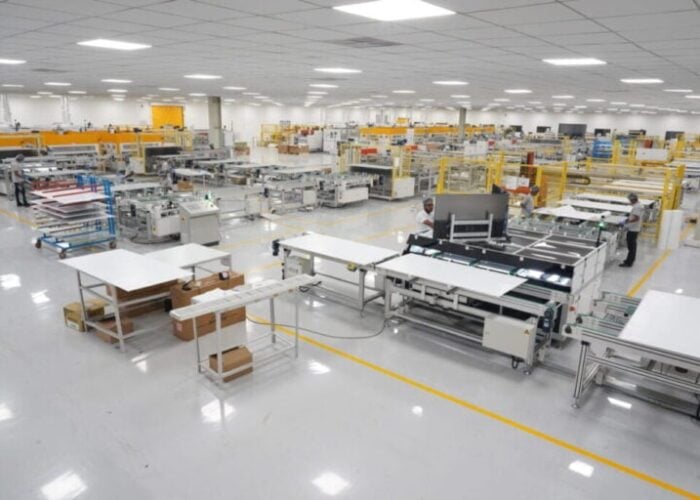
Indeed the plant in Singapore is at the heart of its claims for longer-term cost competitiveness. The highly automated plant uses a skilled workforce but employs less than 50% of the number typically found in Tier 1 plants in China.
Although the upfront cost of highly automated module plants and heavy tool depreciation costs can prove challenging to compete with the cost structures found in China, REC highlighted that cell breakage in Singapore was already as low as 0.4% using a standardized 180µm wafer thickness. Silicon consumption from ingot to module is expected to be down to 5.6g/watt by the fourth quarter of 2010.
The elimination of as many pick-and-place handling robots as possible throughout the facility was said to be behind the low breakage figure. Only four were being used within the plant, compared to 18 being used at a similar plant in Norway, according to the company.
Wafer quality has also been a key factor in REC’s cost competitive roadmap. Erik Lokke-Owre, senior VP of operations in Singapore, noted in his presentation that the plant had already achieved a 0.2-0.3% wafer quality improvement that contributes to an overall annual cost reduction cycle of an expected 10% per annum.
The plant also includes eight advanced cell lines, each with a nameplate capacity of 70MW, giving REC a total of 550MW. Near-zero defects and perfect manufacturing flow dynamics were at the core of its competitive position, Lokke-Owre added.
Average cell efficiencies were pegged at 16.8% without further planned enhancements and process optimization, while current yields have exceeded 94%. The use of advanced process control (APC) and statistical process control (SPC) systems and protocols would ensure quality cells at a world-class level, he said.
Solar module costs were said to be on target to fall to €1.05/watt by the fourth quarter of 2011, down from €1.49/watt in the third quarter of 2010, representing a 30% decline over five quarters.
REC executives also noted that sales demand is expected to be strong in 2011, giving the company confidence in achieving full capacity for its FBR silicon and Singapore plants.
“I am impressed by the performance demonstrated by the Singapore organization during construction and ramp-up of the new facility,” noted Enger. “This achievement gives me confidence in the organization's ability to continue to improve and further strengthen REC's competitive position.”