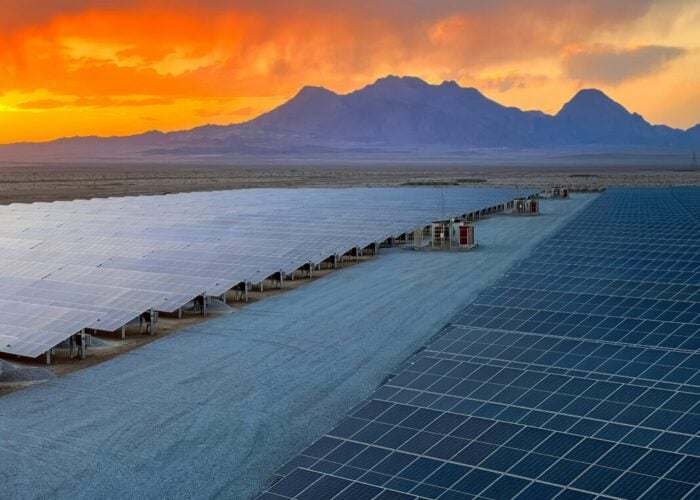
All of Europe’s energy needs could be met by covering an area in the Sahara Desert with solar panels, it was announced in Copenhagen.
With a solar farm as large as Ireland, Europe could realistically consider receiving 20% of its energy from renewable sources by 2020. Since the sun in North Africa is twice as strong as it is in southern Europe, just 0.3% of the light will be sufficient to power Europe, said Arnulf Jaeger-Waldau of the European commission’s Institute for Energy. Scientists envision that 100GW could be generated by 2050, which is more than the combined electricity output from all sources in the UK.
Try Premium for just $1
- Full premium access for the first month at only $1
- Converts to an annual rate after 30 days unless cancelled
- Cancel anytime during the trial period
Premium Benefits
- Expert industry analysis and interviews
- Digital access to PV Tech Power journal
- Exclusive event discounts
Or get the full Premium subscription right away
Or continue reading this article for free
In what could be a £50 billion multiple government investment over the next ten years, these solar farms could produce electricity either through photovoltaic cells or by turning water to steam by focusing the sun’s rays with mirrors. In addition, the cost of moving electricity long distances is down at least three-quarters. The investment would also make the Sahara an exceptional prospect for private investors years from now.
Solar farms in North Africa would make fossils fuels less relevant and would make Europe less likely to depend on Russia and the Middle East for energy. Trials of concentrated solar power for sources of European electricity will be planned for Egypt, Morocco, Algeria and Dubai while Libya and Tunisia may also be considered as alternatives.
While political hurdles such as resident complaints exist about having transmission cables near their homes, there is also the possibility of wind farms being placed along the North African coast. Winds created by the Sun heating the air are stronger during the summer, when European wind turbines, are less productive.