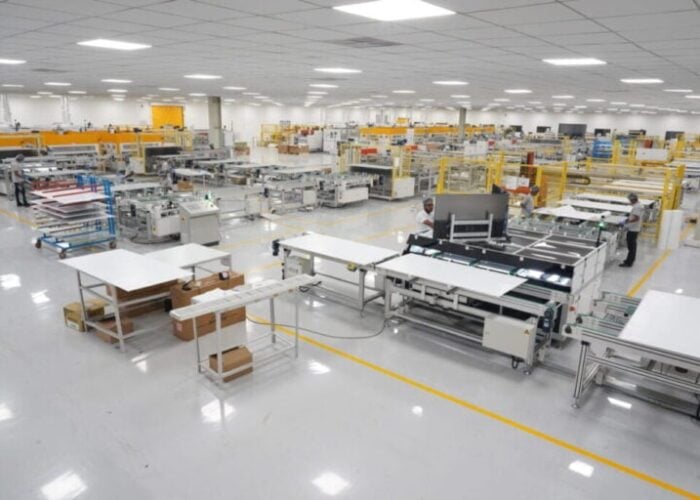
SolarPark Korea passes PID tests with 0.1% power degradation

  •   Major Korean PV module manufacturer, SolarPark Korea has had two 60 cell mono-crystalline and three multi-crystalline modules pass the Potential Induced Degradation (PID) test.
    Major Korean PV module manufacturer, SolarPark Korea has had two 60 cell mono-crystalline and three multi-crystalline modules pass the Potential Induced Degradation (PID) test.

Major Korean PV module manufacturer, SolarPark Korea has had two 60 cell mono-crystalline and three multi-crystalline modules pass the Potential Induced Degradation (PID) test, conducted at Photovoltaic Institute Berlin (PI Berlin) and certified by TÜV-SUD.

PI Berlin exposed the modules to 1,000 volts of bias voltage for 96 hours at a temperature of 60°C and relative humidity of 85%, resulting in a ‘Quality Categorization A’ indicating a measurement of less than 0.1% power output degradation.

“Knowing that this test was becoming an important issue, our quality lab conducted several internal PID tests on modules to ensure good results,” noted Hyunwoo Park, CEO of SolarPark Korea. “Our modules were able to achieve this through our 100% automated production, which only leaves room for perfection and consistent high quality. Customers know that we stand by our quality and that we are reliable.”
Newsletter

Preview Latest
Subscribe
We won't share your details - promise!

Publications

  • Photovoltaics International 19th Edition

    For manufacturers who had their heads in the bunker during 2012, fighting falling ASPs and eroding margins, the nineteenth edition brings you details of what lies in store for this coming year. Wright Williams & Kelly return in this issue with their popular analysis of payback on technology buys; crucially they analyze n-type wafers, Al2O3 passivation and copper metallization. SERIS shows us how to achieve 18.7% efficiencies using low-cost etching techniques on diffused wafers. We also have two important technology roundups: CIGS from Helmholtz Berlin, and PV module encapsulation techniques from Fraunhofer ISE.

  • Manufacturing The Solar Future: The 2013 Production Annual

    In the ever-changing global solar markets, cost reduction and measures to increase cell efficiencies are the key tools available to PV manufacturers to create new opportunities and drive your business to the next level. Manufacturing the Solar Future 2013 is the third in the Photovoltaics International PV Production Annual series, delivering the next instalment of in-depth technical manufacturing information on PV production processes designed to help you gain the competitive edge.

Partners

Acknowledgements

Solar Media