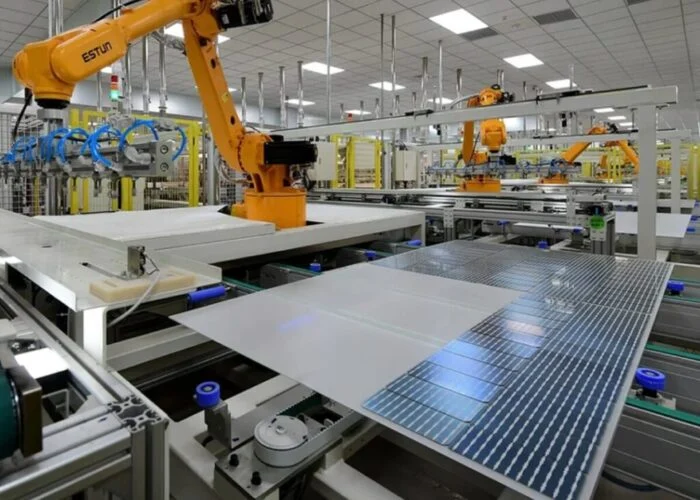
A partnership project to increase multicrystalline ingot casting quality and lower production costs at Yingli Green has been hailed a success.
PV-Tech has been told that, as part of the project, Yingli Green’s ingot furnaces have been fully-upgraded with a new gas refrigeration process.
Try Premium for just $1
- Full premium access for the first month at only $1
- Converts to an annual rate after 30 days unless cancelled
- Cancel anytime during the trial period
Premium Benefits
- Expert industry analysis and interviews
- Digital access to PV Tech Power journal
- Exclusive event discounts
Or get the full Premium subscription right away
Or continue reading this article for free
Yingli Green said that experimental results from wafers produced from the upgraded ingot furnaces delivered solar cells with a best average conversion efficiency of 17.75%.
The conversion efficiency increase is inline with Yingli Green’s Q3 2012 guidance that commercial-scale multicrystalline cell efficiencies would reach 17.5% by the end of 2012.
Liansheng Miao, Chairman and Chief Executive Officer of Yingli Green Energy said: “The improved technology will allow us to enhance our competitiveness through reduced consumption of energy and raw materials and improved yield rate. As a leading renewable energy company, Yingli has been committed to technology and product innovation, which has enabled us to emerge stronger under the challenging market conditions.”
The development project was carried out between its wholly-owned subsidiary Tianjin Yingli New Energy Resources Company and Zhejiang Jingsheng Mechanical & Electrical Company.
Typically, a gas refrigeration system works in tandem with two furnace heating zones and one cooling system to optimize temperature and process controls to improve ingot quality, especially in larger sized furnaces.