Product Briefing Outline: mbj-Solutions have introduced an offline solar module inspection system designed for the use in the factory and laboratory. The ‘SolarModule EL-basic’ is an advanced offline electroluminescence inspection system. Different module sizes, laminated and not laminated can be inspected without any extensive adjustment work. The design of the system combines usability, high resolution, short tact time and fast return on investment in one machine.
Problem: Micro cracks on solar modules are mostly invisible to the human eye, yet present a significant risk of decreasing the module’s performance. Micro cracks can happen anywhere and anytime, during production, transportation or installation.
Try Premium for just $1
- Full premium access for the first month at only $1
- Converts to an annual rate after 30 days unless cancelled
- Cancel anytime during the trial period
Premium Benefits
- Expert industry analysis and interviews
- Digital access to PV Tech Power journal
- Exclusive event discounts
Or get the full Premium subscription right away
Or continue reading this article for free
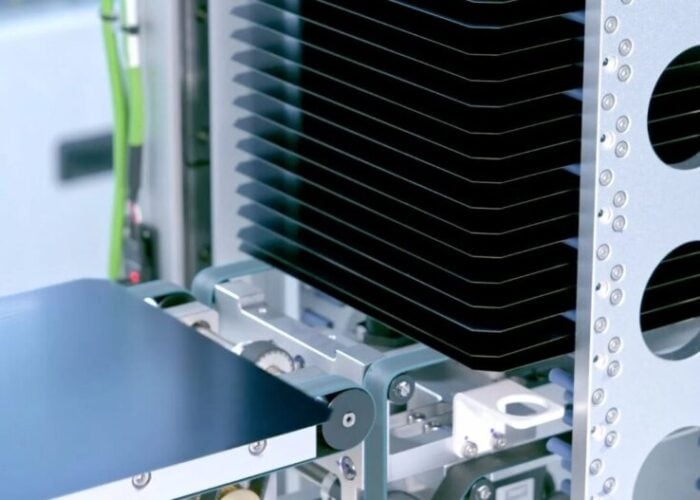
Solution: Once a module is placed on the roller tables, sensors detect its leading edge and the module is moved into the system automatically. Guide rollers assure the module’s precise positioning. The operator connects the power supply to the solar module. After the electrical connection is confirmed, the module will be conveyed to the inspection position and the operator may close the front cover. Image acquisition starts automatically. A high resolution image is captured of each solar cell. Three cooled near infrared (NIR) CCD cameras are moved to acquire images of each particular solar cell within the module under test. This inspection concept allows for shortest inspection cycles and highest resolution. All images of a 6 x 10 module will be captured in less than 30 seconds. The images are displayed on the user interface in a matrix view and the operator can grade the module as either ‘good’ or ‘reject’ depending on the defects visible in the images.
Applications: The system can be used for offline testing or in semi automated operation for inline applications in final inspection at the end of the solar module production line, before lamination process, in the laboratory or for trading companies to audit their suppliers. The system is designed for both mono- and multi crystalline silicon solar modules. Its software controlled test module power supply allows it to run all available module power classes, e.g. 6 x 10 module with 200Wp, 210Wp, etc…
Platform: The Solar Module EL-basic has a unique mechanical design which makes it very flexible and very easy to operate. Roller tables provide effortless loading and unloading of the modules which are facing down during the entire procedure. This design allows inspecting framed and non-laminated modules in various sizes and formats with only one machine and without any prior adjustments.
Availability: Currently available.