A Class A fire designation carries considerable weight when photovoltaic modules are specified for rooftops. It can be read as a straightforward indication of the highest level of fire safety. The technical meaning is narrower.
Fire classifications are tied to defined standards, test methods and acceptance criteria. They establish how a product performed under specified conditions. They do not necessarily describe every aspect of its behaviour in a fire, nor do they establish that two products carrying the same classification will respond identically.
Try Premium for just $1
- Full premium access for the first month at only $1
- Converts to an annual rate after 30 days unless cancelled
- Cancel anytime during the trial period
Premium Benefits
- Expert industry analysis and interviews
- Digital access to PV Tech Power journal
- Exclusive event discounts
Or get the full Premium subscription right away
Or continue reading this article for free
That distinction is becoming increasingly relevant as PV moves onto buildings where the consequences of fire extend well beyond the solar installation. Warehouses contain valuable inventory, factories depend on uninterrupted production, and hospitals, data centres and other critical facilities have particularly low tolerance for disruption.
The question for developers, asset owners and specifiers is therefore not only whether a module carries a Class A designation.
If two modules carry a Class A designation, how much can we actually conclude about their fire performance?
The answer starts with understanding what Class A actually tests.
What Class A establishes and why it does not always mean the same thing
“Class A” is not a universal description of fire safety. Fire classifications are tied to specific standards and test methods, and those standards assess different aspects of fire behaviour. Two products carrying a Class A designation may therefore have been tested for different risks.
Under UL 790, a standard developed by the US-based organisation Underwriters Laboratories (UL), Class A relates to performance under severe external fire exposure. The standard includes four fire-exposure test methods: intermittent-flame exposure, spread of flame, burning brand and flying brand. The module-level assessment discussed here uses two of these methods: spread of flame and burning brand.
The tests examine how far flames spread, whether fire penetrates the module and roof covering, whether sustained flaming occurs and whether burning or glowing material falls from the test deck. Passing establishes that the tested product met the defined Class A criteria under those conditions.
IEC 61730, developed by the International Electrotechnical Commission (IEC), is the international safety qualification standard for PV modules. It covers electrical, mechanical and fire-related safety, giving it a broader scope than UL 790. The fire test designated MST 23 in IEC 61730-2 uses methods based on UL 790.
This distinction also defines what Class A does not establish. A UL 790 Class A result does not certify that a module cannot ignite internally. It describes how the tested product responded to an external fire under defined test conditions. Potential causes of fire within a PV module or system, such as localised overheating, electrical connection faults or arcing, require separate consideration and supporting evidence.
European standards add another layer. EN 13501-1 classifies the reaction to fire of construction products, while EN 13501-5 addresses the external fire performance of roofs and roof coverings. These standards assess different aspects of fire behaviour and use their own classification systems. A UL 790 Class A result therefore cannot simply be translated into a European fire classification.
For project developers, EPCs and asset owners, the more useful question is therefore not: Does it have Class A? Questions shift to: Class A according to which standard? What was tested? Was the complete module tested? What did it do during the test? Were the test samples specially submitted, or randomly selected from normal production? And does the certification cover the product that will actually be supplied?
Performance differences within Class A
A fire classification is a threshold, not a complete description of fire behaviour. Two modules can meet the same acceptance criteria without behaving identically throughout the test. The classification does not express every difference in flame spread, integrity or the sequence in which components fail.
For example, a report may confirm that flame spread remained within the Class A limit without stating the exact distance reached. It may confirm that a burning brand caused no penetration without recording how much longer the specimen could have resisted exposure. Both are successful results, but neither supports an unmeasured performance claim.
More detailed testing can record the timing of glass failure, fire penetration, rear-side flaming or the release of burning material. Such observations provide a more complete picture of fire behaviour, without creating a category above Class A.
Fire resistance cannot be reduced to thicker glass
Glass is one of the most visible elements of a module’s response to external fire. Its type, construction and resistance to thermal stress influence how long the module surface maintains its integrity. But thicker glass alone does not establish better fire performance.
A PV module is a system of glass, cells, encapsulants, electrical connections, junction boxes and other materials. Their interaction determines how the module behaves when exposed to fire or when a fault develops within it. Fire performance is therefore the result of the complete physical system, not a single component.
These elements address different aspects of fire risk. Flame-retardant polymers and fire-resistant glass can influence how a module responds once exposed to fire. Electrical connections, connectors and junction-box design, together with connection quality and manufacturing controls, can influence the risk of faults and arcing. Cell behaviour under partial shading can affect localised temperatures and hot-spot formation.
The evidence for individual components also has a defined scope. A flammability rating for an encapsulant or junction-box material, for example, cannot automatically be applied to the assembled module. Component-level evidence and module-level fire classification answer different questions.
Beyond Class A
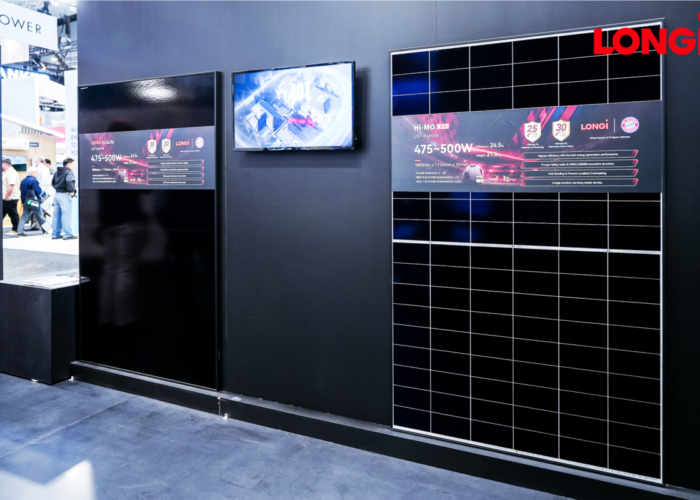
The Hi-MO X10 Guardian Fire-Resistant from LONGi combines measures to resist external fire exposure with features designed to reduce potential sources of ignition within the module. Its testing covers several aspects of fire behaviour that a single classification cannot describe.
The module has a Class A fire rating according to UL 790 and passed spread-of-flame and burning-brand testing under IEC 61730-2 MST 23. Flame spread remained within the Class A limit, with no significant lateral spread and no flaming or glowing parts falling from the test assembly. In the burning-brand test, the burning source did not penetrate the module and roof covering, and the module showed no sustained flaming.
The module has also achieved Class B under EN 13501-1, indicating a very limited contribution to fire under the prescribed test conditions. Class B is currently regarded as the highest practically achievable reaction-to-fire classification for conventional PV modules. This result complements the external-fire performance assessed under UL 790.
The module has also passed testing for B_ROOF(t4) under EN 13501-5, the highest classification under the t4 method for assessing the performance of roof systems exposed to external fire. The result applies to the roof construction and installation conditions covered by the assessment.
The modules used for the TÜV Rheinland Class A tests were randomly selected from a normal production batch, confirming that the tested specimens came from regular manufacturing. This connects the Class A result more closely to the modules manufactured at scale and addresses a question that the classification alone cannot answer: how representative was the tested product of normal production?
The fire-resistant design itself addresses several mechanisms. Fire-resistant glass and flame-retardant encapsulation materials help limit fire propagation when the module is exposed to fire. At cell level, current-management features limit localised overheating
under partial shading, while reinforced electrical connections, high-sealing connectors and the junction-box design address potential fault and arcing risks.
Additional high-temperature testing examines behaviour beyond the conditions expressed by the Class A classification. In LONGi’s thermal-shock testing, the fire-resistant construction was exposed repeatedly to temperatures approaching 1,000°C and resisted glass shattering for more than 1.5 hours under the specified test conditions.
For buildings where fire can result in substantial asset loss, business interruption or risks to people, this distinction has practical consequences. A Class A designation remains an important starting point, but increasingly it should prompt a second question: what evidence sits behind it?