
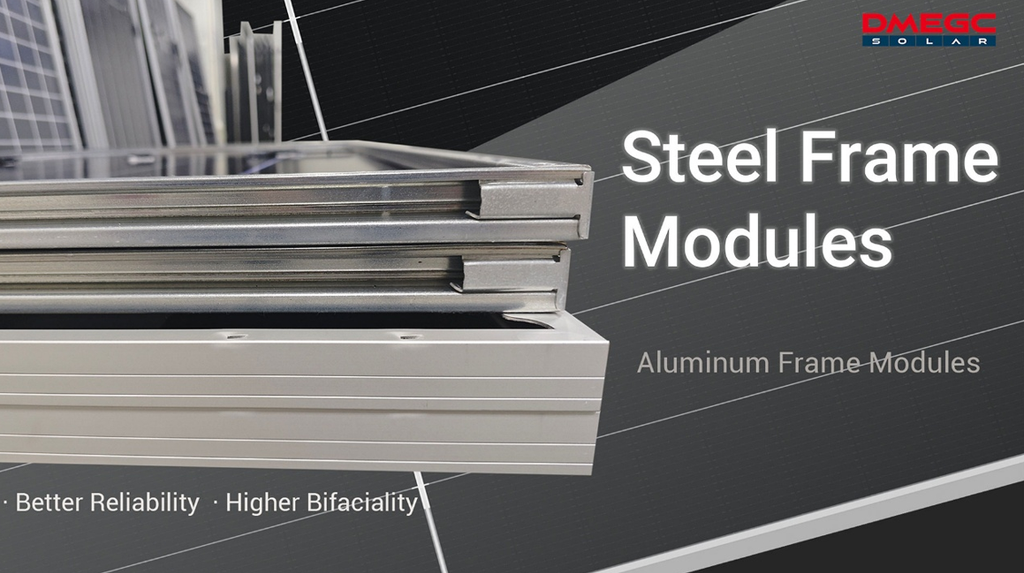
DMEGC Solar has announced the launch of a new series of steel-frame PV modules, representing a significant engineering shift from traditional aluminium frames, offering enhanced durability and a groundbreaking section design that maximizes rear-side energy capture.
The move to steel is driven by a combination of technical and environmental advantages. According to the company’s technical documentation, the steel grade used offers a much higher tensile strength, nearly double that of standard aluminium alloys. This allows the modules to withstand extreme mechanical loads—with a snow load up to 6000Pa and a wind load up to 5000Pa when properly mounted.
One of the most critical reliability improvements comes from the material’s Coefficient of Thermal Expansion (CTE). Steel has a CTE of 12 (10⁻⁶ m/k), which is much closer to glass (6.9) than aluminium (23). This compatibility suggests that steel-framed modules experience far less environmental stress over their lifetime, reducing the risk of micro-cracks.
The highlight of the launch is the new cross-section design for the steel frame. Unlike traditional frames that cast shadows on the rear side of the module, DMEGC’s innovative “S-shaped” cross-section reduces vertical shading on the back of the module by 76%. This design increases the unshaded rear area by 3.6% and theoretically increases the bifaciality factor by approximately 2.8%. When combined with new cell technologies and anti-reflective coating (ARC) on the back glass, DMEGC states that its modules can achieve a bifaciality factor of up to 85%.
According to DMEGC’s yield simulations, this 85% bifaciality factor translates to an annual power generation of 2,078 kWh/kWp/year. This represents an additional 0.6% gain in power generation revenue compared to conventional modules, giving project developers a tangible boost to their bottom line.
To address concerns about steel corrosion, the company utilizes Zn-Al-Mg coated steel (ZAM), this specialized coating providing exceptional resistance to environmental degradation.
