
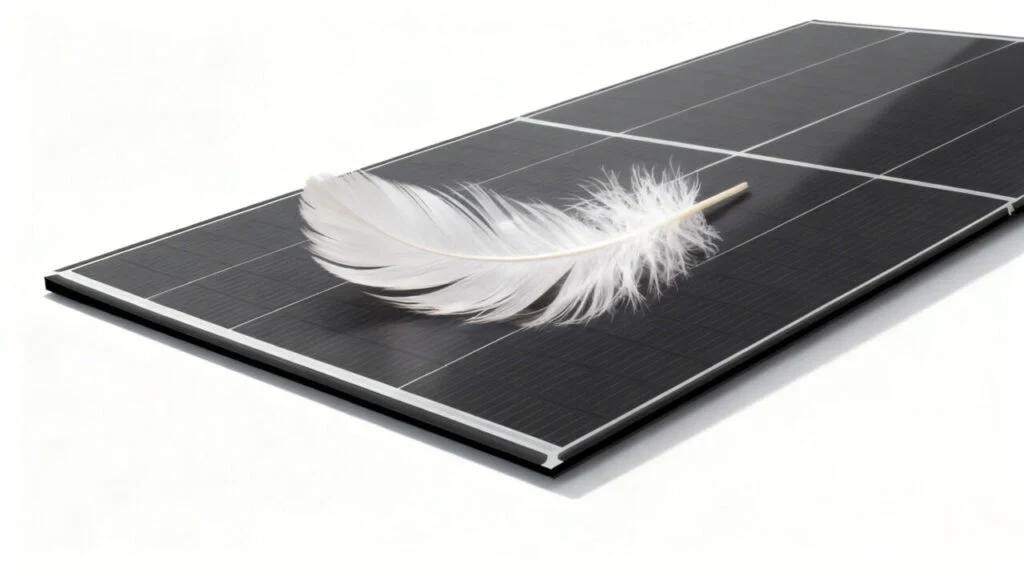
JinkoSolar has officially launched its first lightweight anti-glare module at PV Expo 2026 in Tokyo, the product precisely addressing the key challenges facing the Japanese distributed solar market, including insufficient load-bearing capacity of existing rooftops, sensitivity to light conditions and an aging workforce. Leveraging the company’s Tiger Neo 3.0 technology platform, it achieves a breakthrough in lightweight design, anti-glare performance and reliability, providing an innovative solution that combines safety and environmental friendliness for the integration of solar power in densely populated areas.
Addressing the practical constraints of limited load-bearing capacity on a large number of existing roofs in Japan and the aging installation workforce, the new product takes lightweight design to new heights: while conventional modules of the same size weigh 24 kg (12 kg/m²), this lightweight module weighs only 13 kg (6.5 kg/m²), representing an overall weight reduction of 45%. It significantly outperforms some other lightweight glass solutions (which still weigh over 7 kg/m²), allowing a single person to handle both transportation and installation. This not only enhances construction efficiency, but also opens up technical feasibility for PV installation on a wider range of low-load-bearing roofs.
The module’s anti-glare performance far exceeds Japanese subsidy standards, the module surface featuring a special anti-glare coating and embossing process, resulting in a gloss level below 3GU, far exceeding the anti-glare subsidy requirement of 7GU.
The all-glass encapsulation solution addresses the usual reliability concerns with lightweight modules, Jinko’s adoption of this technology route ensuring structural strength and safety performance throughout the module’s entire lifecycle, while achieving extreme weight reduction. Superior reliability, fire resistance and structural support complete the product’s impressive list of features.