
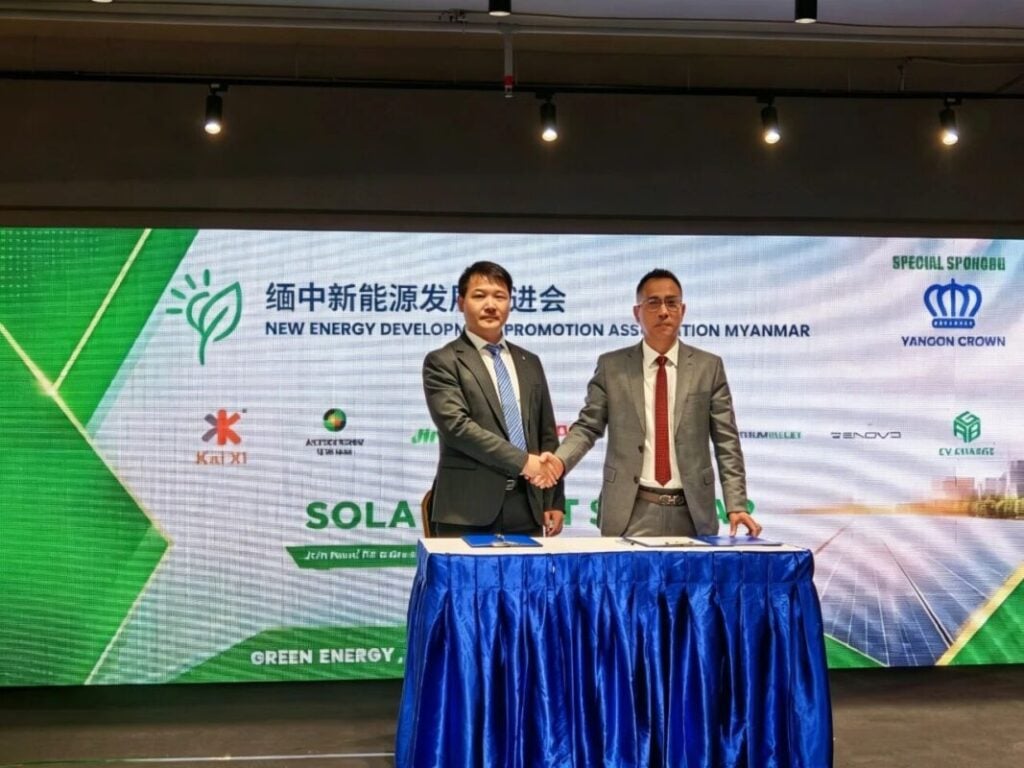
JinkoSolar has announced the signing of a 100MW distribution agreement for its Tiger Neo 3.0 modules with leading Myanmar EPC contractor Kaixi International New Energy to support the country’s rapidly growing C&I distributed solar sector.
Myanmar is located in a tropical monsoon climate zone, characterized by a long rainy season from June to October with frequent overcast and low-light conditions. In addition, C&I rooftops often face layout constraints, equipment pipeline shading and overlapping shadows from surrounding buildings, with these factors placing stringent demands on a module’s low-light response and power retention capabilities. Equipped with the latest generation of TOPCon cell technology, the Tiger Neo 3.0 effectively addresses such challenges, delivering mass-produced cell efficiencies exceeding 27%, a front-side module efficiency of 24.8% and a maximum power output of 670W.
Given the limited space of C&I projects, power generation density directly determines the overall return on investment. The Tiger Neo 3.0 can increase the installed capacity by 8%-10% within the same rooftop area, significantly reducing the use of modules, mounting structures and cables, thereby lowering Balance of System (BOS) costs. Coupled with an ultra-low temperature coefficient of -0.26%/°C, the module maintains minimal power degradation even in Myanmar’s year-round high-temperature environment.
Under low irradiation conditions of 200W/m², the module maintains a relative power output of 95%-98%, with a low-light relative efficiency that is over 3 percentage points higher than that of BC technology. During early mornings, overcast days and twilight hours common in the rainy season, the module turns on earlier and shuts down later, ensuring a stable, self-sufficient power supply for users.
C&I rooftops frequently encounter partial shading from air conditioning units, exhaust pipes and adjacent buildings. Traditional modules are prone to sharp drops in string power due to the “bucket effect.” The Tiger Neo 3.0 significantly improves shading tolerance through a restructured cell layout, maintaining highly stable output across varying conditions. Furthermore, with a first-year degradation of less than 1% and a linear annual degradation of only 0.35%, the Tiger Neo 3.0 delivers robust and reliable power generation returns over its 30-year lifecycle, performing consistently in high-temperature and high-humidity environments.
