The US Section 232 tariffs on polysilicon imports announced last week have changed the landscape of the country’s solar industry overnight.
We know that from December there will be a minimum import price applied to imports of polysilicon and solar wafers, cells and modules, and a 15% tariff on all such products entering the US. We don’t yet know what impact that will have on US solar manufacturing, in particular the upstream production of polysilicon, silicon wafers and solar cells.
Try Premium for just $1
- Full premium access for the first month at only $1
- Converts to an annual rate after 30 days unless cancelled
- Cancel anytime during the trial period
Premium Benefits
- Expert industry analysis and interviews
- Digital access to PV Tech Power journal
- Exclusive event discounts
Or get the full Premium subscription right away
Or continue reading this article for free
The new normal
The US currently has a roughly 50GW gap between its module and cell capacity. According to PV Tech Research, there is around 66GW of module production capacity in the states and only about 11GW of cell capacity. The gap is even greater for wafer production, with only Corning producing US-made wafers from its site in Michigan.
This means over the next few years at least, most US-made modules will rely on imported cells, which just became more expensive. The Section 232 levy sets a US$0.22 per watt minimum import price on solar cells and a US$100 per kilogram minimum on silicon wafers, as well as the 15% flat tariff.
According to Intertek CEA, this means the effective selling price of cells in the US will be 25.3 cents per watt (¢/W), and modules will be 43.7¢/W. Wafers will hit 13.8¢/W. These rates then stack with other tariffs such as antidumping and countervailing duty (AD/CVD) levies that currently cover many products from Southeast Asia and India.
Moustafa Ramadan, head of PV Tech Research, told us that the minimum import price will effectively be the minimum market price for US solar products once Section 232 comes into force. He suggested that everyone, even the few producers with captive US cell supply, will sell at that rate for products not already under supply contracts. Moreover, Intertek CEA’s analysis suggests that module imports to the US will effectively stop once the tariffs come in on 4 December, as there is sufficient domestic capacity to meet demand, and imported prices will be too high.
This price increase will naturally lead to higher prices for solar power from new projects, which could reduce demand for US solar in the coming years. Reacting to the Section 232 announcement, Tim Pawlenty, CEO of the Solar Energy Industries Association (SEIA), said: “Imposing tariffs and prices floors on solar materials will create new challenges for American manufacturers and raise energy costs for families and businesses.”
Intertek CEA also said the US could see projects cancelled that are currently in development due to “unfavourable economics”, and expects reduced solar installations through 2030 and beyond.
Ramadan told us that this is, in essence, a short-term boon for manufacturers and a “pain point” for developers thanks to higher prices.
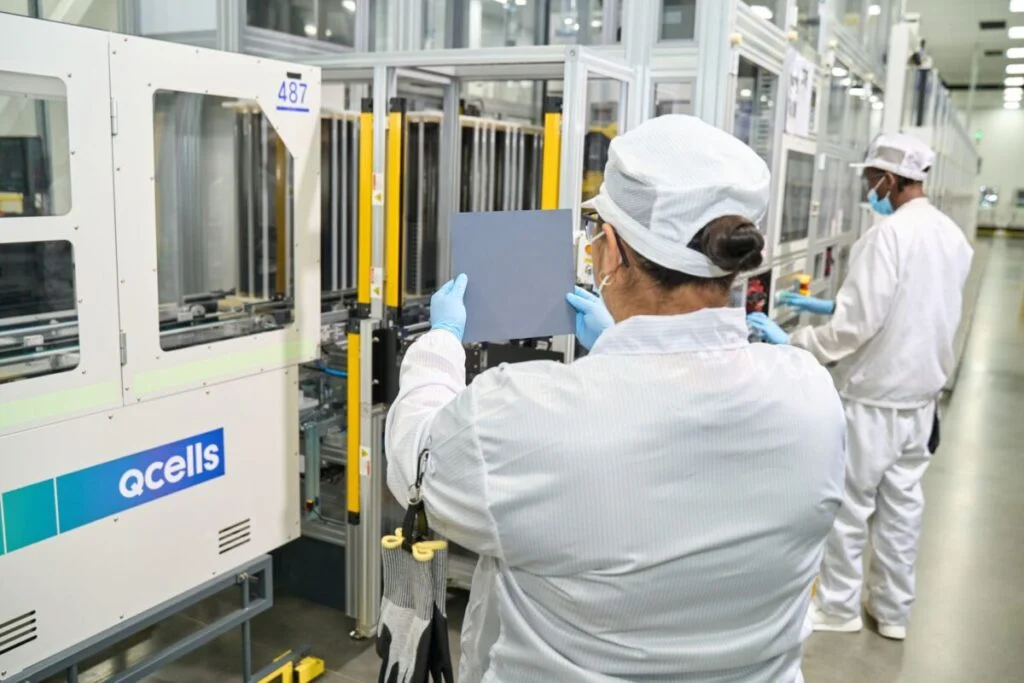
Some manufacturers will benefit from the changes, notably First Solar and Corning, and to a lesser extent Qcells and others that have invested in cell production, such as T1 Energy, Toyo and Tesla. Companies with secure overseas cell supply may also see some advantage.
But we don’t yet know how much Section 232 is a good-faith attempt at propping up US solar manufacturing, or another attack on solar PV by the current US administration, which has shown itself willing to target renewables with restrictive policy and trade measures. It may ultimately result in lower solar deployments and fewer viable manufacturers.
‘Unlikely to incentivise US cell factories’
In a comment to PV Tech, Jason Grumet, CEO of American Clean Power Association, said: “Over the last several years, the US solar industry has made tremendous progress in reestablishing domestic solar manufacturing, but the recent Administration proclamation will slow that progress.”
On paper, there is now a significant cost advantage to having an integrated domestic manufacturing operation that would be free from the litany of tariffs and restrictions on US solar imports and able to capture the final years of the domestic content and 45X manufacturing credits.
But it’s not that simple. The issue may be that Section 232 creates more punishment for using imported products than incentives for using domestic ones – more “stick” than “carrot”.
According to Intertek CEA, “This policy is unlikely to incentivise additional US cell factories” that are not already financed or underway. This is largely because new facilities won’t be viable until 2028 at the absolute earliest, at which point the domestic content demand driver for US products will disappear and the phaseout of the Section 45X advanced manufacturing credit will begin from 2030. These eat away at the competitive edge for US factories.
A similar case stands for wafer and polysilicon capacity. 45X offered generous production credits for domestic wafer facilities, but CEA puts the timeframe for new wafer facilities out to 2029-2030, just when that credit will begin to taper off. “The case for US polysilicon, ingot, and wafer capacity remains limited,” the company’s analysis said, and polysilicon production will rely on expanded wafer capacity.
Not everyone agrees. Last week, Aaron Hall, president of Anza, told PV Tech he thought Section 232 was “a very strong domestic manufacturing policy”.
He continued: “The biggest story is wafers, because that’s where the domestic supply chain remains the least developed today. We expect this policy to accelerate investment across the manufacturing ecosystem, particularly upstream.”
Ramadan points out that the onus will be on investment and finance to prop up US wafer production, as well as manufacturers. He told us that the amount of up-front investment for a new facility increases hugely with every step up the solar supply chain, with massive capital commitments required for wafer and polysilicon plants.
The higher prices from Section 232 put new uncertainty into those investment decisions. As Ramadan explained: “All these prices only work if the end consumer – in this case the deployer – can make their projects financially stack with these prices, and, more importantly, will the final power purchaser be willing to pay that difference?”
However, he did acknowledge that, on paper, the case for domestic US wafer production improved overnight with the Section 232 announcement.
One thing worth noting is that products that have already entered the US, or do so before 4 December, will not be subject to Section 232. There may be a flurry of imports and supply deals in the coming months to beat the tariffs, but the supply gap between modules and upstream components will still be stark.
Clearly, there is some divergence in expert opinion on the impact of Section 232 tariffs. We can probably tell there will be winners and losers among the manufacturers, with those that have already established upstream capacity best placed to win. End demand may also take a hit as solar buyers have to pay more for the same power, and that sentiment may affect the confidence of investors looking at expensive upstream capacity.
The Section 232 update will have a significant impact on the US solar supply chain, which will be discussed in more detail at the PV CellTech USA conference on 13-14 October 2026. The event will address the policy and investment landscape for US solar manufacturing, across the supply chain, and include speakers such as Solar Energy Manufacturers for America (SEMA) Coalition executive director Mike Carr. Read the full agenda here and book tickets on the event website.