
As the PV industry drowns in homogeneous price wars driven by overcapacity, slashing R&D spending and compromising product quality amid mounting cost reduction pressure have become widespread industry norms. A critical question confronts every market participant: what truly constitutes the difficult yet correct path forward for the sector? Compete for short-term survival through price battles? Strike a balance between cost cuts and quality integrity? Or sustain long-term investment amid waves of technological iteration?
This is a question every PV business and decision-maker in the industry must ponder—and Runergy has clearly found its own answer.
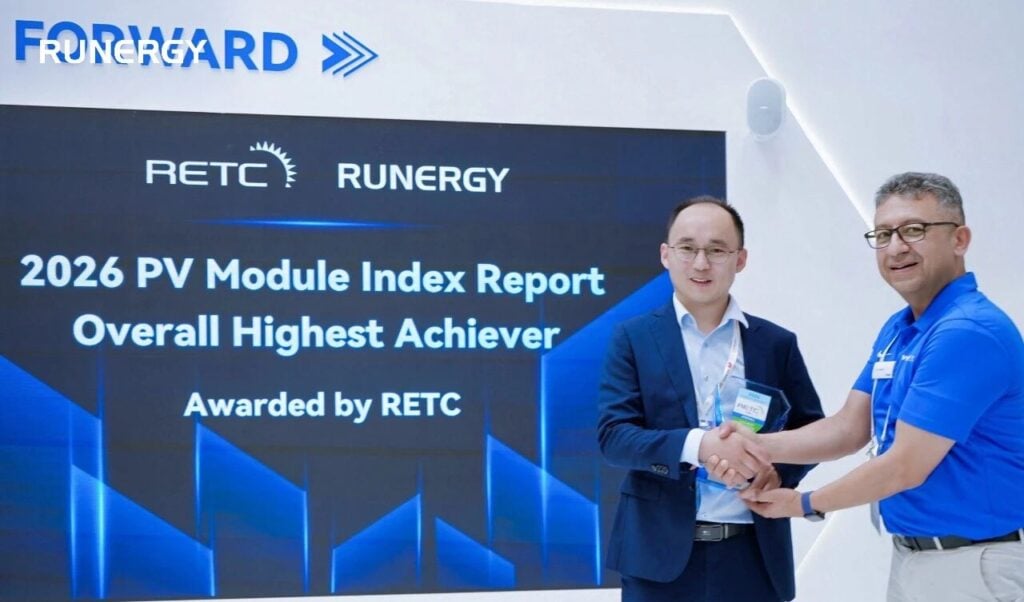
In June, RETC released the 2026 edition of its PV Module Index report, with Runergy once again recognized, for the fourth consecutive year, as an ‘Overall Highest Achiever’.
An RETC Highest Achiever award is viewed as a gold standard within the PV industry, given the stringent testing it imposes, far more demanding than basic IEC criteria, across areas including TC600 thermal cycling, DH2000 damp heat, UVID220 dynamic mechanical load and PID resistance. Qualified modules must pass all test sequences with outstanding performance across all metrics and selections are based on RETC’s proprietary comprehensive module evaluation system, which subjects candidate products to continuous tracking and testing for up to 18 months.
Runergy’s success stems from its extreme pursuit of product reliability. When it first claimed the recognition in 2023, the company was one of only four global manufacturers to post top-tier scores. Maintaining full-category top ratings in 2024 and 2025, by 2026 Runergy had become one of only nine manufacturers worldwide to sustain the elite rating for three years or longer. Over four years, the company had transformed a one-off outstanding performance into consistent excellence.
RETC CEO Cherif Kedir commented: “Solar energy has evolved into a highly standardized commodity. Quality differentiation is critical to securing long-term reliability, consistency and performance.” Runergy’s four-year streak at the top table serves as third-party validation of its modules’ stable full-lifecycle performance. Far more than a certification, the achievement is the natural outcome of the company embedding reliability into every product’s DNA.
Amid fierce industry-wide competition, many companies scale back R&D and sacrifice quality. Runergy has instead chosen long-termism to navigate market cycles, erecting an authentic value moat built on technology and superior quality.
The N-type TOPCon segment bears the brunt of the fiercest homogeneous competition. Numerous manufacturers chase short-term capacity expansion and market profits while neglecting R&D investment. As TOPCon technology evolved from Generation 1.0 to 2.0 and now 3.0, countless companies have been eliminated and their production capacities phased out. Runergy, by contrast, has been an active participant—and even a front-runner—in this wave of technological upgrades.
General Manager Dr. Tao Longzhong boasts over two decades of specialized experience in PV technology. This inherent technical mindset has guided Runergy to reject impulsive speculation and quick-profit opportunism. On the TOPCon track, Runergy avoids empty conceptual hype, advancing steadily along the roadmap of lab R&D → pilot verification → large-scale mass production. On one hand, the company has built a photovoltaic research institute with investment exceeding USD 60 million, assembling a 698-member specialized R&D team comprising of experts from world-leading institutions including Fraunhofer, ISFH and Sun Yat-sen University, which maintains diversified technical reserves covering PERC, TOPCon, HJT, BC and tandem cell architectures.
On the other hand, Runergy also strictly adheres to engineering-oriented innovation, ensuring all technological breakthroughs are viable for mass manufacturing. Every full-area cell efficiency record set by Runergy—from 26.55% to 26.9%—is based on standard M10 silicon wafers and fully scalable production processes, rather than artificial lab-only demonstration data.
In 2026, the company’s TOPCon 3.0 cells were featured on NREL’s global efficiency chart, marking the first time a Chinese manufacturer had secured a spot in the world record rankings for monocrystalline core technology. This landmark breakthrough arose from years of systematic accumulation in material systems and production engineering. Today, Runergy’s mass-produced cells deliver an average conversion efficiency of between 26.2% and 26.5%, with total production capacity surpassing 63GW. The company has successfully translated world-record lab performance into tangible mass-production dividends, converting technological advantages into real power generation gains for customers.
The photovoltaic industry is inherently cyclical, swinging between capacity expansion booms and price downturns. Many companies lose their footing amid volatility, trapped in a vicious cycle of capacity expansion → price slashing → further expansion driven by homogeneous rivalry. Runergy’s multi-year sustained technological and market leadership hinges on its unwavering strategic resolve: prioritizing technology while pursuing scalable advantages, refusing short-term competition that comes at the cost of product quality. This resolve originates from its founding mission of technology-driven development. Established in 2013, Runergy has positioned R&D as the core engine of corporate growth, accumulating 319 patents and constructing multiple provincial-level research platforms such as the Jiangsu High-Efficiency Solar Cell Engineering Research Centre.
At the height of industry price wars, when peers drastically cut R&D budgets, Runergy sustained stable investment in research and talent cultivation. This patient long-term approach has yielded rapid breakthroughs: efficiency leaps from 24.87% for P-type cells to 26.9% for N-type products, plus the four consecutive RETC recognitions, all the natural result of consistent long-term investment. This resolve is reflected in differentiated competitive positioning. When the industry devolves into uniform cost-cutting contests, Runergy targets premium global markets, building differentiated value through superior quality and exceptional reliability.
RETC certification acts as a premium quality passport for high-end European and American markets. Four consecutive years of authoritative validation have earned Runergy broad recognition among global project developers and financial institutions, freeing the brand from low-end price wars and winning market share based on intrinsic product value. Its 2GW production base in the United States operates at full capacity with complete order fulfillment, and its products are sold across dozens of countries and regions worldwide. Runergy’s practice proves a core truth: the ultimate competition in PV is not about undercutting rivals on price, but delivering enduring asset value to customers. This resolve also extends to forward-looking technical layout. Rather than resting on its current TOPCon leadership, Runergy simultaneously develops next-generation technical routes including HJT, back-contact cells and perovskite-silicon tandem stacks, building capabilities for the next technological cycle. Its tiered R&D pipeline—mass-produce one generation, develop the next, reserve future architectures—empowers the company to retain initiative amid industrial technological shifts and avoid elimination during generational upgrades.
As the industry enters a major consolidation phase with mass capacity phasing-out, backward manufacturers will inevitably fall by the wayside. However, manufacturers that persistently invest in R&D and uphold stringent quality control should not—and will not—be eliminated. They form the backbone and future of the entire sector, which explains Runergy’s resilient vitality amid turbulent market cycles. As reported, Runergy’s 2GW module factory in the U.S. operated at full capacity with full order delivery in 2025, generating solid economic returns.
Runergy’s return to sound, sustainable growth stands as a reward for respecting cyclical industrial laws, and is a vital lesson for the whole sector in navigating market volatility: a lasting competitive moat never stems from sheer production scale, but from profound technological depth and consistent quality standards. Successfully weathering industrial cycles is never about chasing fleeting profits, but staying true to technological fundamentals and respecting customer asset value. As the PV industry transitions from a scale-expansion era to one defined by value-based competition, only when more manufacturers return to a tech-centric mindset, refine product quality through pursuit of excellence and build dependable assets with long-term vision, can the sector rebuild its value ecosystem and embark on a track of healthy, sustainable development.
