
The global transition to renewable energy is currently defined by a sharp material tension: the surging demand for high-efficiency solar cells is clashing with the rising cost and geological scarcity of silver. As the industry’s primary conductive material, silver consumption represents a significant portion of the total non-silicon cost of a solar module. To scale toward terawatt-level deployment, the industry must pivot. We are no longer just looking for incremental savings; we are witnessing a fundamental shift toward “low silver” and “no silver” metallization frameworks.
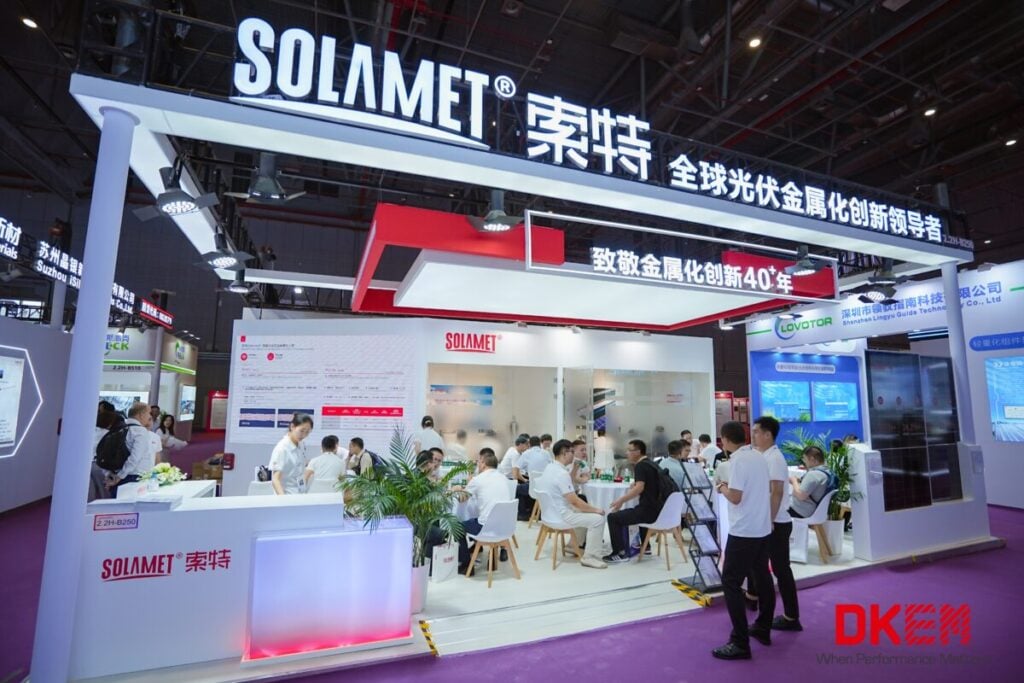
Leading this transformation is Solamet®, an industry pioneer built upon 200+ years of innovation DNA and 40+ years of frontline metallization practice. Since transitioning from the DuPont legacy to an independent company in July 2021, Solamet has leveraged its dual technology centres in Shanghai and Taiwan to accelerate a roadmap toward cost leadership. The strategic objective is clear: maintain—and even enhance—cell efficiency while drastically reducing the silver laydown through advanced metallurgy and process engineering.
1. The Efficiency-Cost Equilibrium: Ag-Ni and LECO Integration for TOPCon and TBC
For manufacturers balancing current high-volume production with cost-reduction mandates, using nickel to partly replace silver offers a critical “middle ground”, such as the PV3NN (Front-side) and PV6NN (Rear-side) silver-nickel (Ag-Ni) finger pastes for n-TOPCON. In the high temperature fire-through metallization pastes, nickel acts as fillers to reduce the silver content in the pastes while ensuring high cell efficiency. These “multi-gradient” solutions provide various silver content options (5-15% nickel content) to allow manufacturers to customize their silver reduction based on specific line reliability requirements.
2. Redefining TOPCon Economics with PV6NS and PV43T
As n-TOPCon technology cements its position as the market’s dominant architecture, the pressure to optimize its silver-intensive metallization is immense. Solamet’s solution is a sophisticated “product package” strategy that decouples the functions of the contact layer and the conductor layer.
This approach utilizes the PV6NS Rear-side seed layer silver paste in synergy with the PV43T Ag-coated Cu conductor paste. In this stacked configuration, the PV6NS acts as a high-performance “seed” specifically engineered to establish low-resistance electrical contact with the cell. Once ohmic contact is secured, the PV43T conductor layer—which replaces a substantial portion of the bulk silver with silver-coated copper—handles the current transport.
By utilizing this multi-layered strategy, manufacturers can slash silver consumption with minimized reliability risks associated with traditional copper transitions. This dual-layer innovation directly supports the PV industry’s core mission of “high-efficiency solar cells with low cost.”
3. The Copper Revolution: PV46 Series for BC and TOPCon
While silver-coated copper provides an immediate bridge, the long-term strategic “Holy Grail” is the move to pure copper metallization. Copper offers a clear path to material sustainability and price stability, insulating manufacturers from the volatility of precious metal markets.
Solamet’s PV46 Series is the vanguard of this transition, specifically tailored for the industry’s most advanced cell architectures:
- PV46B: Optimized for the TOPCon market.
- PV46D: Designed for Tunnel Oxide Passivating Back Contact (TBC) applications.
- PV46A: Integrated into Heterojunction (HJT) and Heterojunction Back Contact (HBC)/ Heterojunction Tunnel Oxide Passivated Back Contact (HTBC) roadmaps.
The most well-known issue for copper paste is oxidation, which typically requires processing under nitrogen or reducing atmosphere, drastically increasing complexity, cost and safety concerns in adopting copper paste in current cell manufacturing processes. Solamet’s innovative PV46B and PV46D copper paste, with proprietary anti-oxidation design, is compatible with air curing or sintering process, significantly lowering the copper paste adoption barrier by utilizing existing thermal processing equipment, ensuring future generations of high efficiency solar cell technology remain economically viable at scale.
The history of solar cell metallization has been a journey of constant refinement, from the first commercial fire-through paste in 1999 to the current 2025–2027 roadmap. Solamet’s trajectory is now focused on ultra-low silver content, pure copper integration and specialized solutions for TOPCon, xBC and Perovskite Tandem cells.
By successfully taking low silver and silver-free approaches from laboratories to gigawatt-scale production lines, Solamet is steadily uncoupling solar power from its reliance on precious metals. As low-silver hybrids and copper alternatives are going to achieve strict parity with standard pastes in both field reliability and energy yield, the industry will arrive at an inevitable turning point. The question is no longer whether the solar industry can survive without silver, but how quickly forward-thinking manufacturers will transition into this inevitable, post-silver era.
