
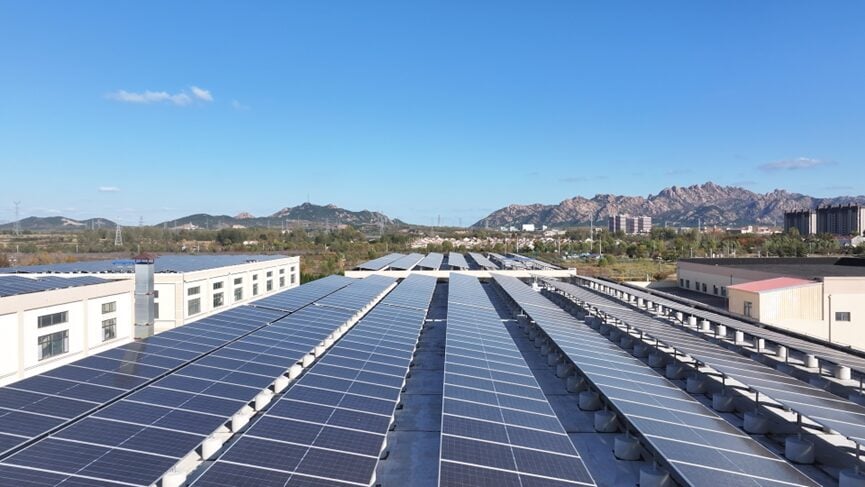
The 0.7 MW distributed PV project in a pet food production facility in Qingdao, eastern China, has been grid-connected using Trinasolar’s Vertex N 650W series modules, marking another step forward in the application of TOPCon 2.0 modules on commercial and industrial (C&I) rooftops.
Located in a coastal area characterized by strong ocean winds, the project faced significant challenges including structural robustness and long-term reliability. Pet food production is a highly energy-intensive industry, where high power consumption directly impacts operating costs, sustainability goals and overall production efficiency. As a result, manufacturers are placing greater emphasis on energy-efficient technologies to reduce expenses and meet tightening environmental standards. Trinasolar’s Vertex N 650W series modules stood out for ensuring stable performance and maximizing overall green power output.
The Vertex modules, powered by i-TOPCon Ultra technology, offer excellent efficiency, high bifaciality and low degradation. These features, together with strong low-irradiance performance, maximize total energy yield even under Qingdao’s frequently changing coastal weather, enabling more green power generation within limited rooftop space.
The project is expected to deliver around 950,000 kWh of clean electricity each year, reducing carbon emissions by an estimated 273 tons.
Trina president for China MU Vincent Wu commented: “This project stands as a flagship example of using Trinasolar’s high-efficiency modules in pet food production. Trinasolar offers diverse scenario-based solutions covering low-load rooftops, glare-sensitive airport zones, dust- and snow-prone environments and facilities with elevated fire-safety requirements. With the global rollout of TOPCon 2.0 modules, Trina can deliver even greater customer value through higher energy yields, enhanced operational stability and stronger long-term system reliability.”