LONGi is launching two new back contact (BC) solar modules in Australia, which senior executives told PV Tech at All-Energy Australia 2026 is “the most valuable market” for the company.
Speaking in Melbourne, the executives explained how the Chinese manufacturer plans to compete with TOPCon modules in a cost-sensitive utility-scale market. They also outlined how LONGi wants to sell integrated solar PV and battery storage systems rather than modules alone.
Try Premium for just $1
- Full premium access for the first month at only $1
- Converts to an annual rate after 30 days unless cancelled
- Cancel anytime during the trial period
Premium Benefits
- Expert industry analysis and interviews
- Digital access to PV Tech Power journal
- Exclusive event discounts
Or get the full Premium subscription right away
Or continue reading this article for free
PV Tech spoke with Louis Liu, vice president of LONGi Group and president of its global sales and marketing division, and Alex Li, senior director of global product strategy, marketing and product solutions. Li is responsible for new product development and promotion globally.
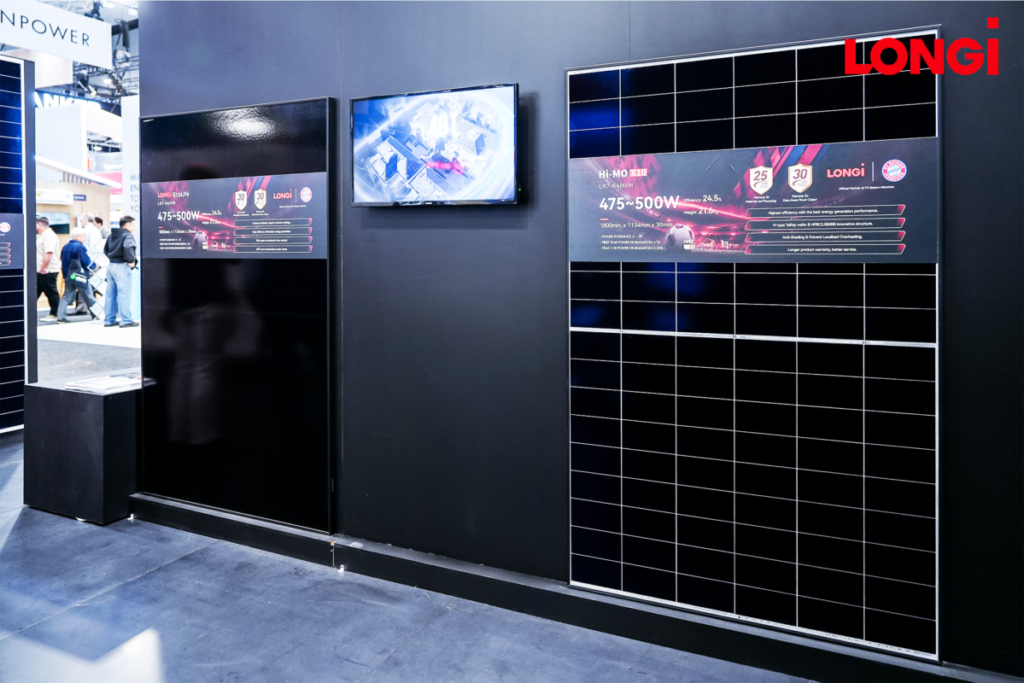
The two launches are the Hi-MO 9 Prime for utility-scale projects and the Hi-MO X12, which LONGi describes as its flagship module for distributed generation. Both are built on the company’s HPBC 2.0 cell technology.
The Hi-MO X12 uses what LONGi calls integrated conductive backsheet (ICB) technology. Li describes it as “not a simple product upgrade”, but an evolution “from one generation to a second generation” of the company’s BC products.
The change targets mechanical reliability under Australia’s fluctuating temperatures. “For example, as we said, in Melbourne, you have four seasons a day,” Li noted. “The temperature variations are quite dramatic in Australia for most of the application environments.”
According to Li, ICB removes the mechanically weakest point of a solar module, “the solder ribbon on the back side”, which introduces mechanical non-uniformity on the rear of the module.
“By removing that, we tend to substantially enhance the uniformity and mechanical strength of the entire architecture of a solar panel,” he said.
Li explained that this is intended to reduce structural deformation caused by temperature swings, with the aim of delivering “a long-term, reliable and safe asset” for rooftop applications in Australia.
LONGi says ICB removes more than 15,000 potential solder joint failure points and adds 6-8W of power output. The company rates the commercial and industrial version of the Hi-MO X12 at 660-690W, with efficiency above 25.54%.
Value over price against TOPCon
TOPCon currently dominates Australia’s utility-scale market, and developers there are sensitive to cost. Liu argued that buyers are looking past the module price.
“I don’t think the customers always care about the price,” he said. “Based on the conversation and communication with our customers, they really care about the value.”
Liu explains that customers are financing assets over 25 years, so lifetime returns and reliability come first. “If there’s no reliability, all the financial calculation is nothing,” he said.
He claimed, “BC always gets 10 to 15 watts higher than TOPCon” in power output, and added that the technology can reduce the risk of fire and hotspots. He did not say which TOPCon products he was comparing against.
Li points to field data for the upgraded utility module, the Hi-MO 9 Prime, which LONGi promotes as offering more value from every ray of sunlight. The company rates it at up to 680W and 25.17% efficiency, with around 4.62% more DC capacity than conventional TOPCon modules on the same land area.
He said demonstration projects in China, Australia, Southeast Asia, Europe and Latin America were set up to show how BC modules “really behave or perform in real life, rather than just simulations or calculations on paper”.
“What we’ve discovered is that back contact can offer an uplift in terms of energy yield spanning from 2.5% all the way to 6%,” Li said. He did not give the time period, site count or reference modules behind the range.
Li attributed the spread to temperature. “It’s semiconductor physics. Nobody can challenge on that,” he argued. Solar modules produce less as temperatures rise, he explained, but by how much depends on the physical properties of the modules and the architecture of the cell.
At hot sites such as Australia, Portugal and Spain, he said BC modules have produced “9% more” on some summer days than conventional TOPCon technology “on the same day, on the same site, under the same environment”. This figure refers to daily output on selected days rather than annual yield.
Li also cited discussions with testing and certification body TÜV Rheinland on how solar modules perform in low light. He said front-side metal contacts on conventional modules, including PERC and TOPCon, are “a few tens of microns thick” and act as “an optical obstacle or local shadowing” when the sun is low.
That gives BC modules an advantage in the early morning and late afternoon, which he noted “aligns with our observations in the lab as well”. TÜV Rheinland also awarded the Hi-MO 9 Prime a product conformity certificate during the exhibition, according to LONGi.
Liu added that “in this industry, we always overemphasise bifaciality”. Even in the Middle East, which he called “the most valuable area for bifaciality”, he said a BC module with front-side power “maybe five to seven watts higher” than TOPCon can generate more energy “even [if] the bifaciality is 10% lower”.
LONGi ONE and solar-plus-storage
LONGi began deploying its battery storage business this year, according to Liu. He said Australia matters because it has moved to “another phase of new energy”, shifting from adding solar PV capacity to combining generation and storage into a system.
That shift underpins LONGi’s “LONGi ONE” strategy, which Liu summarised as “one responsibility, one platform and also one service”. A June PV Tech interview with Liu described the Full-Stack LONGi ONE strategy as the company’s move from a PV module supplier to an integrated clean energy systems partner. That interview put LONGi’s cumulative BC module shipments at more than 60GW, with a target of 100GW by the end of 2026.
Li predicted that “three years from now, there is no standalone PV nor standalone battery energy storage system (BESS)” in Australia, with integrated projects becoming the norm. He identified the main challenge as getting solar PV and battery storage assets, which typically “operate independently”, to communicate under one architecture and charge or discharge based on grid demand or price signals.
“It’s not just a technical challenge, but also a financial challenge,” Li said, pointing to bankability and long-term serviceability.
Liu noted that Australian customers have a deep technical understanding of equipment, which he said makes the market demanding for suppliers. Their pain point now, he explained, is building new commercial models for combined systems and finding a single party to take responsibility for the whole asset.
For microgrids, Liu said mining is “more and more important” for LONGi, citing references in Zambia and Indonesia. Remote mine sites without grid coverage need solar PV plants and often rely on diesel, so customers care about diesel replacement and logistics as well as cheaper energy. Remote residential and agricultural users are also targets, he said.
Li added that Australia’s demand is “growing very rapidly” while its infrastructure is weak, “especially on the East Coast”. He says LONGi wants integrated solar PV and battery storage projects to provide grid-forming capability, inertia support and frequency regulation.
“It should be quite comparable to a hydroelectric power plant, where you can control the output, where you can control your inertia, and you can control how you support grid stability,” Li argues.
Asked what a successful year in Australia would look like, Liu said the measure was customer satisfaction. He added that LONGi wants to design products for specific scenarios, such as extreme heat and dust, rather than produce one product for every market.