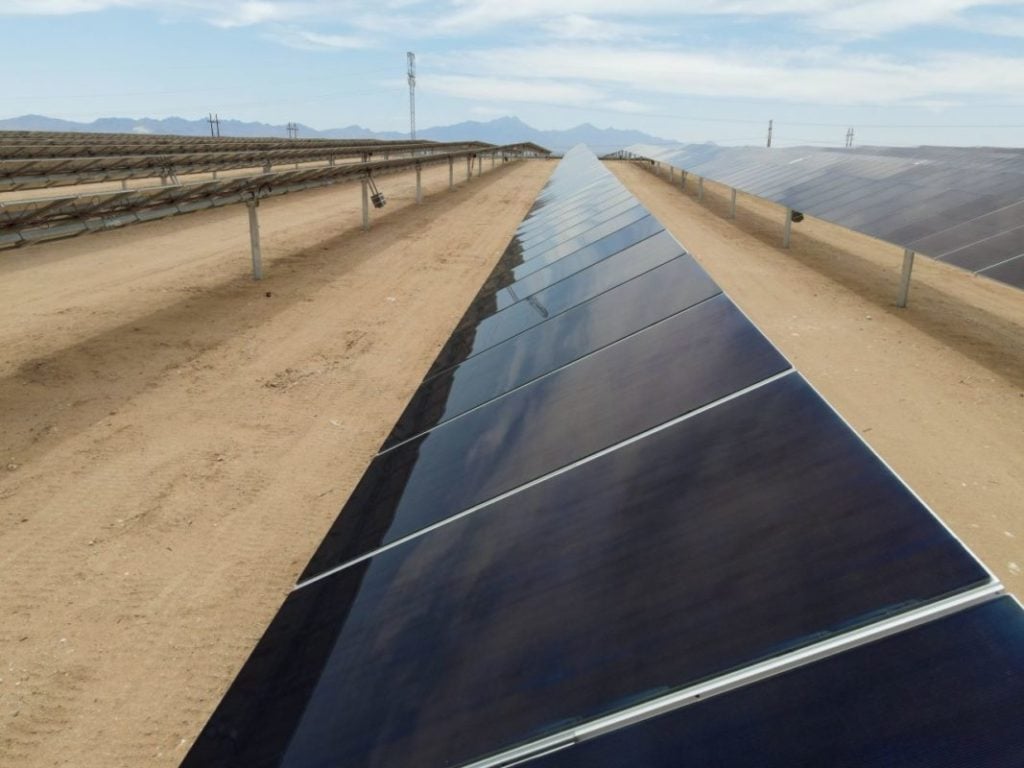
The Arizona Corporation Commission (ACC) voted last week to cut the export rate—the price at which residential solar consumers can sell excess electricity back to the grid—by 10%, which will mark the seventh consecutive year that the ACC has cut the export rate by this percentage.
The ruling applies to customers on grids operated by utilities Arizona Public Service (APS) and Unisource Energy Service (UNS), while the ACC will vote on a similar cut for customers on a third grid, operated by Tuscon Electric Power (TEP), next month. For customers on the APS and UNS grids, their export rate will decrease to US$0.5554/kWh on 1 September, which translates to a price of 5.5 cents per kilowatt hour.
Try Premium for just $1
- Full premium access for the first month at only $1
- Converts to an annual rate after 30 days unless cancelled
- Cancel anytime during the trial period
Premium Benefits
- Expert industry analysis and interviews
- Digital access to PV Tech Power journal
- Exclusive event discounts
Or get the full Premium subscription right away
Or continue reading this article for free
This is down from the price of US$0.06171, and while customers with existing residential solar systems will be able to continue exporting electricity at the rate that was in effect when they made their interconnection request, customers that made requests any time after September will be subjected to the new, lower, rate.
Last week’s vote is the latest in a long series of cuts to the electricity export rate in Arizona, which has seen the price slashed by 10% each year, save for 2022, since 2018. The 10% figure is no accident—Arizona law sets a cap on the percentage by which the export rate can be cut each year at 10%—and APS, which proposed this year’s cut, initially argued in favour of a more extreme decrease.
APS’ initial proposal for the new rate is US$0.04511/kWh, but as this would be a 36.8% year-on-year decrease, the cut was capped at 10%. While this rule prevents any one year-on-year decline in the cap from being too extreme, it does not protect residential customers from cuts made over a longer period of time. In 2018, the export rate in Arizona was set at US$0.129/kWh, meaning that in the last eight years, residential customers in Arizona have seen a 56.9% decrease in the price for which they can sell power generated at home solar systems.
It is for this reason that a number of solar advocacy groups in the state have objected to the ACC ruling; Vote Solar, for instance, argues that the new price “undervalues the electricity solar provides, discouraging solar adoption during a time of growing energy demand in the state”.
“We are disappointed by the ACC’s decision to discourage solar adoption, keeping meaningful relief for customers and communities out of reach while missing an opportunity to build a more resilient and affordable energy system for Arizona,” said Kate Bowman, Vote Solar’s senior west regulatory director.
Longstanding legal disputes
Last week’s ACC vote follows a long line of legal disputes between grid operators and solar advocacy groups in Arizona. Earlier this year, the Arizona Court of Appeals ruled that a 2024 rule introduced by the state’s utilities to impose additional charges of US$2-3 a month on homes that generate residential solar was “in violation of due process”, and abolished the charges.
In 2023, ACC also considered cutting the solar export rate by as much as 50%—which would have been in violation of the 10% cap set in 2017—and Bowman said at the time that a stable export rate is “the fundamental reason solar has continued to thrive in Arizona”. Vote Solar opposed both the 2024 efforts to add additional charges for customers and the 2023 proposal to slash export rates by up to 50%, and other industry groups have criticised this pattern of behaviour from the ACC.
“There are really only two ways to save money on your electric bill. You can adopt energy efficiency and demand response measures or you can install rooftop solar and storage,” said Autumn Johnson, executive director of the Arizona branch of the Solar Energy Industries Association (SEIA).
“The Commission has taken numerous actions recently to undermine both options at a time of rising power bills; [the latest export rate cut] is one such example.”
Residential solar is a key part of the Arizona energy mix, with the state having the fourth-largest operational solar portfolio by capacity and the third-largest residential solar sector, according to SEIA figures. As of June this year, 15.8% of Arizona homes have operational solar installations.