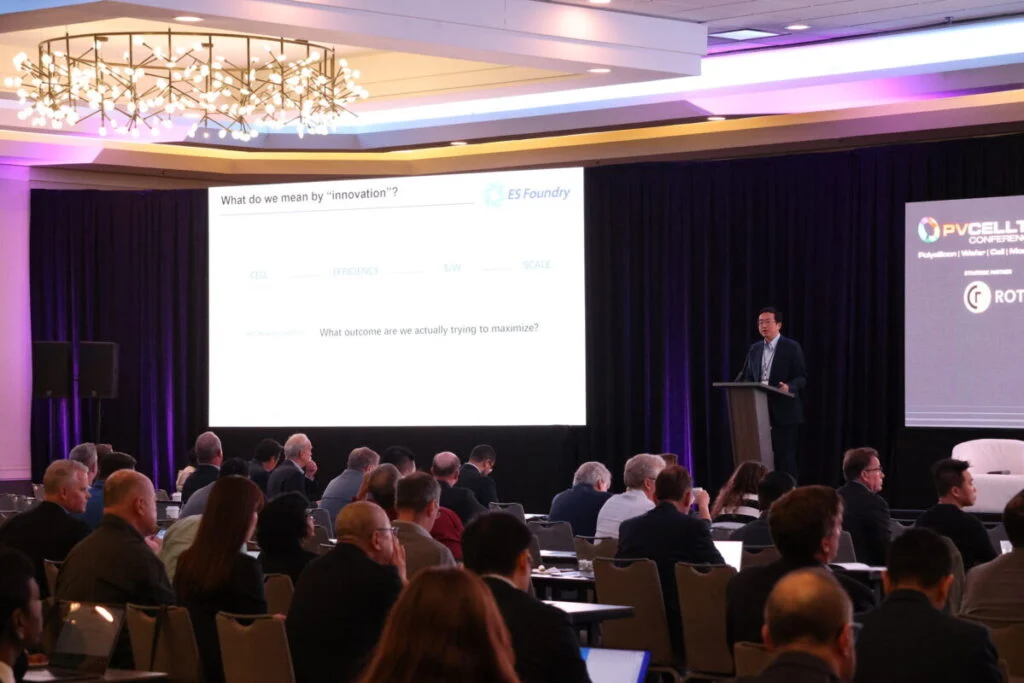
Industry experts from all fields of the solar PV industry, from leading manufacturers to legal experts, gathered this week in San Francisco for PV CellTech USA to discuss the current and future landscape of the domestic solar manufacturing industry.
The first sessions on day one focused on policy and, in particular, the Section 232 tariffs on polysilicon and the possibility for Section 45X to be extended, as well as the investment tax credit (ITC) for developers and independent power producers (IPP).
Try Premium for just $1
- Full premium access for the first month at only $1
- Converts to an annual rate after 30 days unless cancelled
- Cancel anytime during the trial period
Premium Benefits
- Expert industry analysis and interviews
- Digital access to PV Tech Power journal
- Exclusive event discounts
Or get the full Premium subscription right away
Or continue reading this article for free
Other key takeaways from this year’s conference are the workforce challenges in solar manufacturing and the industry’s next frontier: space-based solar power.
Policy at the forefront: Section 232, 45X
Undoubtedly, policy was a key topic of conversation at the conference, especially Section 232 and the possibility of extending tax credits for manufacturing through Section 45X and the ITC.
Regarding Section 232, there are still some uncertainties regarding the state of affairs post-4 December 2026, but the Trump administration has already taken steps to minimise opportunities to exploit loopholes in the legislation, such as the anti-stockpiling measures imposed last month.
“The current administration will aim to make examples of people who try to avoid or circumvent the restrictions through very strict enforcement,” said Moustafa Ramadan, head of PV Tech Research. We heard that attempts to bring in semi-finished components, such as blue wafers, would not succeed as the administration is closely monitoring the entire solar value chain. There are already mentions of dozens of importers who have been barred from importing solar products before the 4 December deadline.
However, the current outlook for the tariffs are not set in stone and will likely need to be modified in the coming months, especially to allow time for solar manufacturers to onshore domestic solar cell manufacturing and further upstream in the supply chain.
On the extension of tax credits for manufacturing, the consensus is to do so, with optimism that there is room to revisit the expiration date. On top of that, and certainly tied to Section 232, is the need to ensure that other parts of the supply chain receive sufficient financial support to build domestic manufacturing capacity.
Until now, the majority of the domestic manufacturing has been towards modules and cells, but more could be done to help other parts of the supply chain, including other components that are still scarce in the US, such as silver paste, encapsulants and glass, and to ensure manufacturers receive the financial support necessary to build manufacturing capacity.
One part is clear, though, which is how the policy and trade tariffs ladscape affecting solar PV products is ever evolving. For instance, attention will now turn towards the Section 301 duties on certain solar manufacturing equipment that are excluded from tariffs until 9 November, when it is set to expire and would need to be extended as the Office of the United States Trade Representative (USTR) did in the past.
Maintaining and training skilled workers
Another much-discussed issue across both days of PV CellTech for solar PV manufacturers across the value chain has been the difficulty of hiring and retaining skilled workers.
The lack of current know-how for solar manufacturing, especially solar cells, is making things much harder for PV manufacturers to find and keep skilled workers. Considering that the US only began producing solar cells again in 2024, five years after the last time the US had domestic cell manufacturing, the pool of workers with knowledge in that area is still limited.
However, manufacturing hubs such as Texas, where many companies have built or are building PV manufacturing facilities, could help create an ecosystem where it would be easier to hire workers who have already received the necessary training or have experience in solar manufacturing.
Marvin Yang, sales and business development manager at Texas-based manufacturer Imperial Star, spoke on a panel discussion about the challenges associated with building a robust domestic supply chain, and said that “developing people early” is a priority to ensure a skilled workforce.
“We plan for expansion by developing people early,” he told PV Tech, speaking about the company’s module manufacturing plant in Tomball, Texas. “During Phase 1 in Tomball, we hired and trained 20% additional staff in key engineering, quality and operations roles.”
“They gain hands-on experience in the existing factory so they’re ready to lead as we bring Phases 2 and 3 into production. That gives us an experienced team in place before the new lines start and ensures a smooth ramp up to 5GW in 2027.”
Space-based solar: From fiction to reality?
Finally, the last key takeaway from this year’s PV CellTech USA is space solar. This new frontier for the solar industry could be a new door for solar cell technology, as the demand for it will increase in the coming years, with hundreds of satellites being launched into space.
If, last year, all the attention was on perovskite, this year space-based solar has been discussed throughout the conference, with the second day starting with a session on how space solar is driving the next generation of PV innovation.
Even though gallium arsenide solar cells have been the predominant technology until recently, silicon cells are making a comeback, with PERC, TOPCon, and HJT favoured due to limited gallium availability and insufficient capacity to supply the market. Among these, p-type heterojunction (P-HJT) seems to have the advantage compared to the others, as recently showcased with the first in-orbit test of P-HJT modules, from Chinese leading PV manufacturer JA, successfully launched in a Chinese satellite.
Even perovskite could be a compelling technology choice for solar cells, given that the vacuum of space would solve the durability problem the technology currently faces in terrestrial applications and due to the lifetime difference between the requirements of a space solar project, which is less than a decade, compared to the 25-30 years for a utility-scale solar project.
Despite the increased interest in space solar applications, with talks of hyperscalers exploring the possibility of building data centres in space, the market for that sector is expected to remain quite niche and at a much different scale than the hundreds of gigawatts installed on Earth every year globally. The forecasted demand for solar cells in space in the coming years would be around 100MW+, falling well short of the gigawatt-scale.