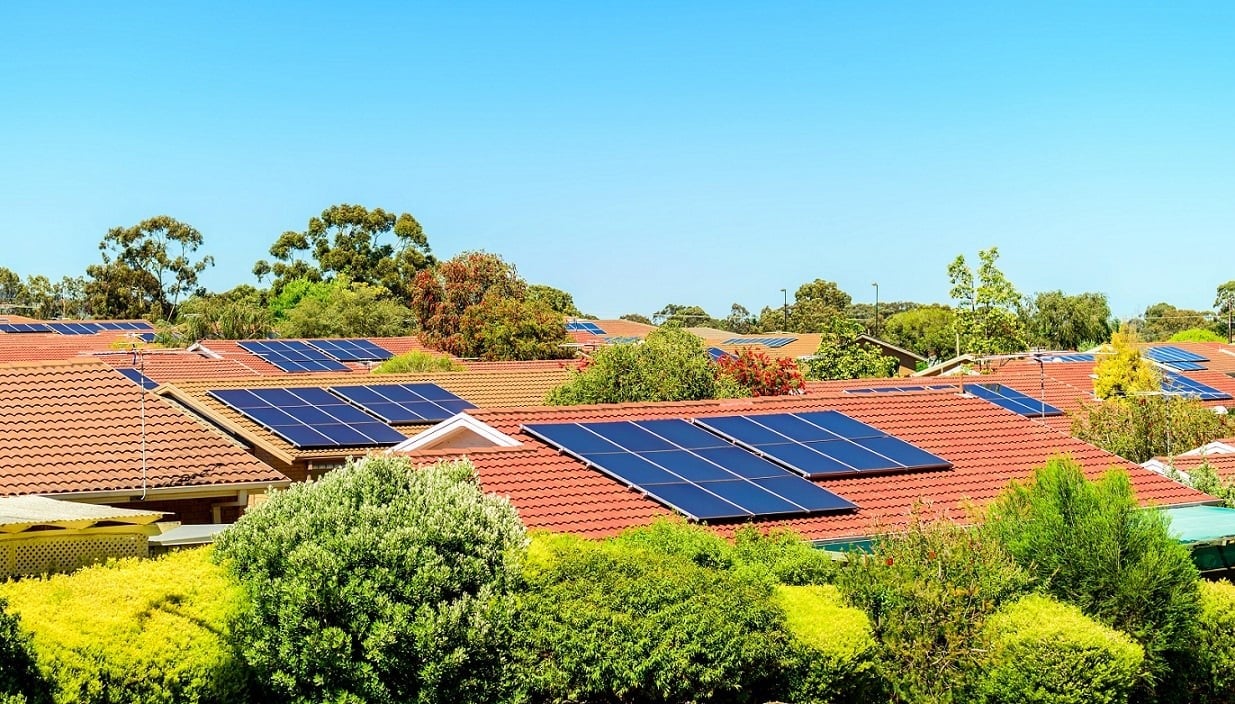
The Global Solar Council (GSC) is set to unveil a ‘global rooftop solar declaration’ tomorrow in which governments around the world will commit to 300 million solar homes by the end of the decade.
The voluntary initiative aims to accelerate residential solar and battery storage deployment worldwide and is set to be announced as part of the COP31 climate summit kicking off this week in Antalya, Türkiye.
Try Premium for just $1
- Full premium access for the first month at only $1
- Converts to an annual rate after 30 days unless cancelled
- Cancel anytime during the trial period
Premium Benefits
- Expert industry analysis and interviews
- Digital access to PV Tech Power journal
- Exclusive event discounts
Or get the full Premium subscription right away
Or continue reading this article for free
Speaking at a GSC press briefing on the opening day of the talks, the organisation’s CEO Sonia Dunlop said the declaration is central to the organisation’s drive to reach 300 million solar homes globally by 2030, up from roughly 150 million today. The announcement, due in full tomorrow morning, will reveal which national and subnational governments have signed on, with Dunlop describing the signatory list as a “good group” drawn largely from the Global South, including several small island states.
Dunlop said the declaration would be a target rather than a deployment initiative. Signatory governments are committing to six specific actions:
- Cutting unnecessary red tape to make rooftop solar installation easier for households
- Unlocking local finance by helping commercial and retail banks grow comfortable with lending against rooftop solar
- Supporting low-income households, renters, apartment residents and social housing tenants to access solar
- Placing small-scale residential solar at the heart of national energy strategies
- Modernising grids for distributed power generation, including integration of batteries and smart technology
- Building a skilled local workforce to install and maintain the technology
Dunlop framed the push as a direct response to what she called “the greatest energy security crisis the world has ever seen”, arguing that rooftop solar paired with home battery storage offers households a practical shield against volatile fossil fuel prices.
An ‘electrification COP’
The declaration lands against the backdrop of what organisers and industry figures are calling an “electrification COP”. In the same briefing, Bruce Douglas, CEO of the Global Renewables Alliance, highlighted the target of “35 by 35” pledge (35% electrification of global energy demand by 2035) being championed at this year’s COP summit, a goal he said the International Energy Agency projects could cut residential electricity bills by 15% and save US$400 billion annually in fossil fuel costs.
“We believe that link to electrification will supercharge the transition,” Douglas said.
Australia, co-host of COP31, was cited repeatedly as a rooftop solar success story, with Nic Dorward of the Australian Renewable Energy Agency noting that one in three Australian rooftops now carries solar PV, alongside more than 700,000 home battery installations. Dorward said managing distributed energy resources at that scale presents “a great problem to have” but requires significant grid coordination work that other nations can learn from as they scale up.
Storage and transmission challenges
The panellists at the briefing also warned that the rapid growth of distributed generation is creating new complexity behind the scenes. ARENA’s Nic Dorward said Australia’s success with rooftop PV and home battery storage has created a significant distributed energy resource management challenge. “A lot of plumbing behind the scenes needs to be sorted out,” he said, noting that most homeowners have little understanding of how their energy actually reaches them, even as they embrace rooftop generation and battery storage.
Dorward pointed to vehicle-to-grid technology as a further source of both opportunity and complexity. Modelling by ARENA suggests that if just 10% of Australia’s expected electric vehicle uptake could be harnessed as grid storage, it would account for a third of the country’s national electricity market. “That’s an extraordinary opportunity, and what we call a sleeping giant opportunity that we want to take advantage of,” he said.
However, he cautioned that integrating EVs as “batteries on wheels” introduces new warranty and coordination issues that regulators are still working through: “Imagine if your home battery was zooming around the street all the time; trying to keep track of how that usage is a really complex challenge. So we’ve got a lot of consumer behaviour and a lot of consumer education.”
His advice to other countries navigating the same transition was to remain “responsive but not reactive”, avoiding policy panic while seizing opportunities as battery costs continue to fall, and to bring communities along as active participants rather than risk losing early adopters to misinformation.
On the global storage picture, Ufuk Alparslan of the energy think tank Ember said that while momentum is building, the world remains well short of where it needs to be.
At the COP29 summit in Baku two years ago, 74 countries signed up to a goal of 1.5TW of energy storage capacity by 2030. According to tracking undertaking by Ember since then, governments around the world have tripled their collective storage targets to 820GW, but this still falls short of the full 2030 goal.
Alparslan argued that storage targets must catch up with installation realities, citing the US as an example of a country with no formal storage target that nonetheless installed 19GW of battery capacity last year, a 50% increase on the previous year. He also highlighted standout regional progress, including Bulgaria’s rapidly scaling battery installations and Saudi Arabia’s development of more than 20 gigawatt-hours of storage capacity, including the world’s largest battery facility.
Both speakers framed storage and grid transmission as inseparable from the rooftop solar story. Bruce Douglas of the Global Renewables Alliance, earlier in the briefing, noted that more than 2TW of renewable energy projects are currently waiting for grid connection worldwide, underscoring why GSC’s rooftop declaration explicitly commits signatory governments to modernising grids for distributed power as part of the broader deployment push being showcased at COP31.