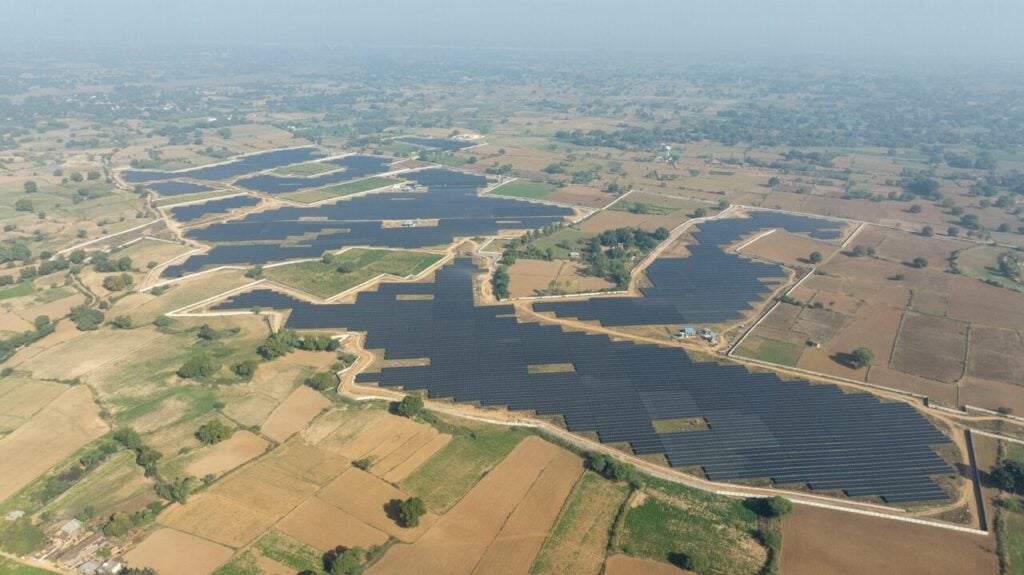
Research and analysis company JMK has released a report on curtailment of renewable energy generation in India, showing that solar PV curtailment reached 96.9GW in September.
While curtailment in September this year was lower than the previous year’s figure, down 24%, this follows a period between May and August in which curtailment was four times higher compared to the same period in 2025.
Try Premium for just $1
- Full premium access for the first month at only $1
- Converts to an annual rate after 30 days unless cancelled
- Cancel anytime during the trial period
Premium Benefits
- Expert industry analysis and interviews
- Digital access to PV Tech Power journal
- Exclusive event discounts
Or get the full Premium subscription right away
Or continue reading this article for free
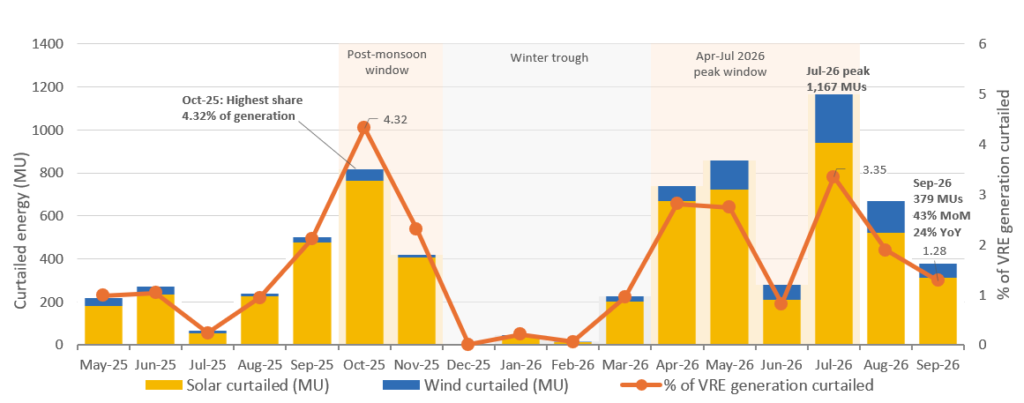
In September 2026, the equivalent of 1.28% (118.6GW) of total renewable energy was curtailed, with solar comprising 96.9GW of curtailment, and the majority of the remainder comprising wind generation. JMK suggests that the reasons for renewable curtailment include demand-generation mismatches, transmission constraints and a lack of storage and grid flexibility.
Seasonal trends can also affect curtailment figures. JMK considers the period from April to July to be the peak window of renewable generation in India, while autumn can be characterised by high renewable output and moderate electricity demand, leading to higher curtailment.
According to JM figures, October 2025 saw the highest rate of curtailment since May 2025, with 4.32% of generation curtailed, as shown in the graph below.
Grid-India divides variable renewable energy (VRE) curtailment into two categories: Real-time system constraints, where back-down instructions are issued on any particular day in order to manage congestion and operating limits; and emergency Tertiary Reserve Ancillary Service (TRAS) Down orders. The latter involves reducing generation to balance supply and demand and indicates the power system is unable to accommodate the power from available renewables.
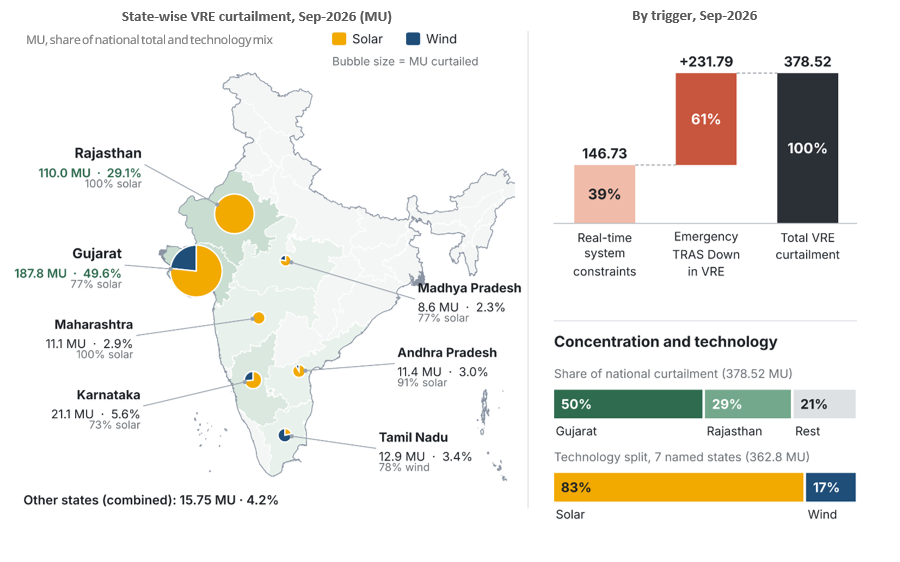
Of September’s curtailment, 146.73MUs (39%) was due to real-time system constraints and 231.79MUs (61%) was due to Emergency TRAS Down in VRE, of which solar accounted for 82%. JMK suggests that September’s figures were “driven mainly by the need to balance the power system, rather than by grid congestion alone.”
Gujarat and Rajasthan generated 79% of curtailed energy in September, with Rajasthan’s curtailment (29.1% of the total) entirely affecting solar projects, as shown in the diagram below.
JMK says BESS can ‘reduce curtailment’
While JMK notes thatcurtailment fell from August to September this year, the analyst frames this as “seasonal relief rather than evidence of a structural improvement in grid integration.”
Indeed, JMK notes that further deployment of battery energy storage systems (BESS) could “reduce curtailment” in the long-term, but notes that BESS projects would have had to provide an average of 12.6 GWh per day in September to obviate curtailment. This figure that equates to 3GW of 4-hour storage capacity.
JMK calls for prioritisation of nodes in Gujarat and Rasjasthan needing storage sized to recurring surpluses in order to help absorb TRAS Down events. Such storage would be able to complement transmission upgrades and improve forecasting for flexible markets, the report states.
The need for seasonal and location-specific curtailment will be increased by further renewable energy installations, reads the report, which adds that addition of around 44.6GW of solar generation in FY2026 has increased pressure on transmission infrastructure and grid flexibility.
While Indian solar PV additions in Q2 2026 were 43% lower than in the previous quarter, JMK figures released earlier this year show that utility-scale solar additions in India rose 32% between H1 2025 and H1 2026.
Accommodating these renewable energy capacity additions will require more investments in India’s transmission infrastructure, according to Indian credit rating agency ICRA, which estimated that the country will need to add around 20,000 circuit kilometres of transmission lines and 120 gigavolt-amperes of substation capacity every year for five years to meet the Indian government’s National Electricity Plan-II targets. India is expected to spend IN5 trillion (US$52 billion) between 2027 and 2032 on its power transmission network.
India is not alone in facing these kinds of grid challenges. Trade body SolarPower Europe commented on the situation regarding grid infrastructure in Europe in September this year, saying that “investment in storage, electrification, flexibility and grid infrastructure must scale rapidly.”