
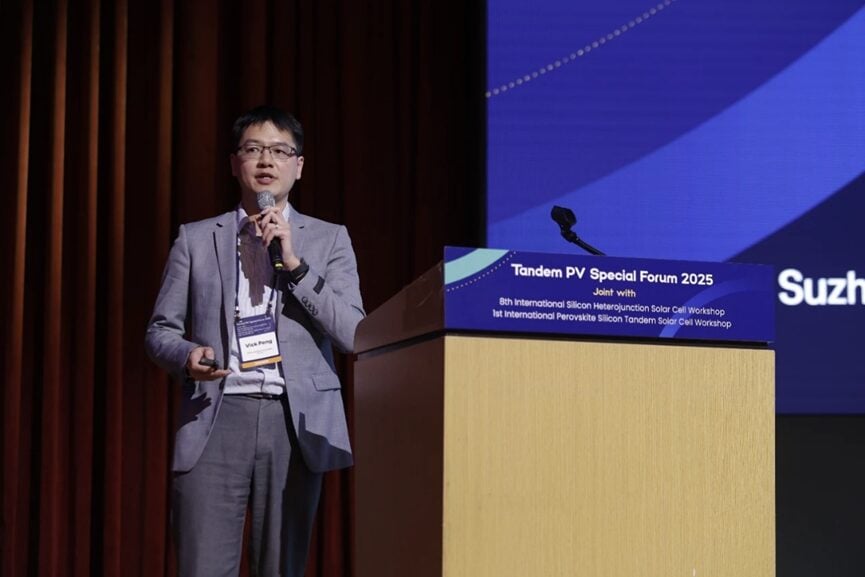
Maxwell has taken part in two international events in Daejeon, South Korea – the 8th international silicon heterojunction solar cell and the 1st international perovskite-silicon tandem solar cell workshops – jointly organized by SNEC, the Korea Institute of Energy Research (KIER), and Germany’s Forschungszentrum Jülich.
Vick Peng, Deputy Director of Cell R&D at Maxwell, delivered a keynote speech to attendees. entitled “Advancing SHJ Towards 27% Efficiency – High-Performance Foundation for Future Tandem Technologies”, sharing the company’s latest R&D progress and technological roadmap in the HJT field and outlining key technical directions for the industry to achieve the milestone of 27% mass-production cell efficiency.
November this year saw N-type crystalline silicon heterojunction cells (210H full-area 220.6 cm²) developed by Maxwell using self-developed mass-producible equipment and processes achieve a conversion efficiency of 26.8%, certified by Germany’s ISFH. The preparation of this batch of cells was based on industrial-grade silicon wafers and screen-printed electrodes, incorporating multiple innovative technologies such as microcrystalline structure and material optimization and carrier transport-passivation balance. The related equipment, materials and processes are fully viable for large-scale mass production.
During the conference, Peng provided an in-depth analysis of the key technologies behind this efficiency breakthrough, covering material innovation, equipment structure optimization and process upgrades.
Building upon the aforementioned validated and effective efficiency enhancement technologies, Peng further introduced Maxwell’s exploration and discoveries regarding next-generation HJT cells. He pointed out that achieving the ultimate balance between passivation and carrier transport is the core for further efficiency gains and the key to laying a high-performance foundation for perovskite/silicon tandem technology.
Beyond leading efficiency, the low-cost potential of HJT technology is accelerating. As silver paste prices continue to rise, the advantage of low silver consumption in HJT cells is becoming increasingly prominent, further enhancing their cost competitiveness. Combined with characteristics including low silicon material consumption, shorter process steps and low carbon emissions, HJT is becoming one of the most competitive and sustainable high-efficiency photovoltaic technologies.