Operators of solar power generation facilities expose themselves to financial risk from the effects of hailstorms, snow and typhoons, according to the latest report from climate insurance provider kWh Analytics.
Details of such risks are examined in kWh Analytics’ Resilient Power Report 2026. The report follows the publication of its annual Solar Risk Assessment paper in May 2026, which highlighted the impact of hail and fire on PV installations, and considered the effects of tracker drift and module twisting on a facility’s performance.
Try Premium for just $1
- Full premium access for the first month at only $1
- Converts to an annual rate after 30 days unless cancelled
- Cancel anytime during the trial period
Premium Benefits
- Expert industry analysis and interviews
- Digital access to PV Tech Power journal
- Exclusive event discounts
Or get the full Premium subscription right away
Or continue reading this article for free
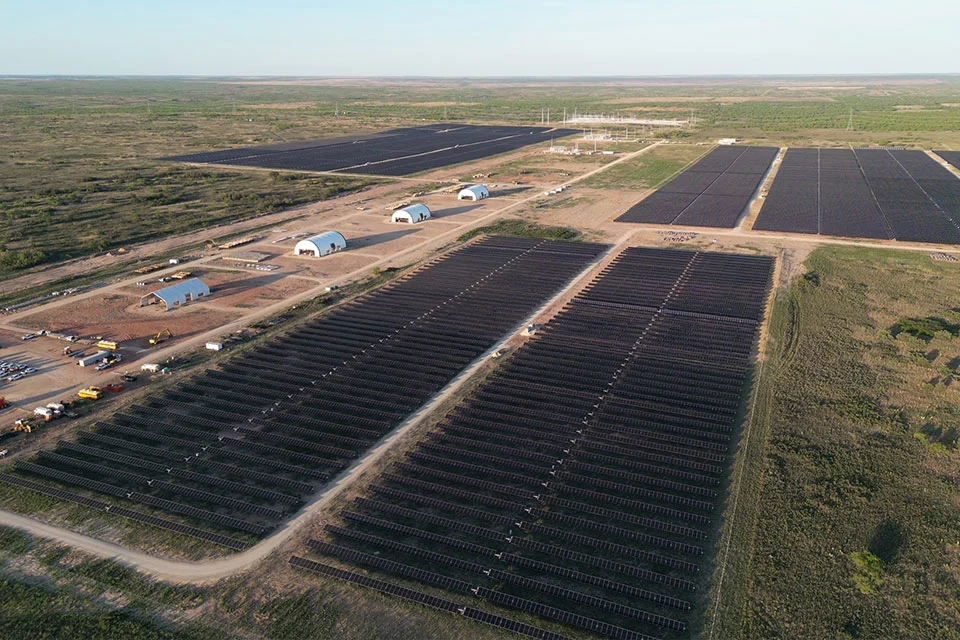
Hail risk is a topic of the Resilient Power Report, which describes the advantages gained when modules are effectively stowed ahead of hailstorms. A paper from Ross Huiman of Clearway and Andrew Griffiths of Nextpower describes how a utility-scale solar park in the heart of ‘hail alley’ in Lubbock, Texas, lost less than 0.018% of its modules thanks to automated stow orders sent to the facility ahead of a forecast hailstorm.
Nextpower trackers were installed at the project, and the authors described how modules were stowed to 60 degrees automatically prior to the hailstorm, and remained in the stowed position for three hours during the storm.
This meant that fewer than 200 modules were damaged across the two project sites, and the authors wrote that, when Clearway personnel attended on-site after the event, they found nearby service vehicles extensively damaged by hail, “including broken windows and battered hoods and car roofs, yet [the operator] made zero insurance claims associated with the solar array.”
Heavy snowfall was another key challenge identified. In winters where heavy snow and prolonged cold periods are forecast, PV sites with remote-controllable trackers have an advantage, report author Matthew Messer of Madison Energy Infrastructure notes.
Snow stow commands can be issued before snowfall to position modules at steep angles. This meant that after storm Fern, which moved across the eastern US in January this year, the prolonged cold spell would have meant snow accumulation on modules “for days or even weeks” had they not been placed in near-upright positions.
At sites without remote snow stow technology, manual technicians were dispatched by Madison to position panels manually, before the storm hit. On-site CCTV was used to monitor the situation and confirm that the module and racking conditions were acceptable during and after the storm.
The report notes that solar production can return up to ten days earlier if modules are stowed before heavy snowfall, compared to not stowing and allowing accumulated snow to melt naturally.
“Our industry has made great strides in understanding the risks facing renewable energy assets and the resilience measures needed to mitigate them. Technologies and protocols that weren’t in place just a few years ago are now operational,” said Jason Kaminsky, CEO of kWh Analytics. “As renewables become the backbone of the grid, working together to scale those solutions will be key to building lasting, resilient infrastructure.”
Solar and storage projects also face typhoon and fire risk, respectively
The report describes a number of other extreme weather effects, such as the impact of typhoons. James Elsworth of the National Laboratory of the Rockies (NRL) writes about typhoon damage at two adjacent solar arrays on a rooftop in Guam, and found that one array had lost most of its PV modules after the typhoon, while the other was intact, despite both being subject to wind speed peaks of 111mph.
The surviving array was found to have used hardened clamps with specific tolerances in securing modules to railings, with their design providing large contact areas and requiring around 90 degrees of rotation to manually disengage them.
A section of the report, written by kWh Analytics’ Mike Kalnas and Adam Shinn, also discusses the common causes of fires in battery energy storage systems (BESS), including HVAC systems’ under-performance leading to overheating and water ingress.
“Either failure mode could cascade into a thermal runaway event, a catastrophic scenario where the release of chemical energy can burn through an entire row of battery containers with minimal (if any) options for containment,” reads the report.
While last year’s Moss Landing fire drew attention to the importance of fire safety in the BESS industry, figures from the US Electric Power Research Institute show that there have been no injuries related to fire events in the US in over six years.
Over the summer, our colleagues at Energy-Storage.news spoke to Scott Murtishaw, executive director at the California Energy Storage Alliance, about the misconceptions about BESS fire risk and the “true safety implications” of energy storage.