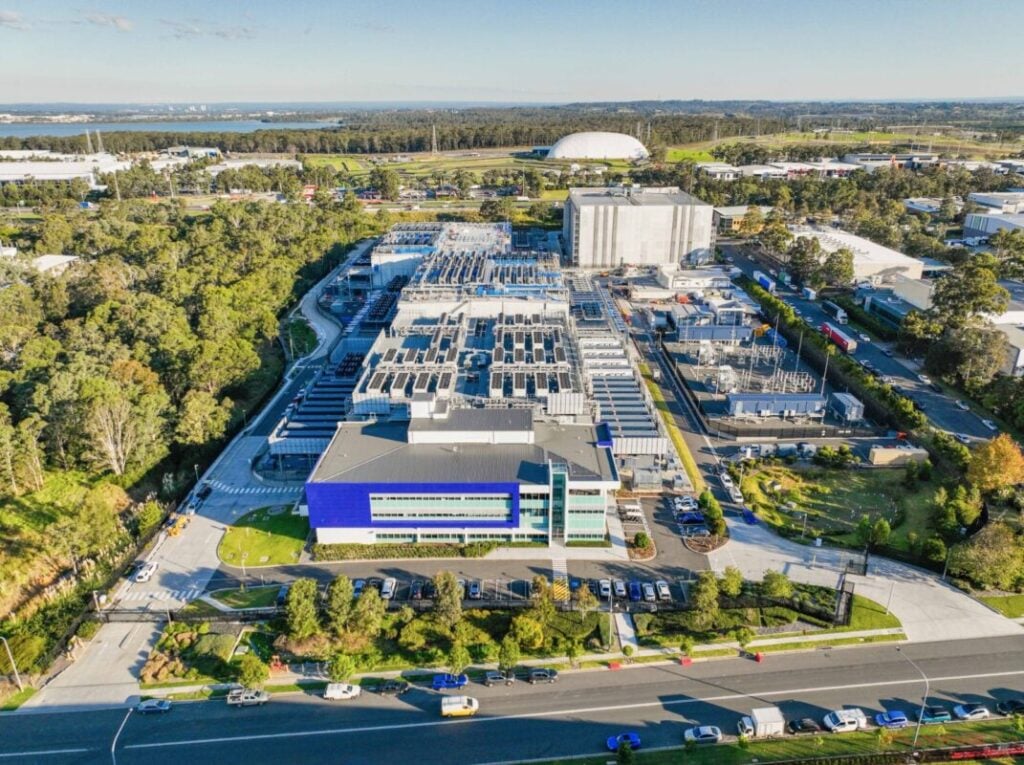
During the midterm election campaign, many of the elected policymakers have emphasised putting a brake on the proliferation of data centres across the US.
This moratorium could have the potential to impact the deployment of renewable energy in the coming years, as tech giants and hyperscalers have become key investors in new renewable energy projects, and offtakers of clean power to meet the electricity demand of their data centres. This was highlighted by some of the industry experts we spoke with last week for our midterm election analysis, which focused on the direct impact the results would have on the solar PV industry.
Try Premium for just $1
- Full premium access for the first month at only $1
- Converts to an annual rate after 30 days unless cancelled
- Cancel anytime during the trial period
Premium Benefits
- Expert industry analysis and interviews
- Digital access to PV Tech Power journal
- Exclusive event discounts
Or get the full Premium subscription right away
Or continue reading this article for free
Moustafa Ramadan, head of PV Tech Research, told PV Tech Premium that the AI boom discussion could be more interesting due to the stance of several elected legislators.
“The AI boom part might be more interesting because a lot of the legislators were elected specifically with campaign mentions of a moratorium on data centre construction,” said Ramadan, adding that a non-negligible portion of the solar growth in the coming years is linked to the AI and data centre boom. “If that boom is slowed down or affected in any way, it would be interesting to see how that can affect solar. That’s the only question that for me would remain still open.”
Ravi Manghani, senior director of strategic sourcing at Anza, also mentioned that out of the 41 ballot measures regarding restricting data centre deployment, all but one passed. He added that voters voted in favour of more moratoriums or banning development of data centres in their districts, which could slow data centre deployment.
“A lot of the story in the past couple of years was that electricity demand is going to grow because of data centres, and it still will, right. It’s not like data centres are going to suddenly disappear, but how quickly will those data centres go through the approval processes and get interconnections?
“I think that probably is a trend that I’ll be watching very closely because all that ties back to how big and how quickly can the renewable energy markets grow because a lot of the renewables growth over the next several years is being tied to or was being tied to data centres.”
More restrictions at state-level too
This will also have an impact on the state level, where legislators have the power to make decisions regarding energy.
Sean Garren, executive director at Vote Solar, said that a certain number of newly elected leaders have made the tie between clean energy and data centres and the importance of “enlisting data centre companies in helping to build the energy that’s needed to make both serve them but also make our overall energy system more affordable.”
“You saw the incoming governor in Wisconsin, David Crowley, saying that data centres need to bring 100% clean power to the table. Same thing in Nevada. A lot of the new, especially at the state level, leaders made that explicit tie that securing and bringing their own clean capacity is a responsibility that the data centres should take seriously,” explained Garren.
For Jon Powers, president and co-founder at CleanCapital, there will be an increase in discussions around distributed generation, behind-the-meter and the role that solar PV and energy storage can play in meeting the demand for the communities data centers are being built in.
“These technologies can often be deployed more quickly than larger infrastructure projects and can provide additional flexibility to the grid. It also depends on the type of data centre being built.
“Now is the time for the solar and energy storage industry to take the opportunity to provide policymakers with insights on creating an environment that encourages investment in new generation, local economic investment, and energy affordability,” added Powers.
Legislation tying renewables with data centres around the world
Although it is still too early to know how the upcoming Congress and newly elected state-level legislators will address the accelerated growth of data centres, other countries have already introduced policies requiring newly built data centres to match their energy demand with renewables.
The Australian prime minister Anthony Albanese, for example, said in July that large-scale data centres would be legally required to put at least as much energy into the grid as they draw from it, and that this supply must be renewable energy. More recently, in the Australian state of New South Wales (NSW), a parliamentary inquiry called for a 100% renewable energy on an hourly basis mandate.
Meanwhile, in Spain, the government unveiled plans to require data centres to have at least 80% of their hourly generation to be powered by renewable energy. Other European countries have also recently moved to require renewables to be tied with newly build data centres, including Greece and Portugal.