A New South Wales (NSW) parliamentary inquiry has recommended that data centres be legally required to supply their own 100% renewable energy on an hourly basis, a stricter test than the state’s current guidelines.
The proposal would require each hour of data centre demand to be met with renewable energy, rather than offset across a year. That would change how much solar, wind and storage operators must contract as data centre load grows in the National Electricity Market (NEM).
Try Premium for just $1
- Full premium access for the first month at only $1
- Converts to an annual rate after 30 days unless cancelled
- Cancel anytime during the trial period
Premium Benefits
- Expert industry analysis and interviews
- Digital access to PV Tech Power journal
- Exclusive event discounts
Or get the full Premium subscription right away
Or continue reading this article for free
The NSW Legislative Council’s Public Accountability and Works Committee published its report on 5 November. Chaired by Greens MLC Abigail Boyd, the committee set its own terms of reference in January 2026, received 143 submissions and held five public hearings before making 26 recommendations.
Recommendation 11 asks the state government to require that all data centre energy demand be “legally mandated to supply their own 100% renewable energy on an hourly basis at a minimum”. Under an hourly test, midday solar output could not be counted against demand at night.
Hourly test would go beyond August guidelines
The state’s Data Centre Guidelines, released in August alongside a wider policy framework, set a looser bar.
In response to budget estimates questions, the NSW Department of Climate Change, Energy, the Environment and Water (DCCEEW) confirmed that the guidelines would not require data centres to supply enough renewable energy to meet their demand.
Instead, the renewable energy generation and storage requirements in the guidelines’ performance measure 13 were “set to achieve an average 80% correlation between new electricity supply and a constant demand (like a data centre) across a year,” the department said.
The committee found that the guidelines “do not sufficiently calculate” the additional energy data centres may need, putting pressure on the network, emissions targets, and other customers. It also found that data centre consumption may be increasing greenhouse gas emissions.
Under the guidelines, proponents should enter power purchase agreements (PPAs) and firming agreements for new renewable energy generation and storage.
They must also show they can cut grid demand by 25% of forecast average load for up to two hours using battery storage and load shifting, with diesel generators ruled out for that purpose.
The NSW Net Zero Commission, the state’s independent climate adviser, argued that obligations should match both the amount and the timing of generation to data centre use. It said this would stop operators offsetting “round-the-clock demand with renewable energy generation that occurs at unrelated times of day”.
The commission said parts of the global data centre industry already seek hourly-matched supply, and that government obligations should make this “the norm rather than the exception”.
The City of Sydney and the Western Sydney Leadership Dialogue also backed hourly matching.
The point bears directly on solar developers. The guidelines note that more than half of proposed data centre projects had committed to PPAs or long-term renewable energy deals by February 2026.
However, these “have tended to favour solar projects rather than the wind, storage and firming capacity needed to support grid reliability”.
AirTrunk said publicly that each additional gigawatt of data centre demand will likely need about 3-4GW of new renewable energy generation to support 24/7 operation. PV Tech‘s analysis of Australia’s data centre boom found that PPAs and certificates do not guarantee renewable energy is physically powering a facility at all times.
Greenpeace told the committee that PPAs are sometimes attached to projects that would have gone ahead anyway. The Clean Energy Council took a different view, arguing that data centre operators are willing to sign long-term PPAs, which helps bring new wind, solar and storage projects forward.
Demand forecasts, curtailment and the federal floor
Demand forecasts given to the inquiry show what is at stake. Ausgrid, which runs the distribution network across Sydney, the Central Coast and the Hunter, said data centres account for about 4% of operational load in NSW today and could reach 17-30% by 2040.
The Clean Energy Council, citing the Australian Energy Market Operator (AEMO), said NSW data centre demand is set to grow fivefold by 2035, reaching 15% of the state’s electricity consumption.
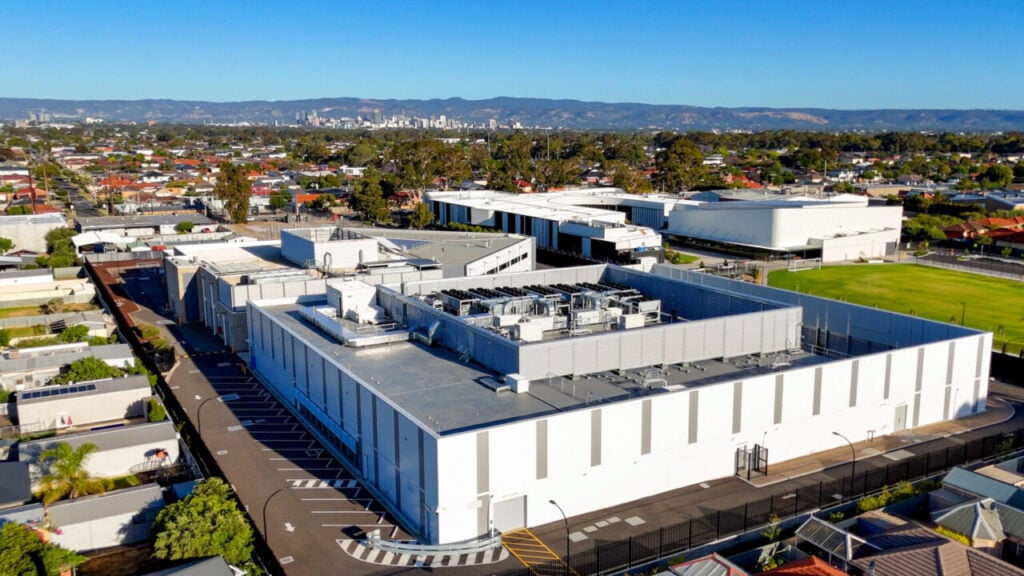
The Carbon Zero Initiative said around 90 data centres operate in NSW, with 22 more approved or in the planning system that could use up to 25,719GWh of electricity a year.
Those estimates came before further announcements, including a 1.4GW data centre proposed for Wagga Wagga in the state’s Riverina region, the report notes.
The committee also warned that phantom demand can distort these forecasts. The guidelines cite Oxford Economics research estimating that six in every seven megawatts of data centre connection requests are phantom demand, while utilities suggest about 20% of applications are likely to proceed.
Ausgrid told the inquiry that proponents often lodge several connection applications across the eastern seaboard and withdraw the rest once one is approved. Transgrid said it does not invest in network infrastructure until a data centre has made a firm commitment and funded its connection works.
The cost of getting this wrong has been estimated elsewhere. Last month the Smart Energy Council said 5GW of data centres connecting without matched new supply could add AU$40 billion (US$28 billion) to wholesale power costs across four eastern states, including AU$8.9 billion in NSW.
The inquiry heard that some renewable energy generation is already being wasted. The Carbon Zero Initiative said 2.1GW of renewable energy is being curtailed in NSW, and called for incentives to locate data centres in regional areas to cut curtailment and anchor new projects.
Professor Ken Baldwin of the Australian National University said data centres could raise demand during periods of high solar output and shift load away from the early evening peak. He argued that siting them in renewable energy zones could ease pressure on urban networks.
The Carbon Zero Initiative earlier coordinated a coalition that demanded data centres stop freeloading on clean energy and be powered by 100% additional renewables from the day they open.
The Net Zero Commission warned that if data centre demand absorbs renewable energy supply before it can displace coal, NSW risks relying on ageing coal generators for longer. Friends of the Earth Australia said the state is already projected to fall short of its 16GW renewable energy target for 2030.
The committee also criticised the use of diesel backup generation, citing a proposed data centre at Kemps Creek in western Sydney that would include 852 diesel generators.
It recommends the state government work with the Environment Protection Authority to reduce that dependence and promote battery storage and other behind-the-meter options.
The federal framework approaches the supply issue through volume. In July, Prime Minister Anthony Albanese said large data centres would be legally required to become net generators of renewable energy, putting at least as much renewable energy into the grid as they draw from it, with legislation targeted for early 2027.
Energy ministers later agreed to progress nationally consistent rules, although Queensland and the Northern Territory broke ranks. The agreement left states room to add tougher local requirements.
Climate Change and Energy Minister Chris Bowen said in August that states would be free to add more rigorous requirements but not to water them down. An hourly mandate in NSW would be one such addition.