Australian Prime Minister Anthony Albanese has said that large-scale data centres will be legally required to put at least as much energy into the grid as they draw from it, and that this supply must be renewable energy.
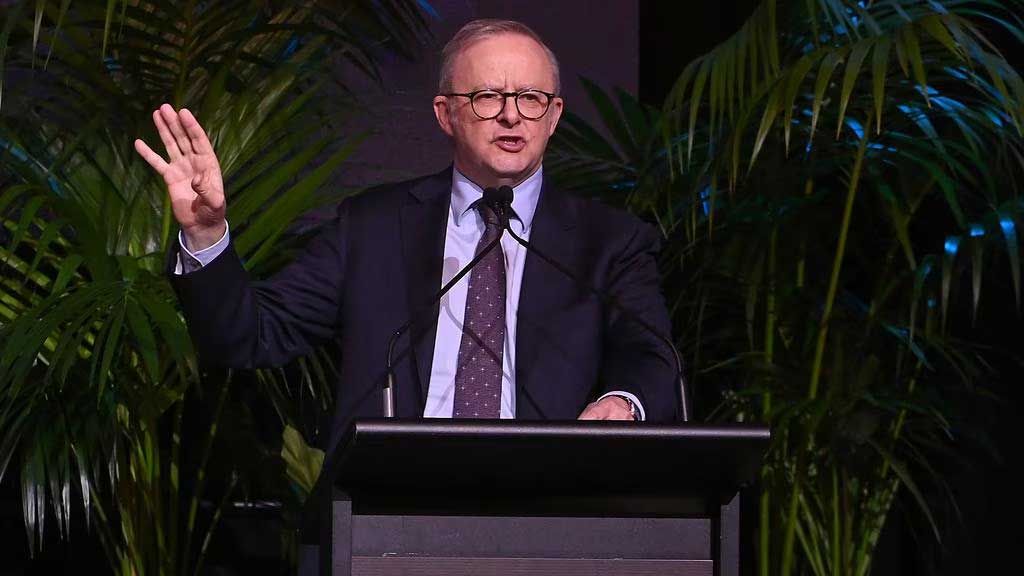
Albanese made the comments on 15 July at the University of Sydney whilst revealing that these measures would be introduced as part of a wider national framework for artificial intelligence (AI).
Try Premium for just $1
- Full premium access for the first month at only $1
- Converts to an annual rate after 30 days unless cancelled
- Cancel anytime during the trial period
Premium Benefits
- Expert industry analysis and interviews
- Digital access to PV Tech Power journal
- Exclusive event discounts
Or get the full Premium subscription right away
Or continue reading this article for free
Speaking to an audience including global AI investors and industry representatives, Albanese confirmed the government would establish Australian Standards covering the siting, energy obligations and water use that will apply to the next generation of large-scale data centres.
“We will create a legal obligation for the next generation of large-scale data centres to underwrite new power supply,” he said.
“To build new renewable energy generation and firming to strengthen our national energy resilience. To be net-generators, not net-users.”
Albanese also announced the creation of an Office of AI within the Department of the Prime Minister and Cabinet, effective immediately, to coordinate the design of the new standards and bring together work currently being conducted across multiple ministries.
He said he would seek agreement on the standards framework from state and territory leaders at a National Cabinet meeting next month, with legislation targeted for introduction to Parliament early next year.
The energy obligation is the most consequential element of the announcement for Australia’s electricity system.
Under the proposed rules, large data centres would be required to pay their full share of grid connection costs, with no costs passed on to households or businesses, and to reduce their power use when the grid is under strain.
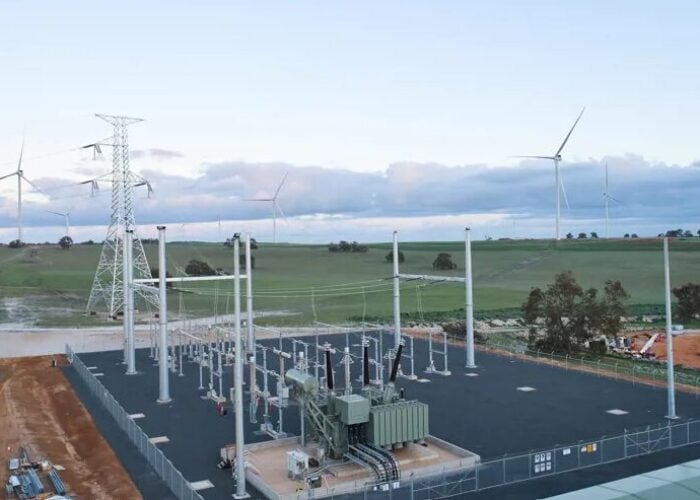
The framework would require the new generation capacity to be built on top of the existing renewable energy rollout rather than drawing from it, implying a material increase in the pipeline of wind farms, solar PV plants, substations and transmission infrastructure required nationally.
Australian trade association the Smart Energy Council welcomed the announcement, stating on LinkedIn: “The Smart Energy Council fully supports this position: data centres must bring additional, clean energy, not compete with households and businesses for our existing energy supply. We look forward to working with the new Office of AI and industry to ensure this emerging sector contributes to Australia’s clean energy transition.”
From voluntary expectation to legal obligation
The announcement converts a set of government expectations for large AI data centres, released in March 2026, into a binding regulatory framework.
Earlier this year, an industry coalition had already warned that a social backlash was inevitable if data centres were allowed to draw from Australia’s existing renewable energy supply rather than funding new generation, with demand forecast to grow from 3TWh to 30TWh by 2035.
The Albanese announcement effectively adopts that position as government policy.
The Australian Energy Market Commission (AEMC) had separately proposed new technical standards in March 2026 requiring large data centres to remain connected to the grid during faults rather than disconnecting, to avoid the risk that large synchronised disconnections could destabilise the National Electricity Market (NEM) during disturbances.
The scale of investment already committed to Australian data centres gives the policy immediate market significance. Amazon has committed AU$20 billion (US$14 billion) to expand its Australian data centre infrastructure, with utility-scale solar PV plants contracted to supply the facilities.
AI company Anthropic, which develops the Claude family of AI models, has been reported to be considering data centre investment of up to AU$21.6 billion in Australia, contingent on the regulatory environment, with a longer-term target implying up to 20GW of new demand, roughly equivalent to 60% of Australia’s current annual electricity generation.
Origin Energy, one of Australia’s largest electricity retailers and generators, said in its most recent financial results that data centres had become the primary driver of electricity demand growth across its customer base, showcasing how rapidly the sector has moved from a marginal load to a system-shaping one.
The requirement for data centres to provide firming alongside new renewable energy generation, not just raw generation capacity, opens a direct pathway for battery storage to be part of how operators meet their compliance obligations.
On our sister site, Energy-Storage.news, Jeff Monday, SVP & chief growth officer at energy storage system integrator Fluence, argued that battery storage co-located with data centres could allow operators to absorb surplus renewable energy generation during periods of oversupply and discharge during peaks, turning what would otherwise be a grid constraint into a grid asset.
The net-generator obligation, if enforced on an annual energy accounting basis, creates a commercial incentive for precisely that configuration.