Fresh signals of capacity restructuring are emerging across China’s PV industry. At the end of June 2026, three mandatory national standards on energy consumption and efficiency for the PV industry were jointly issued, covering the entire industrial chain, from polysilicon, monocrystalline silicon to PV modules and inverters. The full set of new rules will take effect nationwide on 1 January 2027.
The three official standards are as follows: GB47834-2026 Limit Values of Energy Efficiency and Energy Efficiency Grades for Crystalline Silicon PV Modules and Inverters, GB 47835-2026 Unit Product Energy Consumption Limits for Monocrystalline Silicon, and GB 29447-2026 Unit Product Energy Consumption Limits for Polysilicon and Germanium. All carry legally mandatory force and will be fully enforced starting 1 January 2027.
Try Premium for just $1
- Full premium access for the first month at only $1
- Converts to an annual rate after 30 days unless cancelled
- Cancel anytime during the trial period
Premium Benefits
- Expert industry analysis and interviews
- Digital access to PV Tech Power journal
- Exclusive event discounts
Or get the full Premium subscription right away
Or continue reading this article for free
All three standards share a unified three-tier energy-efficiency classification: Grade 1 represents the highest energy performance, while Grade 3 sets the minimum market access benchmark. Dual mandatory constraints apply throughout the production chain, from silicon manufacturing to finished products, pushing the industry to phase out outdated capacity and rationalise supply structure.
Strict entry threshold set for PV modules: sub-630W products banned from sale
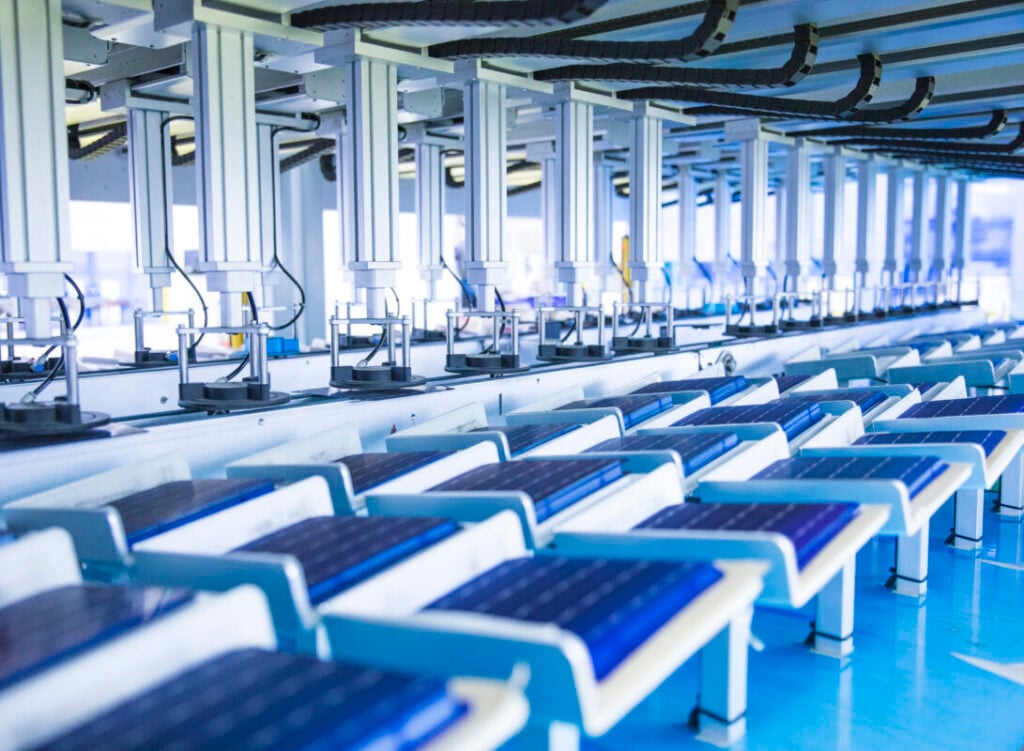
The new standards set clear minimum conversion efficiency benchmarks for all mainstream cell technologies in the PV module segment. Tunnel oxide passivated contact (TOPCon) and heterojunction (HJT) modules must achieve a conversion efficiency of at least 23.2%, while back contact (BC) cell modules face a higher threshold of 23.5%.
Based on the standard module size of 1134mm × 2382mm, this efficiency floor translates to a minimum rated power of 630W. Starting in 2027, any module with power output below this mark will be prohibited from commercial sale.
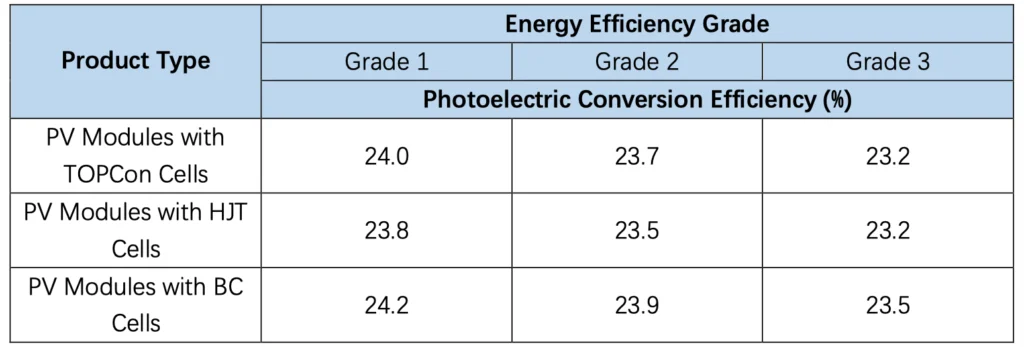
Additionally, the standards introduce multiple product performance constraints to raise overall module quality. The stress-induced, maximum allowable environmental degradation rate for PV modules is capped at 8.6%. For bifacial modules, differentiated bifaciality thresholds are specified: TOPCon at 75% or higher, HJT at 85% or higher, and BC at 70% or higher.
PV inverters, which support the modules, are also classified into three energy- efficiency grades. Mandatory minimum limits are set for the weighted average efficiency and peak efficiency of grid-connected inverters, driving energy-saving upgrades.
New polysilicon energy consumption red lines set to phase out outdated high-energy capacity
1. Trichlorosilane-based polysilicon: The industry’s average production energy consumption currently stands at 7.05 kilograms of coal equivalent consumed per kilogram produced (kgce/kg). The new rules set a strict market access cap of 6.4kgce/kg, rendering numerous existing high-energy conventional production lines non-compliant.
2. Silane fluidised-bed polysilicon: Against the industry baseline of 4.55kgce/kg, the minimum entry standard is set at 5kgce/kg, leaving room for this emerging process to develop.
Since the final official version of the Unit Product Energy Consumption Limits for Polysilicon and Germanium has yet to be released, the industry is currently using the draft version’s indicators as a reference. Upstream and downstream wafer manufacturers must complete targeted energy-saving retrofits on their production lines in advance to ensure compliance.
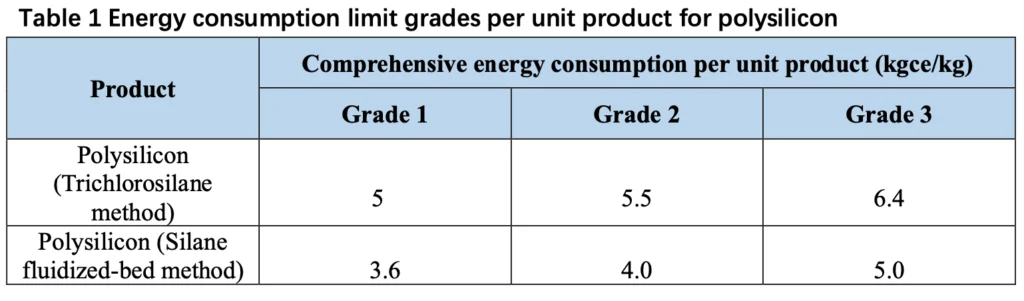
Publicly available industry data show that numerous outdated production lines with power consumption exceeding 60kWh/kg are dragging down the sector’s overall energy efficiency. The industry-weighted average energy consumption for polysilicon produced via the improved Siemens (rod-based) method stands at 7.6 to 8.5kgce/kg, failing to meet the new market-entry threshold.
By the end of last year, GCL-Tech, leveraging its granular polysilicon advantage, posted a comprehensive energy consumption of 13.8kWh/kg, equivalent to roughly 1.7kgce/kg—well below the Tier 1 cap of 3.6kgce/kg and cementing its industry-leading position.
Over the same period, Tongwei’s improved Siemens process delivered a comprehensive energy consumption of 46kWh/kg, translating to approximately 5.65kgce/kg. That outperforms the Tier 3 threshold of 6.4 kgce/kg and approaches the Tier 2 benchmark of 5.5 kgce/kg, making Tongwei a top cost controller among rod polysilicon manufacturers.
Xinte Energy, by contrast, records a comprehensive power consumption of 50-55kWh/kg, equivalent to 6.15-6.76kgce/kg—barely meeting the Tier 3 entry requirement and leaving the company under significant pressure for technology upgrades.
According to preliminary statistics from the Silicon Industry Branch of the China Nonferrous Metals Industry Association, capacity restructuring will take a major toll on China’s effective polysilicon capacity. Domestic operational capacity is expected to fall to 2.40 million tons from 2.87 million tons at the end of 2024, a 16.4% year-end decline and a 31.4% drop against total completed capacity.
The new standards establish a three-tier energy efficiency rating system for PV inverters, with Tier 1 representing the highest level. Grid-connected inverters at each grade must meet mandatory minimum requirements for both weighted average total efficiency and peak conversion efficiency.
Industry analysts point to the three mandatory national standards as a core lever for supply-side structural reform in the PV sector. The industry has long been plagued by unchecked capacity expansion and fierce price competition, with outdated, high-energy, low-efficiency capacity continuously crowding out market resources. By enforcing unified energy consumption and efficiency benchmarks, the new rules weed out inefficient capacity at the source and help rebalance supply and demand.
With just over six months remaining before the 2027 implementation deadline, upstream and downstream PV enterprises must accelerate production-line retrofits, upgrade high-efficiency cell technologies and phase out outdated module lines. In the long run, the new standards will speed up capacity clearance and further consolidate the competitive edge of industry leaders that boast low-energy processes and high-efficiency cell technologies. This will propel the PV industry beyond blind scale expansion into a new phase of high-quality development—one driven by technological advancement and energy-efficiency gains. The three national standards are now publicly available on the National Public Service Platform for Standards Information. All PV enterprises may log in to review the full provisions and make early preparations for compliance.