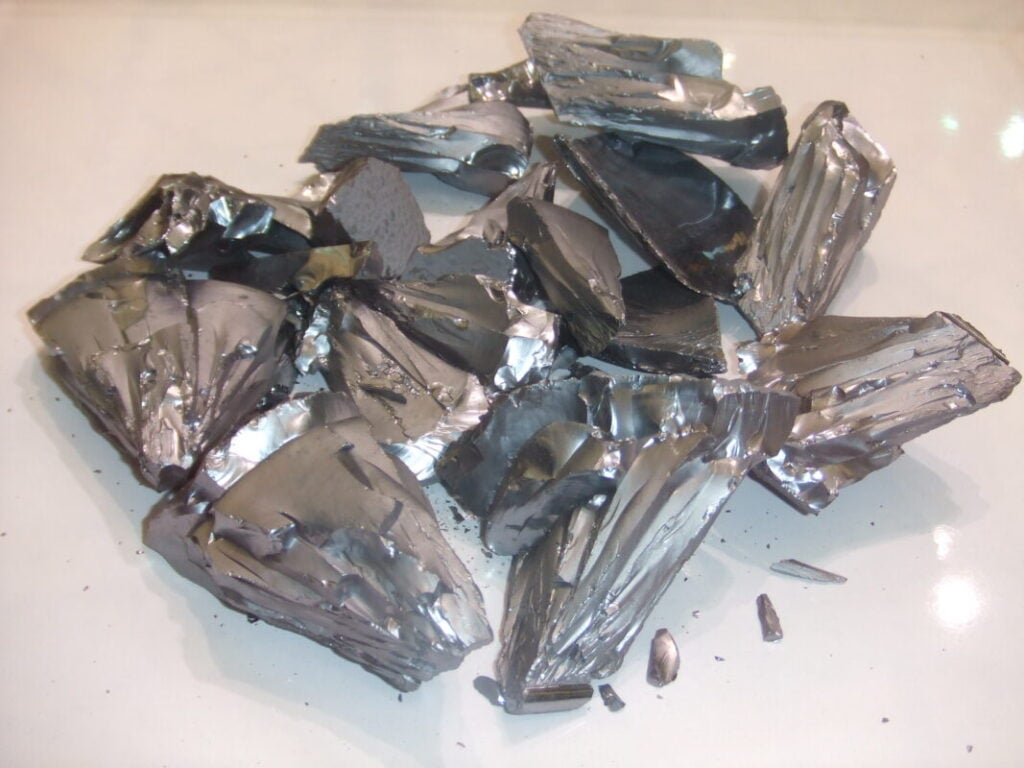
China’s polysilicon market saw no new transactions last week, with quoted prices remaining at the previous week’s baseline.
The market inertia follows a joint pledge signed on 6 August by eight major Chinese polysilicon producers, including Tongwei and GCL Tech, to curb cutthroat competition.
Try Premium for just $1
- Full premium access for the first month at only $1
- Converts to an annual rate after 30 days unless cancelled
- Cancel anytime during the trial period
Premium Benefits
- Expert industry analysis and interviews
- Digital access to PV Tech Power journal
- Exclusive event discounts
Or get the full Premium subscription right away
Or continue reading this article for free
The first weekly price monitoring data released since the self-regulatory agreement was finalised, published on 12 August by the Silicon Industry Branch of the China Nonferrous Metals Industry Association, showed a second consecutive week of zero concluded transactions. Top producers refrained from issuing new quotes for two weeks running, with prices remaining anchored at 29 July levels: n-type recharging material is priced at RMB30,500-33,000/tonne (US$4,526-4,897), averaging RMB32,000, while n-type granular silicon ranges from RMB30,500-32,000/tonne, averaging RMB31,000.
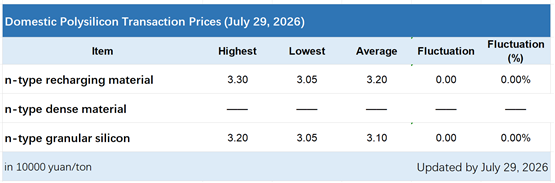
The Silicon Industry Branch noted that polysilicon trading had effectively frozen last week. All polysilicon producers have halted new quotes, and the only limited turnover stems from fulfilling legacy orders. No fresh negotiations or new contracts have been concluded, as widespread wait-and-see sentiment grips the supply chain while the sector awaits a new pricing consensus.
On the supply side, manufacturers are maintaining steady production schedules without major output cuts or plant shutdowns. Demand, however, remains constrained by the pace of downstream PV installations. Wafer makers have limited room to boost capacity utilisation and have broadly delayed procurement. Downstream producers are also monitoring the long-term impact of industry self-regulation and holding off on large-scale inventory builds, neither pushing for lower prices nor hastily accepting new offers based on production costs.
Analysts say the polysilicon segment is undergoing a critical price rebalancing. For over a year, persistent oversupply drove prices below cost thresholds, triggering widespread industry losses. By collectively establishing a cost-based price floor, eight leading producers aim to break this cycle of predatory pricing. In the near term, upstream and downstream players need time to adapt to the new market framework. Stakeholders are assessing the effectiveness of self-discipline measures, the pace of outdated capacity exits and the strength of end-demand recovery as they await negotiations to forge a unified, reasonable benchmark for future transactions above last week’s price floor.
The Silicon Industry Branch views the current spot market freeze—marked by zero transactions, stable quotes, and a pervasive wait-and-see sentiment—as a necessary phase for restoring industry order. The association pledged to continue monitoring corporate compliance with self-discipline measures, collaborate with regulators to prevent predatory price dumping, and facilitate rational dialogue between upstream and downstream players. The goal is to gradually rebuild a stable, sustainable pricing system anchored by cost floors, steering the PV silicon sector away from vicious price wars and toward balanced, high-quality development.
Despite the muted spot market, capital markets have responded vigorously. On 12 August, A-share stocks for major producers Tongwei, GCL Tech, and Xinte Energy each rose by roughly 5%. In the derivatives market, the primary polysilicon futures contract (PS2609) closed up 1,560 points, or 4.26%. Over the week of August 6–12, the front-month futures contract gained 6.44%.
Looking ahead, J.P. Morgan forecasts that polysilicon prices will bottom out and rebound in the second half of the year. While high inventory levels will likely keep near-term trading activity subdued, prices are expected to recover once downstream buyers deplete existing stocks and resume restocking.
The report projects silicon prices will rebound to RMB50,000-55,000/tonne, aligning with the full cost for marginal producers, including a 13% value-added tax. J.P. Morgan currently maintains an overweight rating on Daqo and GCL Tech.