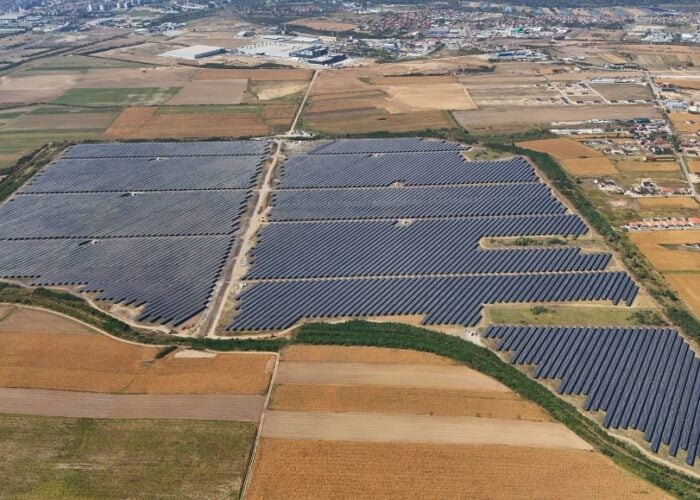
Indian module manufacturer Saatvik Solar, a unit of Saatvik Green Energy Limited (SGEL), has signed a memorandum of understanding (MoU) with the government of Odisha to develop a 3.6GW solar PV cell manufacturing facility at Gopalpur in the Ganjam district.
The agreement with the Industrial Promotion and Investment Corporation of Odisha (IPICOL) covers the proposed Phase II cell facility, which is expected to be operational in FY28. It follows progress on Saatvik Solar’s Phase I development at Gopalpur, comprising 2.4GW of cell and 4GW of module manufacturing capacity.
Try Premium for just $1
- Full premium access for the first month at only $1
- Converts to an annual rate after 30 days unless cancelled
- Cancel anytime during the trial period
Premium Benefits
- Expert industry analysis and interviews
- Digital access to PV Tech Power journal
- Exclusive event discounts
Or get the full Premium subscription right away
Or continue reading this article for free
Saatvik said the facility has now reached the final stages ahead of commissioning, with major construction and infrastructure works completed and equipment installation, testing and validation underway.
Prashant Mathur, CEO, SGEL said: “Odisha is more than a manufacturing milestone for Saatvik; it is a statement of our ambition. As our 2.4GW cell and 4GW module manufacturing lines move towards production, we are taking a decisive step towards building scale, strengthening integration and creating the foundation for our next phase of robust growth.”
The company said its dedicated 220kV substation is ready for charging, while the manufacturing lines are progressing through final installation and process-readiness activities. The cell line is expected to begin ramp-up shortly, with an Approved List of Models and Manufacturers-II (ALMM-II) inspection planned for September.
“Building on the momentum of Phase I, we are advancing plans for a further 3.6GW Phase II expansion at Gopalpur, with Phase II targeted for commercial production by FY28. The future we see is one where India is not only a major consumer of clean energy, but a global manufacturing powerhouse for it,” Mathur added.
Saatvik also operates a 4.8GW module manufacturing facility in Ambala, Haryana. The company said its Odisha development is ultimately intended to comprise 4GW of module capacity and 6GW of cell capacity.
The company did not disclose the investment value, planned commissioning date or technology configuration for the proposed 3.6GW Phase II cell facility in the announcement.
Additionally, the manufacturer reported a decline of 44% year-on year in revenue for operations for the Q1 FY27, ending June 2026. The company said its confirmed order book stood at approximately 6.35GW, equivalent to around 132% of its current 4.8GW operational module capacity.
During the results, Saatvik announced plans for Phase III at the Odisha plant, which will comprise 6GW of ingot and wafer capacity, and is scheduled for completion by FY29.
Vikram Solar inaugurates 6GW TOPCon module plant in Tamil Nadu
In other news, Indian PV manufacturer Vikram Solar has inaugurated its 6GW solar PV module manufacturing plant at Gangaikondan, Chennai in the southern state of Tamil Nadu.
Set within a larger greenfield campus of nearly 600,000 square feet, the manufacturing plant will employ over 800 workers.
Last month, the company commissioned the manufacturing facility. The plant will manufacture Vikram’s Hypersol n-type tunnel oxide passivated contact (TOPCon) G12R modules, offering power outputs of 615-640W and module efficiencies of up to 23.69%.
In January 2026, the manufacturer transitioned its module portfolio to the G12R format, citing “performance, reliability and bankability.”
According to the company, the Gangaikondan campus is planned to expand progressively beyond module manufacturing to include solar cell, wafer and ingot production, bringing multiple stages of the PV value chain together at a single site.
The inauguration follows the recent launch of Vikram Solar’s 5GW Vallam manufacturing facility in Tamil Nadu.
In April, Vikram Solar surpassed 10GW of cumulative global solar module deployments, doubling deployments from 5GW to 10GW in two years. Of the total, around 1.5GW was exported to international markets.
Headquartered in Kolkata, the company plans to install 9GW of solar cell manufacturing capacity by FY2027, expanding that by a further 3GW by FY2028 and add 12GW of wafer and ingot manufacturing capacity by FY2029-30.
In June, Vikram Solar was reportedly planning to invest INR270 billion (US$2.8 billion) in a vertically integrated solar manufacturing hub in West Bengal, covering ingot, wafer, cell and module production, although the company has yet to confirm the reports.
India’s renewable energy transition, from solar PV and energy storage to grid integration, will be a key topic of discussion at the Renewable Energy India (REI) Expo, co-located with the Energy Storage Summit India (ESS India), in Greater Noida on 22-24 October 2026. For the full agenda and booking details, click here.