The Becquerel Institute has released a segment briefing, ‘Operations & Maintenance: AI and Robotics in the PV Value Chain to 2030’, which reports on the potential impact that the latest technologies can have on the construction and maintenance of solar installations.
The briefing document argues that as operations and management (O&M) is the longest phase of PV assets’ lifecycles, it is the segment that has the highest potential for deriving value from technological innovations, and cites robotics and automation in that context.
Try Premium for just $1
- Full premium access for the first month at only $1
- Converts to an annual rate after 30 days unless cancelled
- Cancel anytime during the trial period
Premium Benefits
- Expert industry analysis and interviews
- Digital access to PV Tech Power journal
- Exclusive event discounts
Or get the full Premium subscription right away
Or continue reading this article for free
The headline figures provided with the publication’s announcement state that via the application of suitable technology, a 3-4% energy yield improvement is possible in PV operations, cutting project costs by €2,000-3,000 (US$2,200-3,400)/MW per year. The institute also predicts 65-80% of “routine O&M tasks” could be automatable by 2030.
Certain areas of PV operations have a higher potential for automation, the briefing states, citing system monitoring and anomaly detection as being already near-fully (95%) automatable. The document describes a new task category, “automated diagnostic triage and work-order dispatch” and estimates that 60-75% of tasks therein could be undertaken by automation and robotics.
The paper also says that the recent deferment of the EU AI Act’s so-called ‘high-risk deadline’ to 2 December 2027 for Annex III systems could “ease the near-term compliance path” for the deployment of robotics at PV projects. Under the Act, Annex III labels the use of AI in “critical infrastructure,” such as electricity supply, as “high-risk” due to the cybersecurity concerns associated with integrating new technologies into energy management systems.
Last week, Dutch researchers found that almost 8,000 European solar energy systems were exposed to internet cyberattacks and the Becquerel Institute’s David Moser wrote for PV Tech Power earlier this year that the EU AI Act aims to establish a “regulatory identity” to ease cybersecurity concerns.
Trina Solar launches construction and cleaning robots
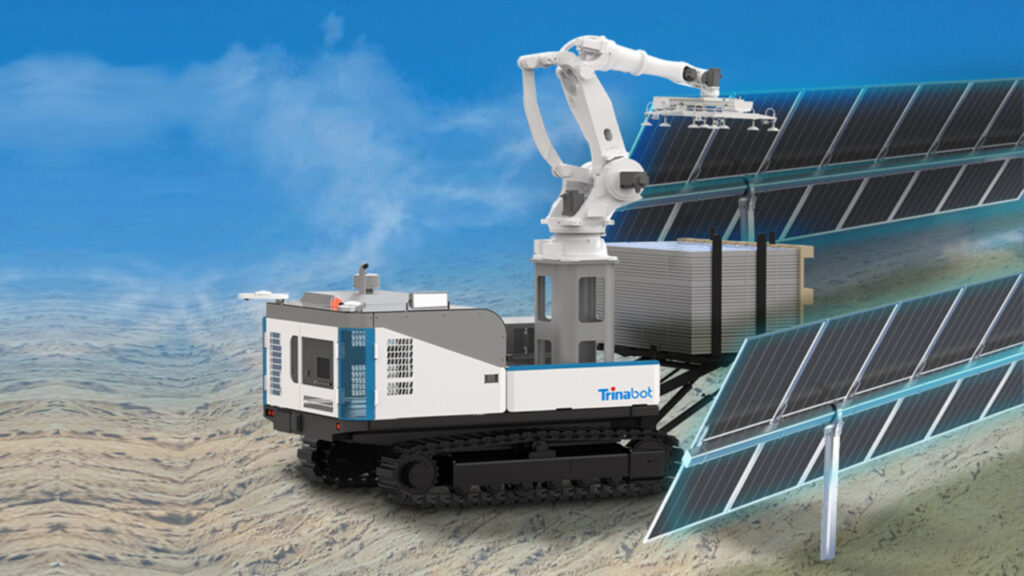
In other technological innovation news, Chinese PV company Trina Solar has launched two automated robotic products. The Buildex PV is intended for large-scale PV construction projects, and the Aurora PV automatically cleans arrays of panels in solar parks.
Buildex PV machinery carries and places solar panels during the construction of solar farms, using computer vision and Lidar (light detection and ranging) sensors for precise deployment over distances of 5mm, the manufacturer states. The panel placing mechanism runs on a vehicular base that can traverse a range of terrain, and adjusts its actions and operating height automatically.
Trina Solar says the Buildex PV system can install up to 90 modules per hour, the equivalent of three to four times more quickly than human labour. It also has the advantage of being able to work for much longer periods than site workers.
The Aurora PV robotic cleaning device, meanwhile, helps remove dust and stains on module surfaces at scale, so can reduce maintenance labour costs. It operates autonomously, running on proprietary self-correction algorithms, and can cope with module height offsets of “up to 50mm”, the company says. It charges itself from self-cleaning modules, and therefore requires little human intervention.
The Buildex PV and Aurora PV devices are the hardware components of Trina’s full-stack Tracker+ software offering, which connects construction and O&M automation. The software also allows users to operate digital twins to test new implementations and attenuations before they are rolled out into the physical world.