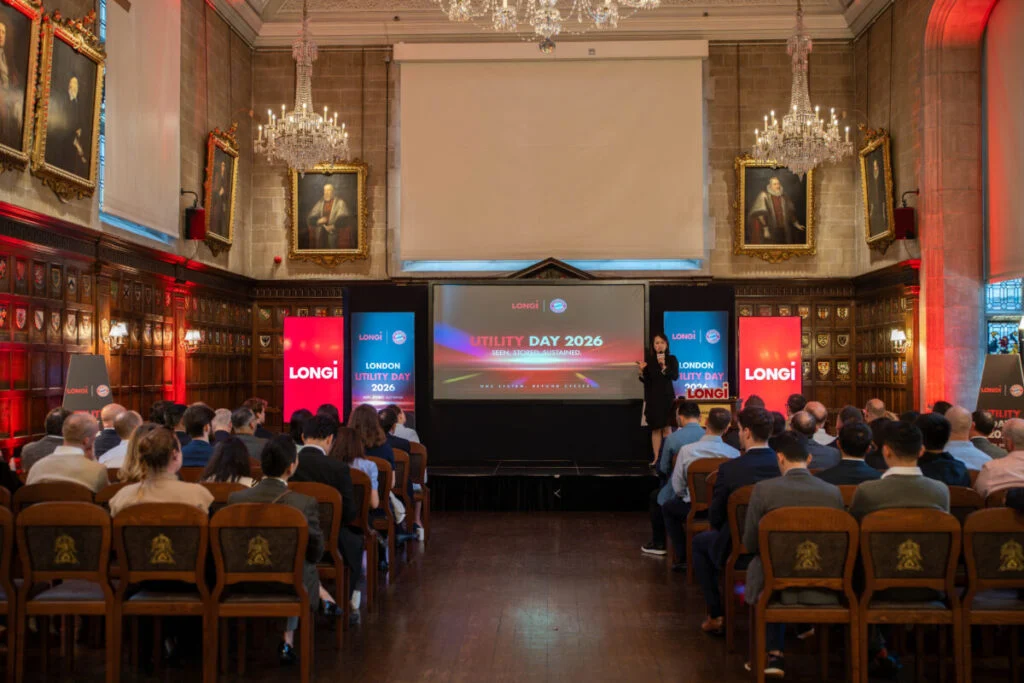
Following LONGi Utility Day in London on 7 October 2026, Leon Zhang, President of Utility Europe, LONGi, discusses the changing economics of European solar, the strategic role of storage, and why technology, local execution and bankability must now work as one system.
PV Tech: Europe’s solar market continues to grow, but the conditions for utility-scale projects are becoming more demanding. What are the most important trends you see today?
Leon Zhang: Europe has moved beyond a phase in which success was measured principally by installing more megawatts. Solar remains central to the region’s energy transition, but utility-scale developers, investors and asset owners are now working in a much more sophisticated environment. Land is scarcer and more expensive; grid connections are constrained; permitting timelines remain challenging; and merchant-price volatility means project economics must be protected over the entire operating life.
Try Premium for just $1
- Full premium access for the first month at only $1
- Converts to an annual rate after 30 days unless cancelled
- Cancel anytime during the trial period
Premium Benefits
- Expert industry analysis and interviews
- Digital access to PV Tech Power journal
- Exclusive event discounts
Or get the full Premium subscription right away
Or continue reading this article for free

The consequence is clear: the conversation is shifting from module efficiency alone to lifetime asset value. Customers need more energy from each site, lower balance-of-system cost, resilient performance under real operating conditions, and a partner that can support them locally from design through operation.
Storage is also becoming an integral part of the utility proposition rather than an optional add-on. As solar penetration rises, projects must be able to manage price cannibalisation, curtailment risk and grid requirements. The winning projects will be designed around system value: high-performing PV, intelligently integrated BESS, and local technical capability.
That is precisely the focus of LONGi Utility Day in London. We brought together customers and partners to discuss how utility solar can become more predictable, more bankable and more valuable over the long term, not simply larger.
How is LONGi responding strategically to these changing market conditions in Europe?
Leon Zhang: Our strategy is to build a stronger, more complete value proposition for utility customers. This means combining leading PV technology with scenario-based design, energy storage, digital intelligence and locally delivered services.
On the PV side, we are advancing from a product-led approach to a solution-led approach. Different sites face different constraints: high ground coverage ratios, challenging albedo conditions, limited land, specific grid requirements, or demanding coastal and climatic environments. Our role is to help customers optimise the complete project, not to offer a one-size-fits-all module.
On the storage side, we are scaling with real commercial momentum. LONGi’s BESS business is performing strongly in Europe, and we have already signed multiple agreements representing more than 2.5GWh of storage projects in the region. This is an important proof point: customers are not only interested in our vision for solar-plus-storage; they are choosing LONGi for major projects.
Our European pipeline is supported by concrete delivery capability. In Italy, LONGi has brought its first integrated solar-plus-storage project in Europe online, combining 35MWp of PV with 13.75MW / 50.16MWh of storage. We have also signed a landmark agreement with a tier-1 European IPP to provide a 300MWh utility-scale PV + BESS project in Italy.
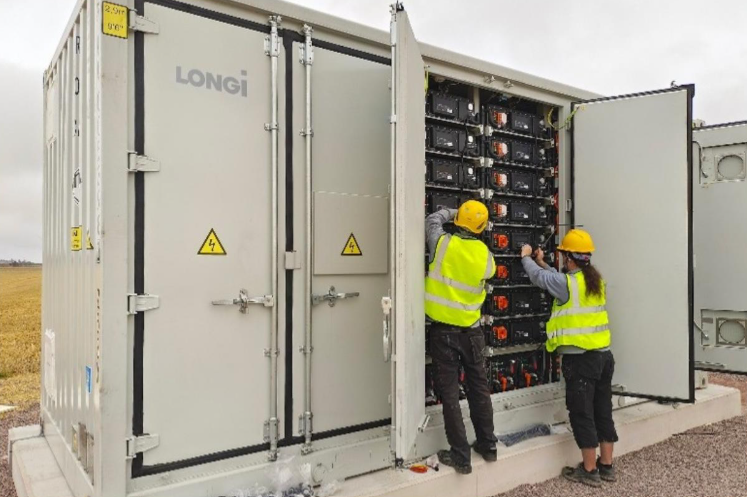
Most recently, we expanded this momentum in Romania through a landmark agreement with Enexus for 50MWh of liquid-cooled BESS across two PV-plus-storage projects in Titu, Dâmbovița County. Building on more than 200MW of LONGi PV modules deployed across Enexus projects since 2025, this is one of our most significant BESS deployments in Europe and one of our largest in Romania to date. It demonstrates the strategic value of moving from a module-supply relationship to an integrated solar-and-storage partnership, delivering energy shifting, capacity firming and grid-support services through a coordinated, grid-ready architecture. Together, these projects demonstrate that LONGi can integrate technology, engineering and long-term value in demanding utility applications.
To give an example, in the UK and Ireland grid connection is a bottleneck for solar and BESS, so this is something we need to help our customers. For the customers its out of their control but we can optimise their megawatts or their megawatt-hours so they can get their payback. The money side has totally changed.
The negative price of electricity is a common problem across the whole of Europe. In the UK, standalone solar makes less sense, so at LONGi we offer integrated solutions. In my perspective I think that the UK has a grid problem that we have to face today, but the British government has already announced 2030 and 2035 goals so it’s very clear what the strategy is for the market, to achieve the 29GWh BESS and 50GW solar [deployment] targets.
Now I think more and more customers are asking not just for solar because power prices are more volatile, so this is why LONGi wanted to start the BESS business from last year, and we already have amazing achievements in the last ten months.
You have described a transition from “efficiency” to “asset value.” What does that mean in practical terms, and what role will Hi-MO 9 Prime play?
Leon Zhang: People have very quickly gone from asking ‘how many megawatts you deliver, when you deliver and what’s the price?’, which are very simple questions, to much more complicated questions about the value across the whole life cycle.
Now LONGi is transferring [focus] from the higher efficiency to the higher asset value, which is something we combine with BESS or we offer integrating the solutions with different scenarios to answer this question to have the better payback across the whole life cycle.

Efficiency remains essential, but it is not the final objective. An asset owner does not invest in a module simply to achieve a higher nameplate rating; they invest to secure reliable energy yield, manage risk and maximise returns over decades. That is why we speak about asset value.
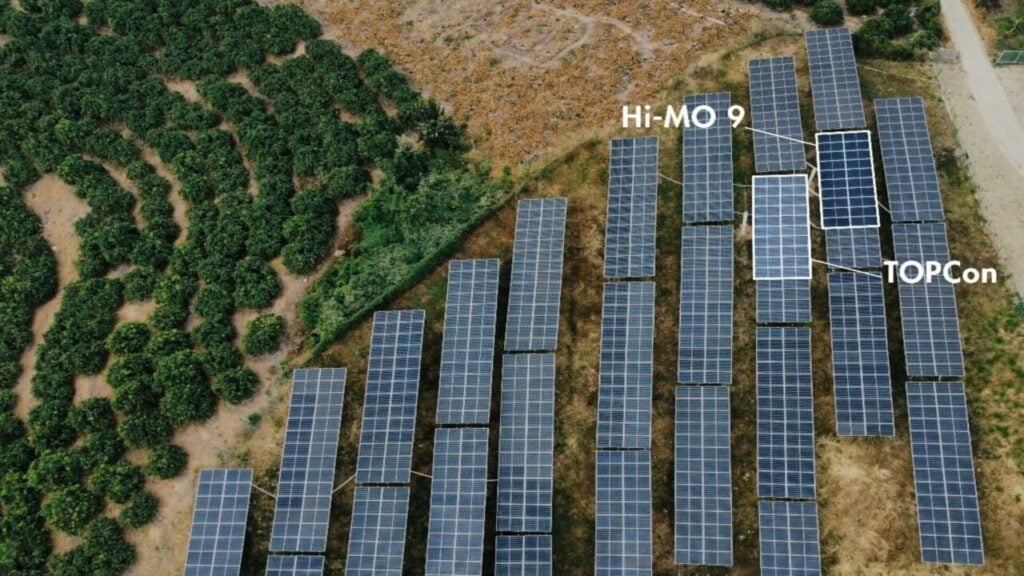
Hi-MO 9 Prime is designed around that principle. It is our next-generation utility module platform based on HPBC 2.0 technology, developed for projects where every watt, every year and every risk matter. It reaches up to 680W and 25.2% module efficiency, and it keeps the proven 2382 × 1134 mm utility form factor, so it fits into established utility designs Under the same module dimensions, it delivers 10Wp more power than
standard TOPCon modules. But the real benefit is broader: higher energy generation, lower BOS cost and enhanced long-term reliability.
The module is especially relevant for high-value utility projects facing land constraints and higher ground coverage ratios. In our modelling of a 10-hectare UK Midlands project at 50% ground coverage ratio, Hi-MO 9 Prime delivers 12.56 MW on the same plot, compared with 12.00 MW for mainstream non-BC modules. That is a 4.62% capacity gain, or roughly 648 MWh of additional annual yield. Its highly parallel BC cell structure reduces power loss by more than 70% when a single cell is shaded, keeping output stable under row-to-row shading, dust or fallen leaves. It is engineered for the medium- and low-albedo conditions that increasingly define European utility development.
For us, the message is simple: customers should evaluate the whole-life economics of the plant. A technology decision must be measured by its contribution to stable, predictable revenue over 30 years, not solely by the price per watt on the day of purchase.
LONGi has recently introduced ACM and the “Technology Forest.” How do these developments strengthen your utility offer?
Leon Zhang: The “Technology Forest” expresses an important belief at LONGi: meaningful innovation does not come from a single breakthrough in isolation. It comes from a connected ecosystem of technologies that improve performance, reliability, manufacturing efficiency and system intelligence together.
This ecosystem includes ACM—Advanced Contact Matrix, integrated conductive backsheet technology, shingled-cell technology, hidden busbar technology, temperature-controlled alloy interconnection, smart-module capability, LONGi One OS and Three-Proof Pro module solutions. Each innovation has value on its own; together, they create a stronger platform for utility-scale asset performance.
ACM is a particularly significant milestone because it shows our ability to convert advanced innovation into industrial scale. LONGi has commenced mass production of ACM solar cells, with 20+ GW of large-scale production initiated at our Xixian manufacturing base. The ACM cell has achieved a certified efficiency of 27.6%, while the related module has reached a certified output of 670 W.
Importantly, ACM uses patented nano-alloy materials to replace silver paste and is compatible with back-contact technology. It can improve mass-production cell conversion efficiency by 0.2–0.3 percentage points. This is not innovation for publicity; it is innovation aimed at improving the economics and resilience of the next generation of solar assets.
Storage is now central to LONGi’s European growth plans. What is the LONGi ONE strategy, and how will the 2815 plan translate into value for customers?
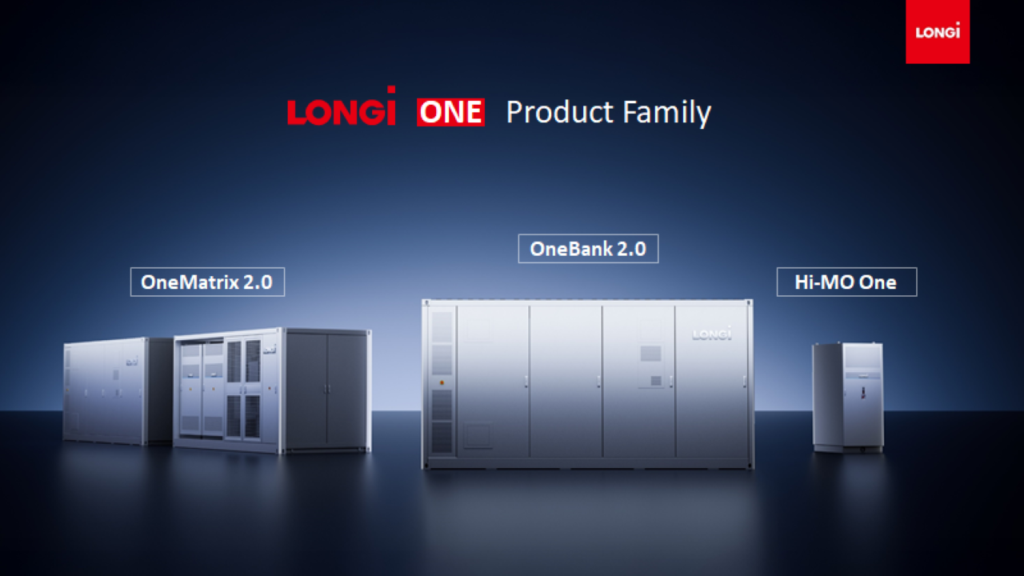
Leon Zhang: LONGi ONE is our integrated solar-plus-storage strategy. It is built on the understanding that customers increasingly need a system that performs as one, not separate components that must be made to work together after procurement.
For utility customers, this means bringing PV, BESS, system-level engineering, intelligent dispatch and lifecycle support into a coordinated solution. It helps to address the operational challenges of a higher-renewables power system: capturing more value from generation, improving flexibility, managing site conditions and building projects that can respond to market and grid signals.
Our commitment is not only technological; it is organisational and local. Through our 2815 strategy, we will establish 15 Centers of Excellence across Europe by 2028. These centres will put technical expertise, service capability and customer support closer to project teams and operating assets. The opening of our first European Center of Excellence in Madrid is an important step in this direction.
For customers, localisation matters. A utility-scale project requires responsive engineering support, a clear understanding of national market requirements and confidence that the supplier will remain present throughout the asset’s life. That is how LONGi intends to grow in Europe: through performance, investment and proximity to our customers.
The penetration of renewables has massively affected the stability of the grid. The grids needs stability that can only be delivered through storage installations. But across Europe, PV assets are just not profitable or bankable; the only way we’re going forward is installing solar-plus-storage. That’s caused by the grid instability and the amount of curtailment of hours at €0/MW; the only way of making a solar asset profitable is installing solar-plus-storage.
In the market we see a bunch of very brave people going with storage; we know that the grid needs it but there is no clear frame for investment in storage. All the IPPs, when they make up the financial models, need to be very creative to go to banks, get financing and move forwards.
Not all the IPPs are getting financing because it’s not easy to build a solid and consistent financial model with a revenue scheme. For example in the UK there are several frequency markets and ancillary markets but the reality is that across Europe, there is not as much clarity as we used to have in solar.
Co-location is a strategic point, not only for LONGi as a supplier but for Europe. Right now, it’s very difficult to make PV asset bankable of you don’t install storage, so it’s the only way going forward, to keep the industry steady and a to keep the industry growing. Sonia Dunlop was saying that next year we might go back to double-digit growth [in solar deployments] and that tis the only way to achieve that. We’re facing issues with bankability, issues with financing and issues with growing our industry.
LONGi has partnered with FC Bayern Munich. What is the strategic message behind the partnership?
Leon Zhang: The partnership with FC Bayern Munich is much more than a sponsorship. It brings together two organisations that believe in excellence, resilience, continuous improvement and the conviction that achievement is never the finish line. Those values strongly align with LONGi’s approach to renewable energy.
Under the theme “POWER ON, GAME ON,” we want to make clean energy more visible, relatable and trusted bringing the energy transition closer to businesses, households and communities. FC Bayern has an exceptional ability to connect with people across Europe and around the world. Together, we can help show that solar and storage are not distant technical concepts; they are practical, powerful tools for a more secure, competitive and sustainable future.
For LONGi, the partnership also reflects our long-term commitment to Europe. Just as elite sport is built on teamwork, discipline and sustained performance, Europe’s energy transition requires trusted partners that can deliver consistently over time. We are proud to stand alongside a club with such a strong European heritage as we help accelerate the transition to a cleaner energy system.
Bankability is decisive for developers, lenders and investors. Why should the European market have confidence in LONGi as a long-term partner?
Leon Zhang: Bankability is earned through consistency. It is a combination of technology leadership, manufacturing scale, financial discipline, reliable delivery, sustainability performance and the confidence to invest for the long term.
Our external recognition reflects that foundation. LONGi received PV Tech’s highest AAA Bankability Rating for the 26th consecutive quarter in Q2 2026. We have also been named a Tier 1 global energy storage manufacturer by BloombergNEF for the ninth consecutive time and were recognised for the second consecutive year on the S&P Global Energy Tier 1 Cleantech Companies list, an assessment that considers cumulative shipments, manufacturing diversification, financial health and sustainability performance. In addition, LONGi was selected for the 2026 Fortune China ESG Impact List, underscoring that long-term value must include responsible business and credible sustainability progress.
But credentials are only meaningful when they translate into confidence on the ground. That is why we are continuing to invest in Europe: in high-efficiency PV technology, integrated solar-plus-storage solutions, local engineering capability, Centers of Excellence and enduring customer partnerships. Our growing BESS project portfolio, including major agreements across the region, shows that the market already recognises LONGi as a serious, reliable participant in Europe’s next phase of renewable-energy growth.
Our message is clear: LONGi is not in Europe simply to supply products. We are here to help build the next generation of energy assets, more productive, more flexible, more bankable and more resilient. With technology leadership, proven execution and a growing local presence, we are determined to remain the leading partner European customers can rely on as the energy transition accelerates.
We have, according to our 2025 annual report, more than US$8 billion in cash and cash equivalents so we’re the only supplier that can show this kind of financial strength, and this is absolutely critical in market where many suppliers are struggling. We see bankability is absolutely critical for our customers, especially for solar-plus-storage.
It’s very rewarding to see the confidence that customers do have in LONGi. We are very proud that we see the customers’ recognition in this sense and the technological point of view; these two points are the points that define LONGi: financial strength and technology leadership.