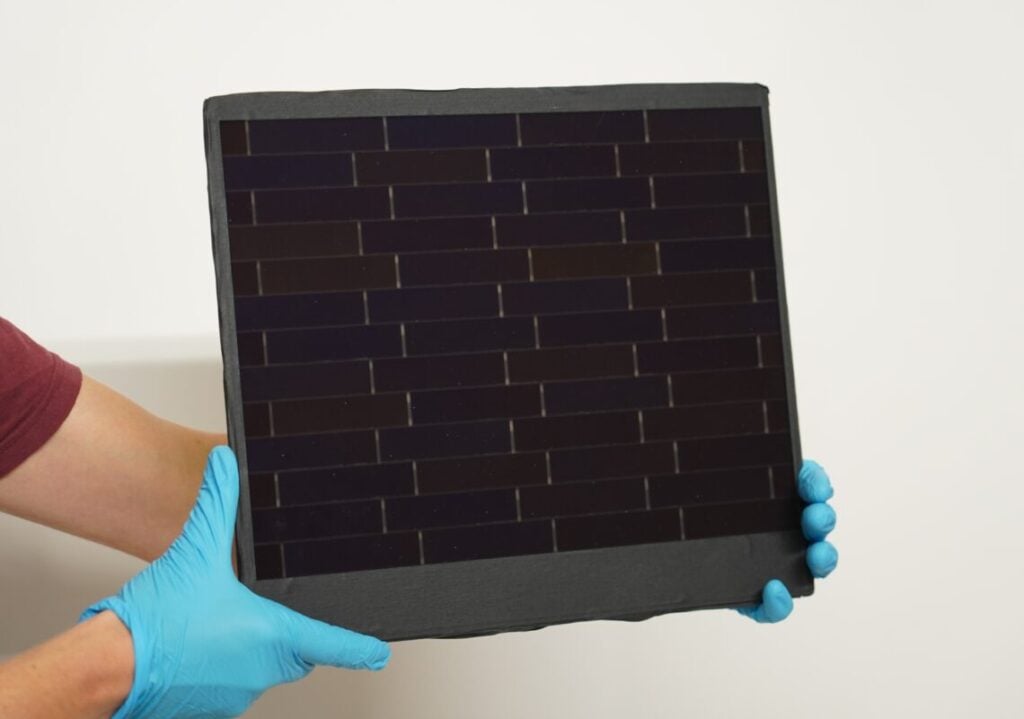
German research institute Fraunhofer Institute for Solar Energy Systems (ISE) has increased the performance of its III-V germanium solar module from 34.2% to 34.4% through an optimised cell interconnection approach.
According to the institute, this was achieved using shingle-matrix technology, which improves area utilisation and reduces shading losses by eliminating conventional cell interconnect ribbons.
Try Premium for just $1
- Full premium access for the first month at only $1
- Converts to an annual rate after 30 days unless cancelled
- Cancel anytime during the trial period
Premium Benefits
- Expert industry analysis and interviews
- Digital access to PV Tech Power journal
- Exclusive event discounts
Or get the full Premium subscription right away
Or continue reading this article for free
The shingle-matrix technology was developed in collaboration with a German mechanical engineering partner. Under the approach, solar cells are cut into narrow strips and arranged in an overlapping shingle configuration before being connected with electrically conductive adhesives. The design allows direct cell-to-cell contact and removes the need for solder-coated copper ribbons commonly used in photovoltaic modules.
According to the institute, eliminating traditional interconnects prevents active cell areas from being shaded, increasing the proportion of light-converting surface area within the module.
For the latest achievement, project coordinator Azur Space Solar Power further developed its triple-junction III-V germanium solar cells, adapting technology originally designed for space applications to operate under the terrestrial solar spectrum. The cells were manufactured on wafer formats compatible with larger-scale production, while German microstructure specialist temicon supplied the anti-reflective coatings used on the module’s front glass.
The latest result further strengthens Germany’s position in high-efficiency III-V photovoltaic research, a segment primarily associated with space and concentrator photovoltaic applications but increasingly being explored for terrestrial use.
The record-setting module builds on a previous milestone reached earlier this year when a Fraunhofer ISE research team developed an 833 square centimetre module with an efficiency of 34.2% under the “Vorfahrt” research project.
The record module will be displayed at Fraunhofer ISE’s booth (A1.440) during Intersolar Europe 2026, part of The Smarter E Europe exhibition in Munich.