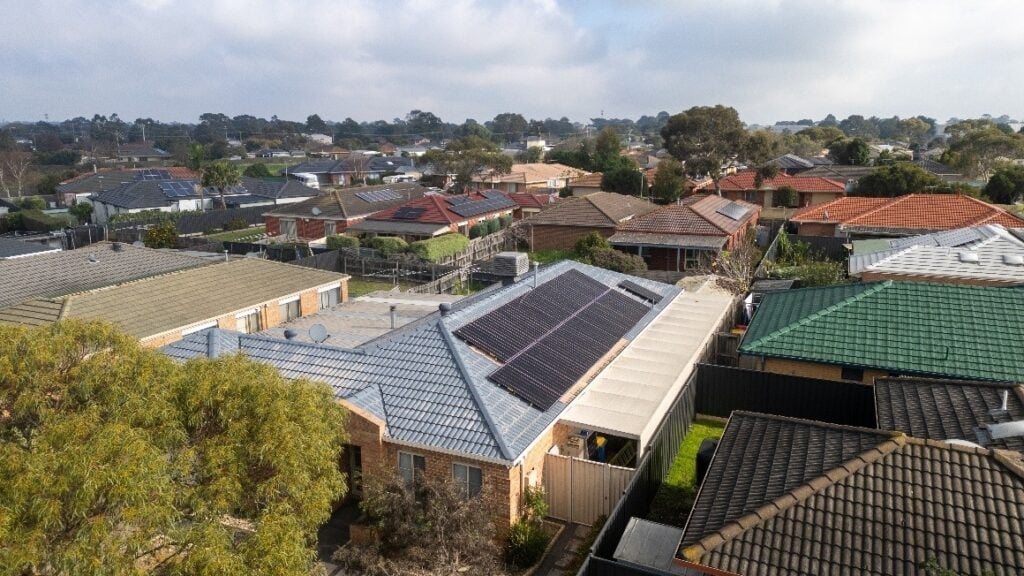
In this interview with PV Tech Premium, Edison Zhou, group director of Australia, New Zealand and Pakistan at Trinasolar Asia Pacific, along with Andrew Percival, head of utility sales, and Ryan Sequeira, head of distribution sales, Australia New Zealand, examine how government battery incentive programmes, commercial and industrial demand growth and the shift toward DC-coupled solar-plus-storage systems are reshaping the rooftop solar market across the region.
Australia’s rooftop solar market is entering a second phase.
Try Premium for just $1
- Full premium access for the first month at only $1
- Converts to an annual rate after 30 days unless cancelled
- Cancel anytime during the trial period
Premium Benefits
- Expert industry analysis and interviews
- Digital access to PV Tech Power journal
- Exclusive event discounts
Or get the full Premium subscription right away
Or continue reading this article for free
The first phase, driven by falling module prices, feed-in tariffs and the small-scale technology certificate scheme, produced one of the highest residential solar penetration rates in the world.
The second is being shaped by something different: battery energy storage systems (BESS).
The federal government’s Cheaper Home Batteries Program, launched in July 2024, has changed the calculation for households considering solar. A battery storage addition now comes with an upfront subsidy, which means the attached solar system needs to work harder, in less space, with less margin for oversized or inefficient equipment.
At the same time, the commercial and industrial segment, which has historically lagged well behind the residential market despite comparable electricity cost pressures, is beginning to accelerate.
New South Wales extended its battery storage rebate scheme in August 2026 to cover systems up to 200kW, a threshold that brings a large portion of commercial rooftops within scope for the first time.
For module manufacturers, both shifts point in the same direction: the product that worked for a standalone residential installation does not automatically work for a battery-integrated system on a constrained rooftop or a commercial building.
“The installer always cares about the size,” says Edison Zhou, group director of Australia, New Zealand and Pakistan at Trinasolar Asia Pacific.
“They don’t want to oversize the modules. Yes, they need the high-power class, but they still request the length of the module below 1.9 metres, and also they don’t want it above 33kg.”
That observation sits at the centre of a product development process Trinasolar ran in the fourth quarter of 2025, bringing its R&D team to Australia to consult directly with installers before finalising the specification of the Vertex S+ G3 515W module, which launched into the Australian market in July 2026.
The resulting module measures 1,842mm by 1,134mm, delivers 24.7% efficiency at 515W output and is built on a dedicated production line in China serving only the Australian market.
Building a product for a battery-ready rooftop
The product Trinasolar developed in response to that market shift is the Vertex S+ G3 515W module, launched in the Australian market following a research process that began in the fourth quarter of 2025, with a visit from Trinasolar’s R&D team to meet Australian installers directly.
The specification decisions that resulted from that process were specific and practical.
The same underlying platform underpins the broader Vertex S+ G3 range launched in international markets. Still, Zhou is clear that the Australian version was developed for a dedicated production line at Trinasolar’s facility in China, serving only this market.
Ryan Sequeira, head of distribution sales, Australia and New Zealand at Trinasolar Australia, describes the commercial logic from the installer’s perspective.
“Installers want to jam as much power into that storage device,” he says, noting that the module’s low-voltage design allows more modules per string, reducing cabling and labour time.
“The new generation three is going to give them all those features and benefits that they’re looking for in a small footprint panel.”
Andrew Percival, head of utility sales for Australia and New Zealand, adds a project-level dimension to that argument.
“We’re seeing a lot more DC-coupled solar farms now emerging to create a more efficient outcome,” he says, pointing to higher efficiency, lower equipment costs, better solar utilisation and reduced grid charging requirements as the commercial drivers.
“It becomes a project that has a better payback and delivers more instant financial results.”
Zhou cites a recent community solar PV power plant project by Angga Principal as an example, combining Vertex S+ G3 modules with a fixed-tilt system and Trinasolar storage in what he describes as an “all-in-one solution for the community project.”
Trinasolar has also supplied Vertex S+ modules for New South Wales’ first decentralised green hydrogen facility near Moree, developed by Hiringa Energy as part of the Good Earth Green Hydrogen and Ammonia (GEGHA) production project.
New Zealand: from drought crisis to solar boom
New Zealand is a different market at a different stage, but the growth trajectory is accelerating.
Trinasolar has been active there since approximately 2010. Zhou says the company delivered around 200MW of modules to New Zealand over the past two years, primarily for utility-scale agricultural solar PV power plants of 30-40MW each.
The residential side has been driven in part by demand for all-black panels, a product preference that Zhou attributes to the national identity associated with the All Blacks.
The context behind that acceleration is well documented. The 2024 energy crisis, triggered by low hydro storage during a prolonged drought, pushed wholesale electricity prices sharply higher and sharpened the commercial case for solar across the country. Zhou adds a structural dimension that goes beyond the crisis itself.
“New Zealand has already reached around 92% of renewable energy. Mainly, it’s hydropower, and it is mainly in the South Island. But most of the commercial and also most of the people live in the North Island. That’s why during the past two years we have seen so many solar PV plants happen.”
New Zealand also became the location for what Trinasolar described as the first commercial order for a perovskite-silicon tandem solar module, signed in June 2026.
For Zhou, the order is consistent with a strategic positioning that runs through the company’s approach to both Australia and New Zealand.
“We always bring our latest technology to the Australian and New Zealand market,” he says. “We are very proud of this.”
A crowded market and what trust buys you
Percival frames the competitive dynamic across both markets around a factor that does not appear on a spec sheet.
“It’s a very crowded market,” he says. “And when you have a crowded market, there needs to be a value-added proposition.”
That proposition, in Percival’s view, is built on years of local presence, delivered projects and an understanding of what customers actually need.
“You get to build a certain amount of trust, but you also learn about what’s important to the customer.”
He specifically points to how understanding of long-term PPA offtake agreements has informed product development.
“Some of the things that we’ve understood in recent times are just how important a PPA offtake agreement is for large-scale projects, and that has been brought into the thinking when it comes to the development of the innovation of Trina’s products.”
Higher bifacial gain from the TOPCon technology, he argues, improves generation across the full solar curve, particularly in low-irradiance conditions at the beginning and end of the day.
“The developer is really reaping the rewards.”
The New Zealand market, Percival notes, operates without the subsidy frameworks that have driven Australian residential growth.
“You don’t need the subsidies in New Zealand. They don’t have them anyway, and we simply are bouncing off the trust and support we have from all our customers over there.”
Trinasolar’s broader APAC strategy sits within what Zhou describes as a dual mandate of globalisation and localisation.
“Globalisation means we have the global manufacturing capability to provide affordable products to the market,” Zhou says. “And localisation-wise, we always build a local team in each country.”
He is cautious about drawing direct comparisons with Japan, Korea and Southeast Asian markets, noting their complexity, but describes Southeast Asia as an emerging market with strong demand growth driven by economic expansion.
“There is more and more demand for electricity, especially for renewable energy.”
For Australia and New Zealand, the positioning is different.
“I do believe that Australia is the pioneer market for renewable energy,” Zhou says. The 30-year performance warranty that Trinasolar offers is, in his framing, both a commercial commitment and a statement about where the company expects to be.
“We are very proud to prove to ourselves that we can serve our customers for 30 years, and we will continue to serve new customers for the next 30 years.”