
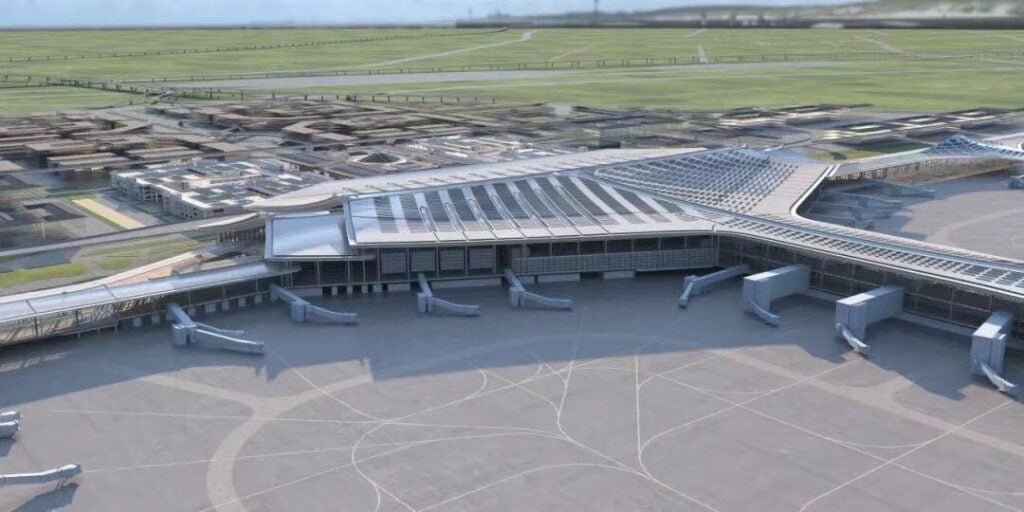
JinkoSolar has announced the deployment of 40MW of its best-selling Tiger Neo series anti-glare modules at Taiyuan Wusu zero-carbon airport, marking China’s first benchmark project in civil aviation to implement comprehensive green and low-carbon construction across energy, architecture and facilities throughout the entire lifecycle.
In an airfield zone, controlling module glare is critical. The Tiger Neo modules apply specialized anti-reflective coatings and texturing to reduce glare and reflectivity and are deployed in light-sensitive areas including both sides of the aircraft runway. The product has passed TÜV Rheinland’s ISO 9050:2003 standard testing and comprehensive reliability verification, backed by a 30-year power warranty.
The anti-glare modules deliver exceptional mechanical load and weather resistance, withstanding airflow impacts and jet blasts from aircraft takeoffs and landings, operating across temperatures ranging from -40°C to 85°C, and maintaining structural integrity and operational reliability during extreme weather conditions including torrential rain, heavy snow and strong winds.
The integrated project leverages renewable energy technologies including photovoltaics, medium-to-deep geothermal energy, cross-seasonal thermal storage and vehicle-to-grid interaction. It is supported by multi-form energy storage, building-integrated photovoltaic-storage-direct-flexible systems, efficient green power consumption and smart energy management. Upon full completion, the project is forecast to generate an average annual electricity output of 120 million kWh, reducing annual carbon dioxide emissions by approximately 120,000 tons.