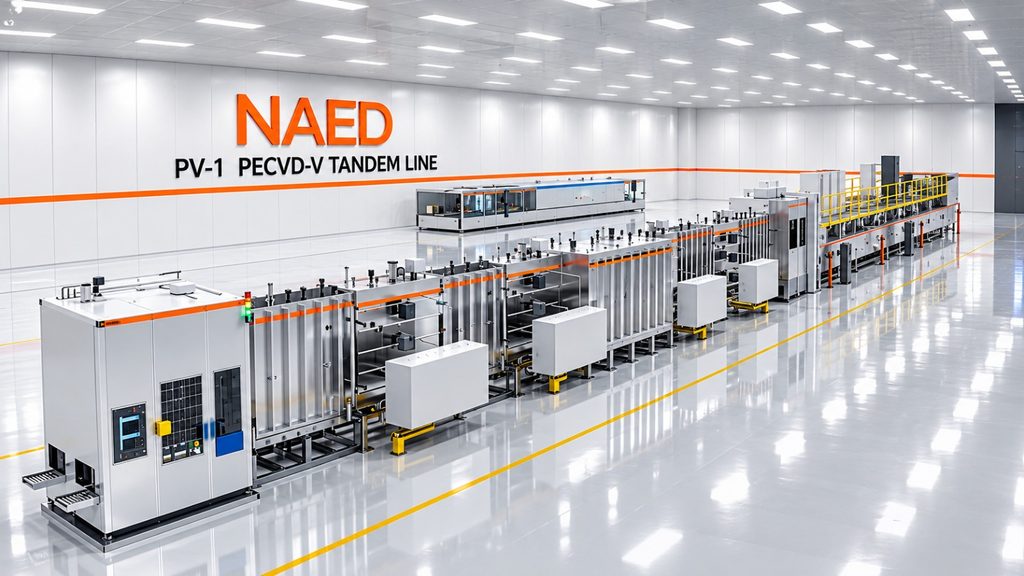
US aerospace and engineering company NAED Energy has unveiled PV-1 PECVD-V, a vertical in-line deposition platform designed for high-volume tandem solar cell production.
The Miami-based company said the tool combines plasma-enhanced chemical vapour deposition (PECVD) and physical vapour deposition (PVD) on a single shared-carrier line, with a rated throughput of 96,000 wafers per hour.
Try Premium for just $1
- Full premium access for the first month at only $1
- Converts to an annual rate after 30 days unless cancelled
- Cancel anytime during the trial period
Premium Benefits
- Expert industry analysis and interviews
- Digital access to PV Tech Power journal
- Exclusive event discounts
Or get the full Premium subscription right away
Or continue reading this article for free
NAED said the tool is purpose-built to produce its ‘T2X’ two-terminal perovskite/heterojunction (HJT) tandem cell, which targets 30% cell efficiency. NAED said it intends to deploy T2X cells into both terrestrial and space solar markets, supported by a line-up of glass-glass T2X modules starting at 600W.
A key feature of the platform is that wafers remain upright on a shared carrier throughout every processing stage. Rather than flipping substrates to reach the second side, the entire carrier is lifted and rotated 180 degrees as a unit, reducing direct wafer handling between steps. The claimed wafer throughput doubles that of NAED’s previous XL-class platform, the company said.
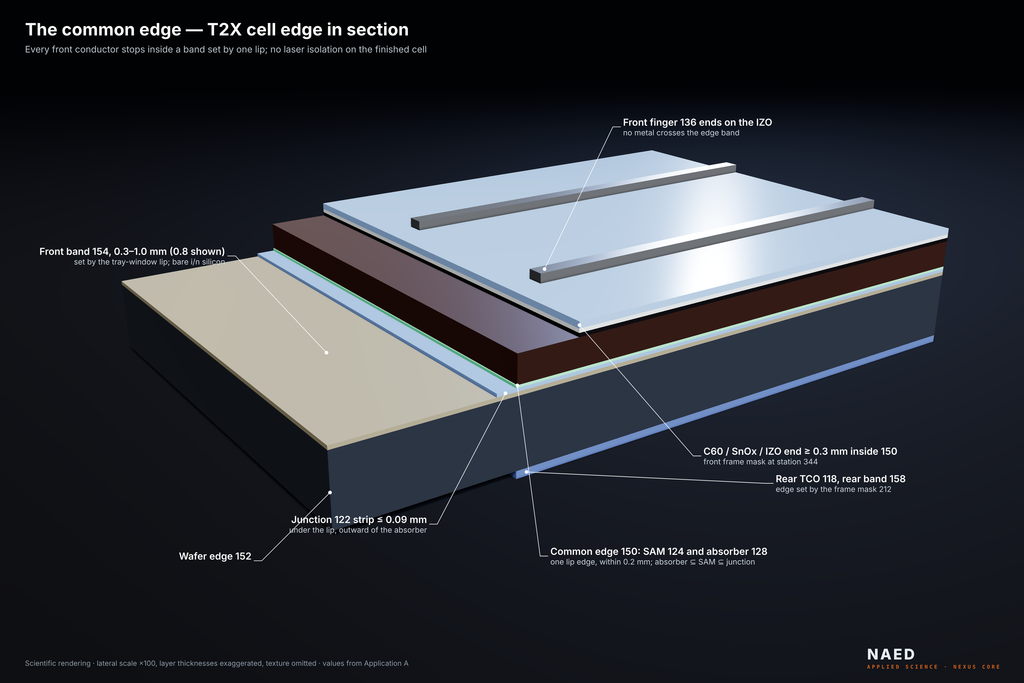
NAED highlighted that its PV-1 tool is designed in-house and machined in NAED’s own aerospace-grade CNC shop in the US, underscoring the company’s domestic manufacturing credentials at a time when supply chain sovereignty is a growing priority across the solar industry.
“Going vertical let us double throughput and build the line around tandem cells from day one, rather than retrofitting tandem onto a platform designed for something else,” said Malcom Longair, media and development lead at NAED Energy Holding Inc.
Six of PV-1’s 13 process tools are complete, with the remaining seven in production. Engineering and design for the full line and its production facility are finished. The PV-1 production line, its 180-degree carrier mechanism, wafer-retention carrier and the T2X cell are all subjects of pending US patent applications.
NAED is now opening reservations for PV-1 production tool slots to manufacturers in the US and internationally via NAED.energy.
Despite the rapid expansion of module and, more recently, cell manufacturing capacity on US soil, domestically made upstream PV production equipment remains a relative rarity.
In a recent interview with PV Tech, Markus Beck, a former Department of Energy official and now an advisor on setting up PV manufacturing lines for RCT Solutions, said America’s dearth of homegrown expertise in PV technology R&D and equipment production undermined the long-term sustainability of its current PV manufacturing gold rush.
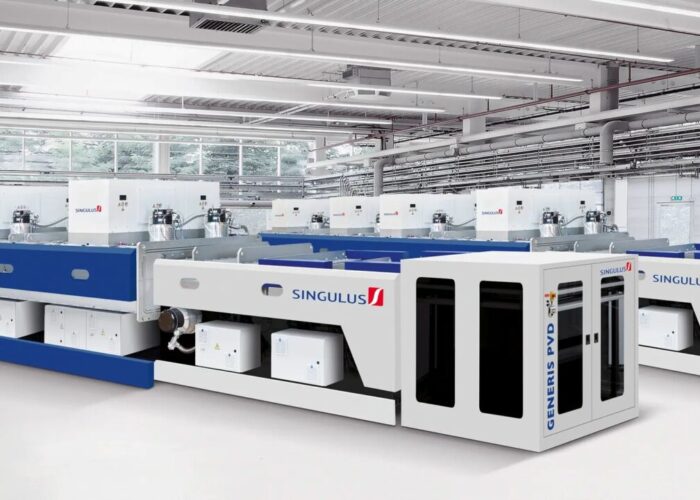
Yesterday, Elon Musk’s SpaceX company announced an order of HJT production equipment from Germany-based Singulus Technologies, underscoring America’s ongoing reliance on imported tooling.