‘Solar Module Super League’ (SMSL) member Q CELLS has become the first PV manufacturer to pass TÜV Rheinland’s new ‘Quality Controlled PV’ certification that equates to an extended stress test program based on IEC TS 63209.
Q CELLS said that TÜV Rheinland’s Quality Controlled PV certification would become its official certification standard for all its next generation of PV panels. This would start with its latest range of Q.PEAK DUO-G9+ panels.
Try Premium for just $1
- Full premium access for the first month at only $1
- Converts to an annual rate after 30 days unless cancelled
- Cancel anytime during the trial period
Premium Benefits
- Expert industry analysis and interviews
- Digital access to PV Tech Power journal
- Exclusive event discounts
Or get the full Premium subscription right away
Or continue reading this article for free
Dr. Nicole Nelles, head of Q CELLS Global Quality Management, stated: “Q CELLS has worked very closely with TÜV Rheinland to not only set the testing standards ever higher, but also shape completely new testing schemes that reflect the industry’s experience in order to exclude known failure modes. The independent TÜV Rheinland representative’s continuous surveillance, as well as the regular material inspections, turn this program into something unique in the industry.”
Lukas Jakisch, business field manager for PV modules at TÜV Rheinland added, “TÜV Rheinland’s surveillance of a manufacturer’s production process – where we perform tests on samples taken at random every month – seeks to identify a consistent level of oversight, with a special focus on reliability and material properties as well as supplier change control.”
Testing procedures
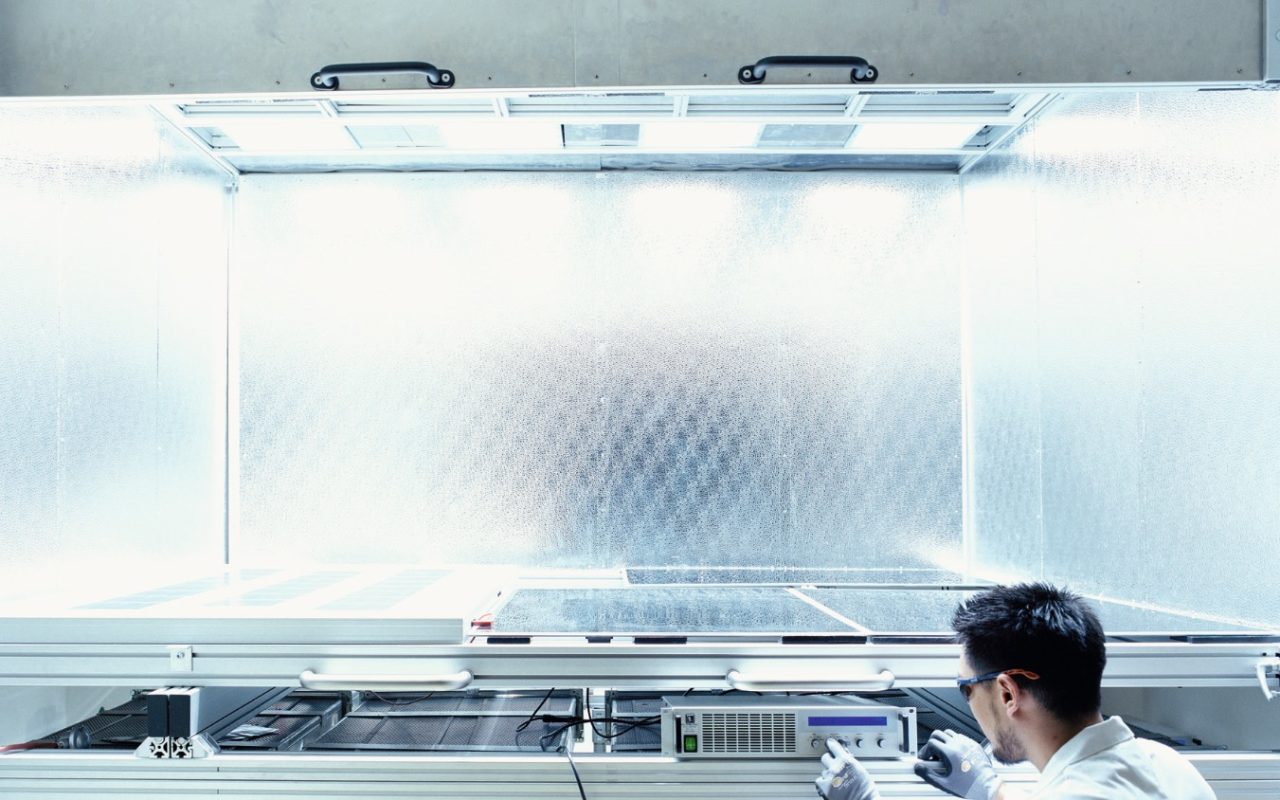
The Quality Controlled PV certification has three major steps, starting with the ‘Component’ qualification test. This is designed to assess long-term product reliability by applying testing durations that are up to three-times longer than standard IEC and UL tests, including 2,000 hours damp heat (DH) testing, compared with 600 thermal cycles typically used.
Durability tests are also included in the component testing regime that covers failure modes not included in standard IEC certification, including PV module backsheet weathering durability as well as the long-term stability of solder bonds.
Further component testing measures include an extended stress test for mechanical load, Potential Induced Degradation (PID), Light and Elevated Temperature Induced Degradation (LeTID) and UV light resistance of the backsheet material.
TÜV Rheinland has also included onsite manufacturing facility sampling, selecting module samples during production runs for full testing as part of the process steps for certification. TÜV Rheinland controls the sampling process.
The third and final component is regular monitoring of the materials and suppliers used by PV module manufacturers products seeking certification while in volume production. Again, TÜV Rheinland experts monitor supplier audits, and material footprint analysis of materials regularly used, both a monthly and a more regular basis if required.
Both TÜV Rheinland and Q CELLS said they were convinced that this material inspection component should become standardised across the PV industry.
Q CELLS also noted that an unspecified number of additional test programs are being developed with TÜV Rheinland to further improve solar panel quality control. The in-house testing procedures are also being organised via Q CELLS’ Technology and R&D headquarters in Thalheim, Germany. Both companies intend to keep the testing program dynamic and regularly updated as and when new testing standards gain approvals
Dr. Nelles added, “We continue to conduct and develop a number of additional test programs in parallel – each designed to deliver and ensure improvements in solar module quality. The aim is to integrate them into the Quality Controlled PV program so that it is continuously evolving with the times. We have set the industry standard, and we want to maintain that standard moving forward.”
PV Tech is teaming with Q CELLS and TÜV Rheinland to broadcast a PV Tech TechTalk series webinar, specifically covering the introduction of the Quality Controlled PV certification.
The TechTalk webinar, entitled “Raising the bar for PV module quality and efficiency with Q CELLS and TÜV Rheinland” will take place on Tuesday, January 19th 2021 – 2:00 PM (GMT)
Guest speakers include, Christian Taubitz, technical expert in the R&D and Technology Department at Q CELLS and Daniel Felsch-Kruse, head of Global QM – Customer Management and Final Goods at Q CELLS. TÜV Rheinland is being represented by Lukas Jakisch, global coordinator of Technical Issues – PV modules at TÜV Rheinland.
Free registration and further details can be found here.