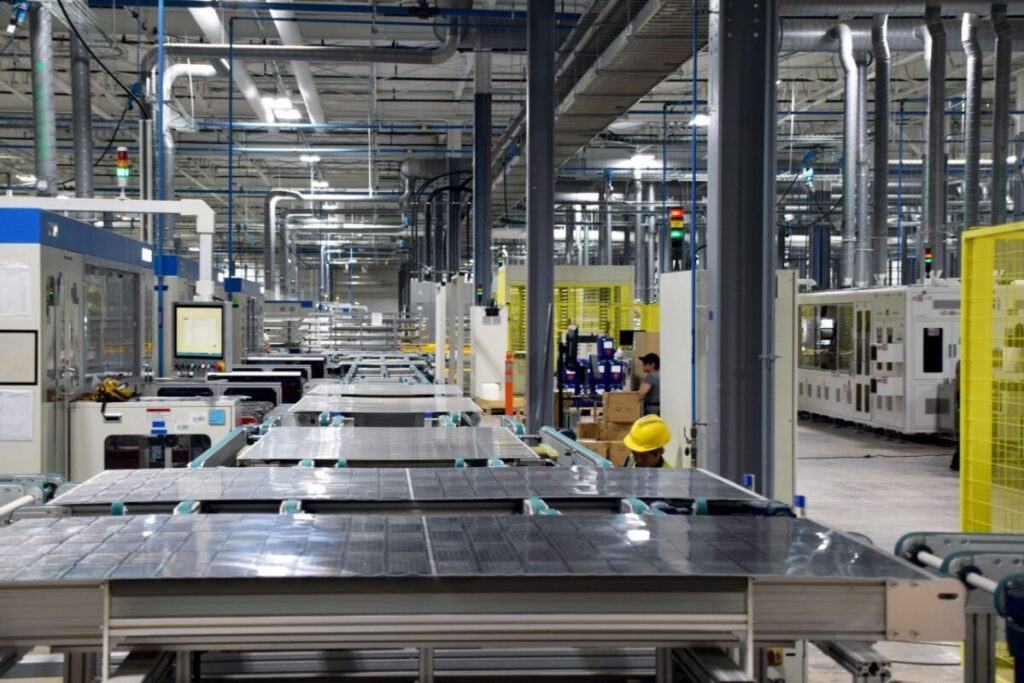
CSI Solar, the PV manufacturing subsidiary of Canadian Solar, has posted massively decreased profits in Q1 2025 amid what it described as “high trade barriers” and “severe supply-demand imbalances”.
The company posted a 91.83% decrease in net profits in Q1 2025 compared with the same period in 2024, a fall from RMB578.7 million (US$79.5 million) in 2024 to RMB47.2 million (US$6.4 million) in 2025.
Try Premium for just $1
- Full premium access for the first month at only $1
- Converts to an annual rate after 30 days unless cancelled
- Cancel anytime during the trial period
Premium Benefits
- Expert industry analysis and interviews
- Digital access to PV Tech Power journal
- Exclusive event discounts
Or get the full Premium subscription right away
Or continue reading this article for free
Basic earnings per share decreased by 93.75% from RMB0.16/share to RMB0.1/share. Overall operating revenues also declined by 10.5% to around RMB8.6 billion (US$1.1 billion) from around RMB9.6 billion (US$1.3 billion).
Though it remained profitable, CSI Solar’s Q1 results follow the trend of other major China-based solar manufacturers over the opening three months of 2025. Market leader JinkoSolar posted net losses of US$181 million in Q1 2025, and all of the major players have been affected by low module selling prices and overcapacity up the supply chain, which has squeezed their margins hard.
In its shareholder information attached to the financial report, Canadian Solar said: “The solar industry is currently facing significant challenges”, and cited “severe supply-demand imbalances leading to intense price competition [and] escalating geopolitical tensions, compounding with high trade barriers and other factors”, for the “considerable operational and financial pressures” affecting solar manufacturers.
Notably, the company said that US president Donald Trump’s “reciprocal” tariffs, which ultimately descended into an emerging trade war with China, knocked roughly RMB550 million (US$75 million) off CSI Solar’s pre-tax profits in Q1 2025.
‘Relocation of certain manufacturing’
In response to trade tensions and Trump’s current 145% tariff rate on Chinese goods, Canadian Solar laid out measures it is taking to “explore new pathways” for its manfuacturing subsidiary.
Most notable is the plan to “accelerate relocation of certain manufacturing and procurement processes to low-tariff regions [to] optimise [the] global manufacturing plan.”
This could speak to a broader impact of the US-China trade war on global PV manufacturing: the potential emergence of new manufacturing hubs for the major Chinese players. Until now, Southeast Asian countries have hosted satellite manufacturing capacity for major Chinese companies, predominantly shipping products to the US.
Canadian Solar also said it would make the most of Trump’s 90-day pause on his tariffs on non-Chinese countries to “maximise existing supply chain capacities in Southeast Asia and other regions.”
CSI Solar’s Southeast Asian manufacturing bases were not included in the US Department of Commerce’s recent antidumping and countervailing duty (AD/CVD) tariff announcement on solar cells from four countries in the region, though the company was previously embroiled in AD/CVD tariff investigations on PV modules. Read more on that here.
Moreover, the company said it would lean into its existing manufacturing capacity in the US. It said it had “first mover and scale advantages” in the US solar module, cell and battery manufacturing market and would use these “to ensure and expedite US factories’ stable output, and ensure continuous, localised product delivery for customers.”
Canadian Solar has a 5GW tunnel oxide passivated contact (TOPCon) module assembly plant operational in Texas and announced plans for a 5GW solar cell production facility in Jeffersonville, Indiana in 2023. At the time, the company said it expects the cell facility to begin producing by the end of 2025.
Recurrent Energy bags US$415 million
Canadian Solar’s solar project development subsidiary, Recurrent Energy, has also secured US$415 million in corporate debt financing to support its transition from a develop-to-sell business to an independent power producer (IPP) model, which aims to develop and own its own PV projects.
The financing was backed by four major banks — Banco Santander, Rabobank, Intesa Sanpaolo and Morgan Stanley — and includes an “accordion feature” that allows it to be increased.
The financing offers disbursements in USD, GBP, EUR and AUD, which Recurrent Energy said “strengthens” its “financial agility, enabling it to pursue strategic opportunities and accelerate the deployment of clean energy projects worldwide.” The company recently inked a construction contract for a 171MW PV project in the Australian state of Victoria which it expects to reach commercial operations by the end of 2026.
This article was amended to clarify more distinctly between CSI Solar and Canadian Solar.