Yingli Green’s solar panel shipments and revenue plummet in 2018

May 1, 2019
Facebook
Twitter
LinkedIn
Reddit
Email
PV module shipments declined from 2,953MW in 2017 to 1,731MW in 2018, a fall of almost 40%, year-on-year.

Debt-laden and technically bankrupt PV module manufacturer, Yingli Green Energy has reported a major decline in its PV panel shipments and revenue in 2018, due to the ‘China 531 New Deal’ that impacted demand for its products. 

With sales primarily dependent on China-based customers, due to severe financial constraints and lack of bankability, Yingli Green was significantly impacted by the decline in utility-scale and Distributed Generation projects in the second half of the year. 

This article requires Premium SubscriptionBasic (FREE) Subscription

Try Premium for just $1

  • Full premium access for the first month at only $1
  • Converts to an annual rate after 30 days unless cancelled
  • Cancel anytime during the trial period

Premium Benefits

  • Expert industry analysis and interviews
  • Digital access to PV Tech Power journal
  • Exclusive event discounts

Or get the full Premium subscription right away

Or continue reading this article for free

The company report 2018 full-year revenue of US$ 648.1 million, down from US$ 1.28 billion in 2017, a 49% year-on-year decline.
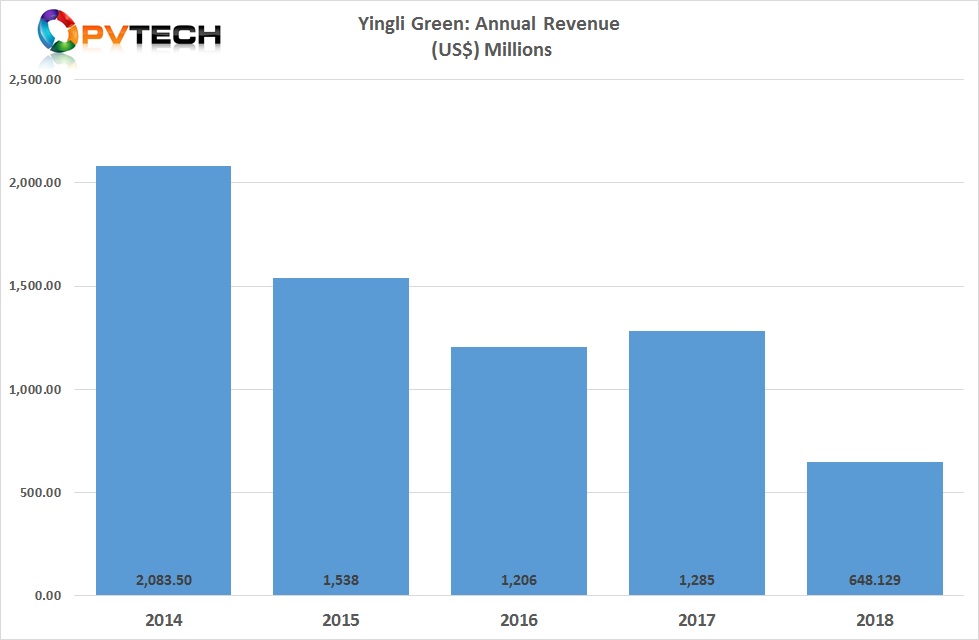
Yingli Green reported 2018 full-year revenue of US$ 648.1 million, down from US$ 1.28 billion in 2017, a 49% year-on-year decline.

This was due to PV module shipments declining from 2,953MW in 2017 to 1,731MW in 2018, a fall of almost 40%, year-on-year. 
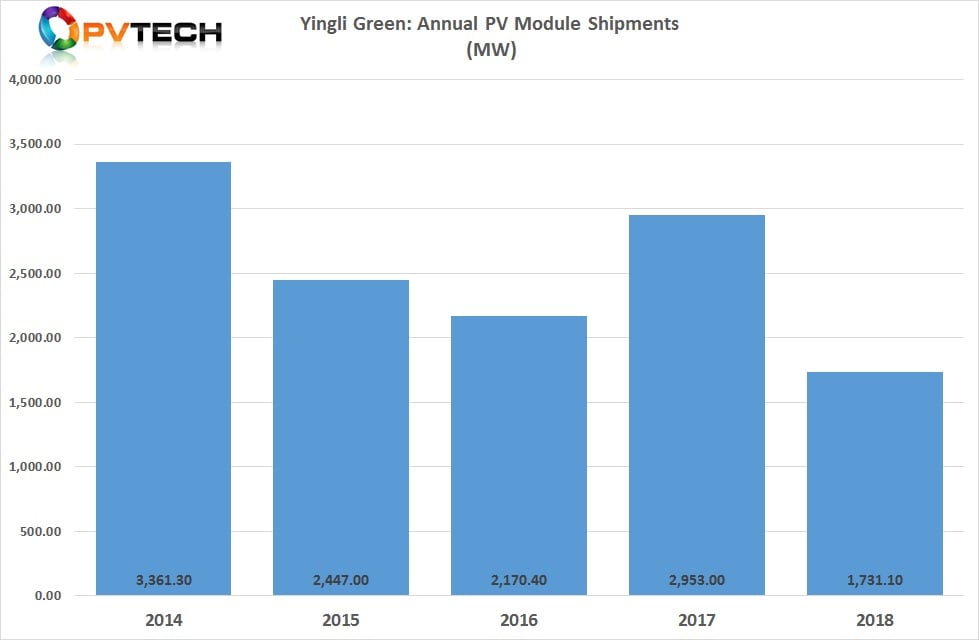
PV module shipments fell almost 40%, year-on-year.

Adding to the many financial problems was the impact of PV module ASP declines, due to overcapacity in the China market, post the 531 New Deal. 

Yingli Green reported a net loss for 2018 of US$ 240.6 million, compared to a net loss of US$530.3 million in 2017. In 2018, gross profit margin decreased to a negative 6.2%.
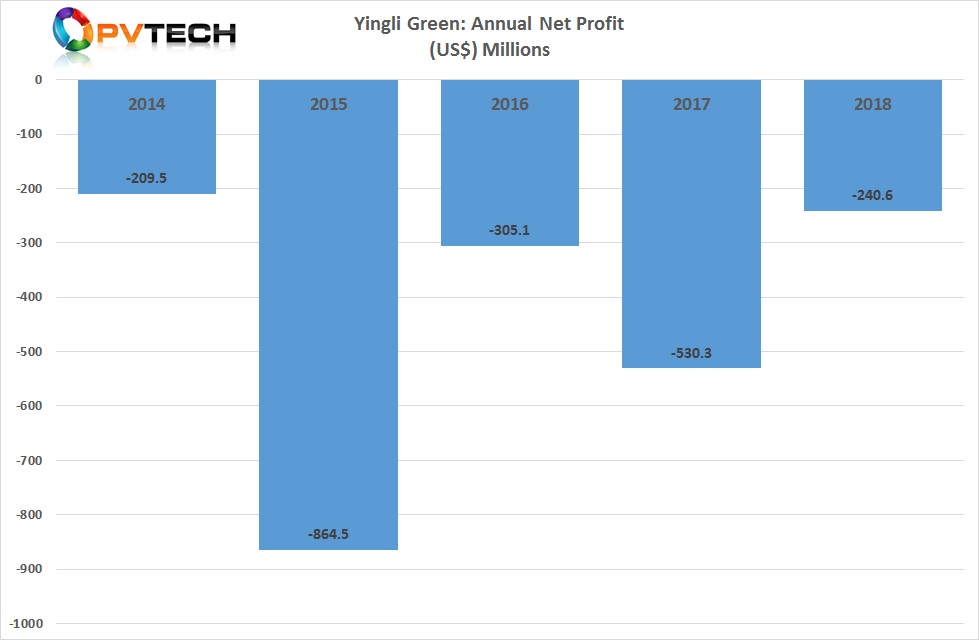
Yingli Green reported a net loss for 2018 of US$ 240.6 million in 2018.

The Total deficit attributable to shareholders of Yingli Green Energy amounted to US$ 1.9 billion in 2018, while its deficit in working capital amounted to US$1.7 billion.

The company has defaulted on an unspecified number of short-term bank loans and continues to be in default of mid-term notes (MTN’s) since 2016.

The company has implemented significant workforce reductions since 2015, when liquidity issues increased and demand for its PV modules declined.  The workforce reductions have been primarily made in manufacturing as the company closed production lines as well as in overseas sales and marketing functions as greater dependence on sales in China developed. 
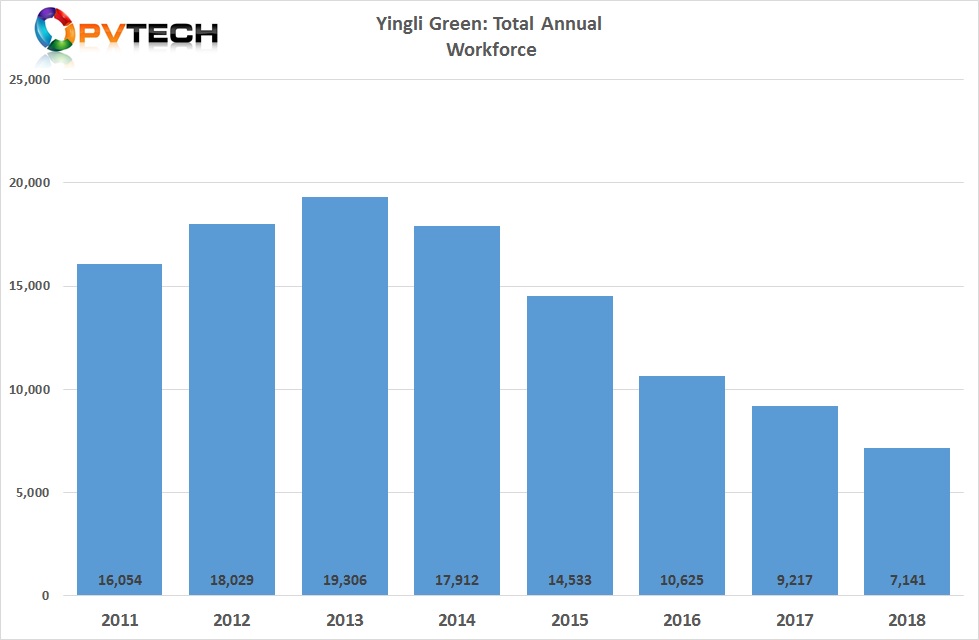
Yingli Green's workforce stood at 7,141 at the end of 2018, down from a peak of 19,306 in 2013.

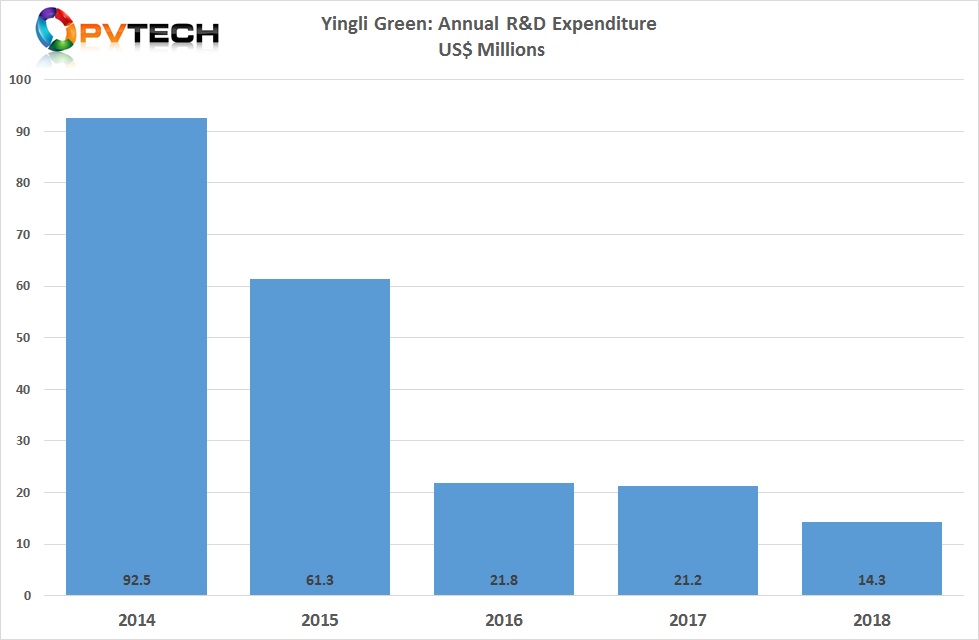
Cost reductions also impacted R&D spending, which declined to US$ 14.3 million in 2018, the fourth consecutive year of spending declines. 

Cost reductions also impacted R&D spending, which declined to US$ 14.3 million in 2018, the fourth consecutive year of spending declines.
Yingli Green’s 2018 annual financial report comes with a ‘going concern’ warning as with previous reports. However, current downstream demand in China continues to underperform from the previous year, adding to Yingli Green’s financial problems.

16 June 2026
Napa, USA
PV Tech has been running PV ModuleTech Conferences since 2017. PV ModuleTech USA, on 16-17 June 2026, will be our fifth PV ModulelTech conference dedicated to the U.S. utility scale solar sector. The event will gather the key stakeholders from solar developers, solar asset owners and investors, PV manufacturing, policy-making and and all interested downstream channels and third-party entities. The goal is simple: to map out the PV module supply channels to the U.S. out to 2028 and beyond.
13 October 2026
San Francisco Bay Area, USA
PV Tech has been running an annual PV CellTech Conference since 2016. PV CellTech USA, on 13-14 October 2026 is our third PV CellTech conference dedicated to the U.S. manufacturing sector. The events in 2023, 2024 and 2025 were a sell out success and 2026 will once again gather the key stakeholders from PV manufacturing, equipment/materials, policy-making and strategy, capital equipment investment and all interested downstream channels and third-party entities. The goal is simple: to map out PV manufacturing in the U.S. out to 2030 and beyond.

Read Next

May 8, 2026
Despite softening demand momentum, premium solar module prices across Europe continued to rise in April.
May 8, 2026
The company has formally terminated its originally planned 15GW ingot pulling and PV cell manufacturing project, redirecting its resources to the more promising lithium battery silicon-carbon anode material sector.
Premium
May 7, 2026
We spoke to Johannes Bernreuter about what Daqo New Energy's remarkable 88% sales drop in Q1 2026 means for the polysilicon industry.
May 6, 2026
A report has found measurable improvements in the performance of technologies used for recycling crystalline silicon and thin-film PV modules.
May 6, 2026
Germany's Fraunhofer ISE has opened a new lab to support the commercialisation of perovskite-silicon PV technology.
May 5, 2026
PV inverter producers are adapting their manufacturing strategies to navigate changing policy and regulations, according to PV Tech Research.

Upcoming Events

Solar Media Events
May 20, 2026
Porto, Portugal
Upcoming Webinars
May 27, 2026
9am BST / 10am CEST
Media Partners, Solar Media Events
June 3, 2026
National Exhibition and Convention Center (Shanghai)
Solar Media Events
June 16, 2026
Napa, USA
Media Partners, Solar Media Events
August 25, 2026
São Paulo, Brazil