This paper provides a concise overview of existing c-Si-based 2-, 3- and 4-terminal tandem technologies, summarizes the current development status, and sets out the future roadmap. In addition, a discussion is included of what will be required over the coming years to bring these promising technologies to market, enabling commercial efficiencies above 30%.
This paper discusses, at both the cell and the module level, the balance between the advantages and drawbacks of increasing the cell bifaciality from a typical value of 90% towards 100%, or decreasing it towards that of monofacial cells (0%).
Because it leads to higher efficiencies than aluminium back-surface field (Al-BSF) cells, passivated emitter and rear cell (PERC) technology is attracting more and more attention in the industry and gaining market share. However, PERC technology brings new challenges with regard to the phenomenon of degradation: some monofacial/bifacial PERC cell modules were found to demonstrate much higher power degradation than Al-BSF cell modules after damp-heat (DH: 85°C and 85% relative humidity RH, 1000h) and potential-induced degradation (PID: 85°C and 85% RH, –1,500V, 96h) tests, which will be the focus of this paper.
The realistic measurement of solar cells is key for the whole PV industry, as accurate information about cell power is one of the most important aspects in solar cell purchase and PV module design.
Although lithium-ion is currently the market leading battery technology in energy storage, this status cannot be guaranteed in perpetuity. Three leading figures from the lithium-ion battery industry give Andy Colthorpe their views how the technology can continue to prosper.
One of the planet’s most abundant elements, hydrogen has the capacity to be a game-changer in decarbonising the global energy system, writes Janice Lin, founder and president of the Green Hydrogen Coalition.
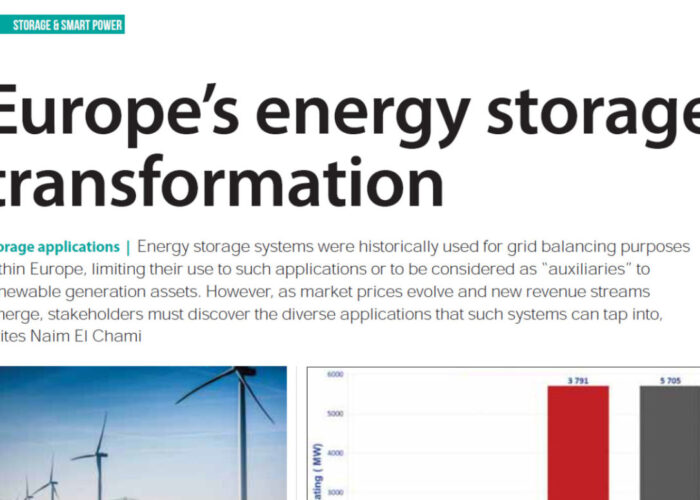
Energy storage systems were historically used for grid balancing purposes within Europe, limiting their use to such applications or to be considered as “auxiliaries” to renewable generation assets. However, as market prices evolve and new revenue streams emerge, stakeholders must discover the diverse applications that such systems can tap into, writes Naim El Chami.
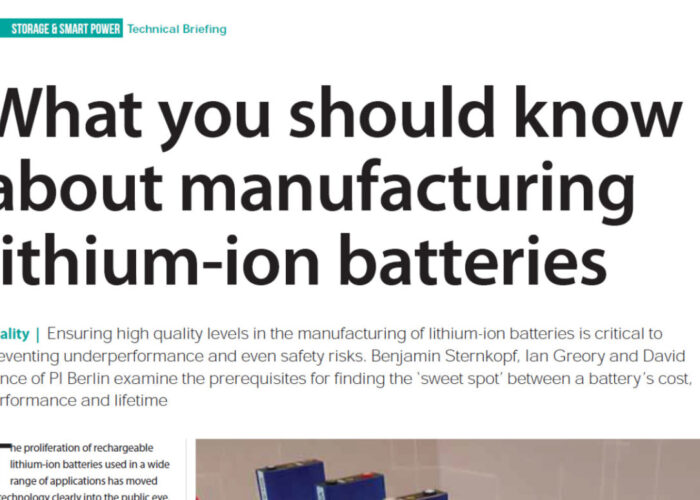
Ensuring high quality levels in the manufacturing of lithium-ion batteries is critical to preventing underperformance and even safety risks. Benjamin Sternkopf, Ian Greory and David Prince of PI Berlin examine the prerequisites for finding the ‘sweet spot’ between a battery’s cost, performance and lifetime.