On 8 July 2026, the Silicon Industry Branch of the China Nonferrous Metals Industry Association released its latest polysilicon price data, indicating continued weakness in the domestic market this week, though the decline slowed markedly.
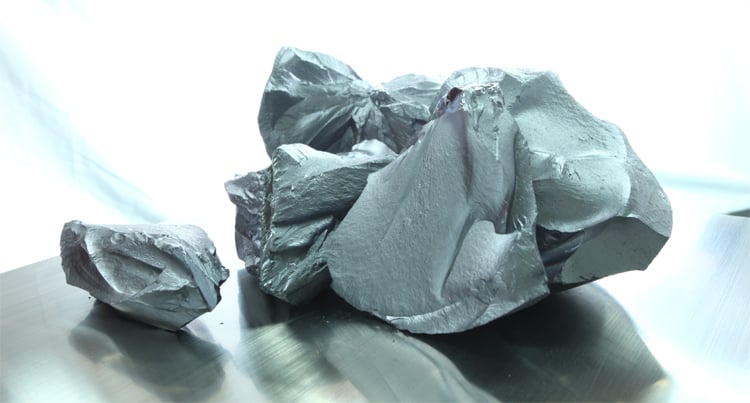
N-type recharge polysilicon traded in a range of RMB31,000-34,000/ton (US$4,560-5002.76), with an average price of RMB32,700/ton, down 0.30% week-on-week. The average transaction price for n-type granular silicon was RMB32,000/ton, down 0.93% from the previous week. No transactions were recorded for dense polysilicon.
Try Premium for just $1
- Full premium access for the first month at only $1
- Converts to an annual rate after 30 days unless cancelled
- Cancel anytime during the trial period
Premium Benefits
- Expert industry analysis and interviews
- Digital access to PV Tech Power journal
- Exclusive event discounts
Or get the full Premium subscription right away
Or continue reading this article for free
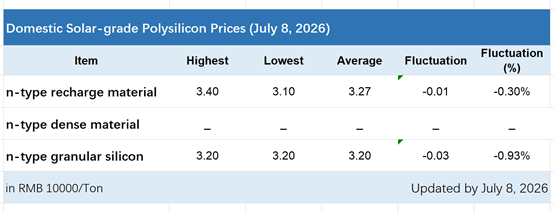
According to the association, overall trading remained sluggish. Downstream buyers placed orders only to meet immediate production needs, and just five manufacturers secured new supply contracts during the week. Market sentiment stayed subdued. To relieve growing inventory pressure, a few producers adjusted delivery and pricing strategies. These volume-driven price cuts across the sector added further downward pressure on quotes.
The slowdown in price declines reflects that current prices have largely hit the cash-cost floor for most active producers, leaving little room for further cuts.
On the supply side, 11 manufacturers are now operating, and as idled lines resume production, domestic output is expected to exceed 100,000 tons in July. Demand remains tepid, with wafer makers only marginally raising utilisation rates, translating to roughly 91,000 tons of polysilicon consumption per month. This points to a modest inventory build-up throughout the month.
Overall, there are no near-term catalysts to drive a price rebound, so the ongoing bottoming-out trend is unlikely to reverse in the immediate future.
On 27 June, China issued the mandatory national standard Unit Product Energy Consumption Limits for Polysilicon and Germanium. The standard will come into force on 1 January next year, granting companies a six-month compliance window.
The Silicon Industry Branch expects that as the new national standard takes hold, market expectations for capacity phase-out will grow. Following an extended period of inventory destocking, the polysilicon sector is poised to steadily firm its price bottom amid periodic volatility and enter a phase of price stabilisation and rebound.