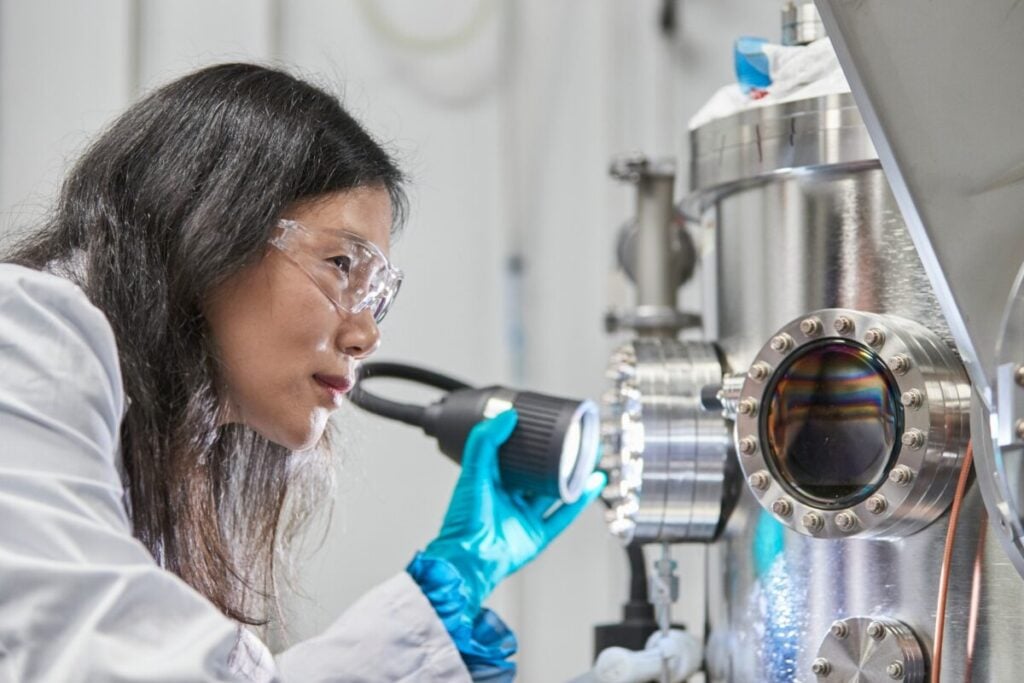
Researchers at the University of New South Wales (UNSW) have identified a manufacturing technique that reduces microscopic defects in copper zinc tin sulphide (CZTS) solar cell material, achieving record voltage performance for the technology and a certified efficiency of 12.4%.
The work, published in Nature Energy and led by Scientia Professor Xiaojing Hao at UNSW’s School of Photovoltaic and Renewable Energy Engineering, addresses a defect problem that has limited CZTS efficiency for years.
Try Premium for just $1
- Full premium access for the first month at only $1
- Converts to an annual rate after 30 days unless cancelled
- Cancel anytime during the trial period
Premium Benefits
- Expert industry analysis and interviews
- Digital access to PV Tech Power journal
- Exclusive event discounts
Or get the full Premium subscription right away
Or continue reading this article for free
Hao and colleagues, including Dr Ao Wang and Dr Kaiwen Sun, found that copper in the material tends to drift away from where it is needed during the earliest stages of the high-temperature manufacturing process, leading to unwanted impurities and structural defects at the atomic scale.
By strengthening the copper-sulphur bonding during the initial thermal reaction, the team was able to keep the material’s ingredients evenly distributed throughout the manufacturing process, substantially reducing the defects that trap photogenerated electrical charge and lower cell voltage.
CZTS, also known as kesterite, is composed of copper, zinc, tin, and sulphur, elements that are abundant and comparatively non-toxic compared with some competing thin-film semiconductor materials.
That has made it an attractive candidate for tandem solar cells, which stack two different materials to capture a broader range of the solar spectrum than silicon alone can absorb.
Unlike some rival technologies for the top layer of a tandem cell, CZTS does not rely on materials facing supply constraints or toxicity concerns, though it has historically underperformed on efficiency relative to its theoretical potential.
Hao has previously set out a staged efficiency roadmap for kesterite’s commercialisation, telling PV Tech that reaching around 20% efficiency would represent a genuine opportunity for commercial uptake, with intermediate targets of 15% and 17% needed to build confidence in the technology along the way.
She argued that the biggest hurdle for any new PV technology is ultimately cost, noting that silicon has already been through repeated cost-reduction cycles that rivals must match to compete.
Hao has also drawn a distinction between how her team has approached kesterite and how the solar industry has approached perovskite, another leading tandem-cell candidate. Where much perovskite research has pursued high efficiencies first and worked to fix stability problems afterwards, Hao has described her group’s approach as starting from the fundamental requirements of a “perfect” material, an abundant, environmentally friendly, stable compound, and building efficiency gains from that foundation.
She has said she expects silicon to remain the dominant PV technology overall, with kesterite’s clearest opportunity lying in tandem cells rather than as a standalone replacement, alongside other candidate materials including perovskites, which UNSW’s team is also researching in parallel.
Building on a decade of incremental gains
The 12.4% result builds on a longer run of UNSW research into kesterite solar cells. In January 2025, the same research group achieved a best-ever efficiency of 13.2% for high-bandgap kesterite cells by introducing hydrogen during annealing, a technique aimed at a different class of high-bandgap CZTS cells intended specifically for the top layer of tandem devices, following efficiencies that had plateaued around 11% for several years prior.
The latest work instead targets voltage performance in standard CZTS cells by controlling defects during the manufacturing process itself, rather than through post-treatment.
Hao has previously said the broader ambition is to identify what comes after silicon, which she has described as approaching the limits of its theoretical efficiency, and to find ways of generating more electricity per unit area for applications where space is limited.
The defect-control principle demonstrated in this research, according to the team, extends beyond CZTS to other multi-element semiconductor materials under development for next-generation solar applications, where similar elemental drift during fabrication can introduce comparable defects.
That positions the work as a design methodology as much as a single material result, one that the researchers suggest could apply to other tandem top-cell candidates being pursued elsewhere in the field.
The research adds to a broader programme of solar materials work at UNSW. The university has also reported identifying an atomic-scale self-repair mechanism in silicon solar cells under sunlight exposure, and separately warned that the solar industry could exhaust global silver reserves within five years without wider deployment of commercial-scale module recycling, pointing to related research into the recyclability of solar panel components.
Beyond solar materials, UNSW has also recently secured AU$6.52 million in funding from the Australian Renewable Energy Agency (ARENA) to study how inverter-based resources interact with grid protection systems, underlining the university’s position across multiple strands of Australia’s renewable energy research base.
Despite the improvement, CZTS efficiency remains well below that of commercial silicon cells, and the technology’s path to market depends on further gains before it becomes viable for tandem cell manufacturing.