Solar PV module testing challenges, the role of battery energy storage systems (BESS) and the changing procurement landscape were key topics of conversation at last week’s PV ModuleTech Europe conference.
Hosted in Málaga by PV Tech, the event brought together experts from manufacturing, procurement and research to discuss the challenges facing the European renewable energy sector, with an emphasis on solar PV modules, battery systems and inverters. One recurring theme in presentations and panel discussions throughout the two-day event was the module testing landscape and the challenges of ensuring module resilience amid the current trend of building larger, thinner modules to reduce material costs and maximise electricity generation.
Try Premium for just $1
- Full premium access for the first month at only $1
- Converts to an annual rate after 30 days unless cancelled
- Cancel anytime during the trial period
Premium Benefits
- Expert industry analysis and interviews
- Digital access to PV Tech Power journal
- Exclusive event discounts
Or get the full Premium subscription right away
Or continue reading this article for free
Jenya Meydbray, vice president and general manager of advanced steel frames at US company Nextpower delivered a presentation in which he pointed to the trend of “big floppy modules” in the industry, first identified by the National Laboratory of the Rockies (NLR)—known then as the National Renewable Energy Laboratory (NREL)—in 2024.
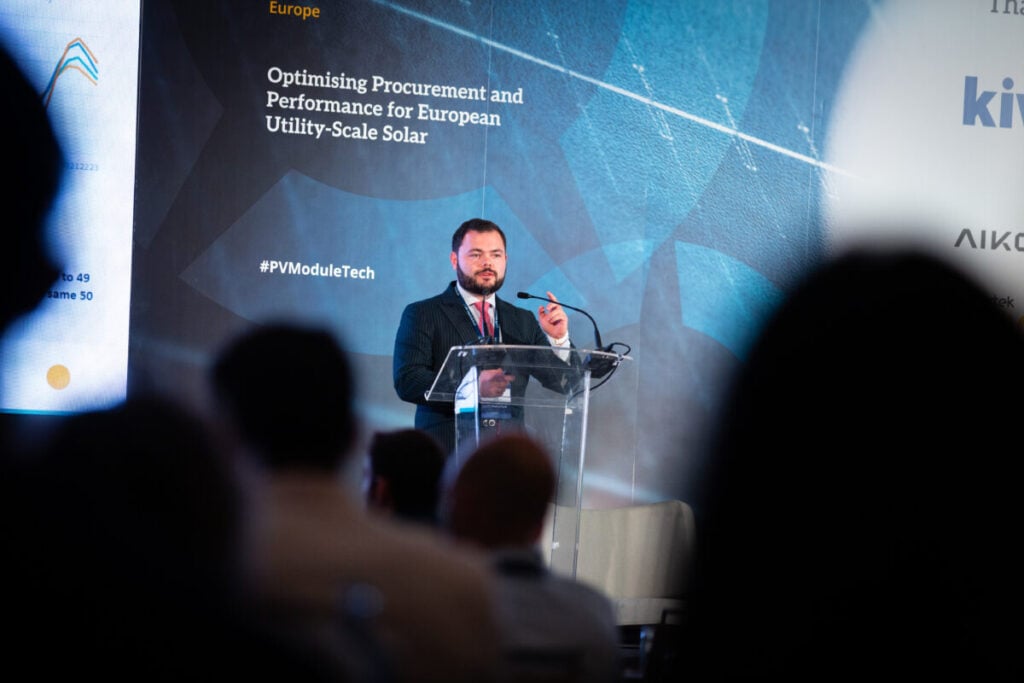
Eduardo Forniés García, senior manager of supplier quality at Sonnedix, delivered a presentation on the first day of PV ModuleTech Europe in which he described how accurately replicating real-life conditions in a testing environment is challenging, and used the example of ultraviolent-induced degradation (UVID) to illustrate this.
“UVID exists—we have measured it in the laboratory—but apparently outdoors the degradation is much less,” he said. “This is something we can model in our financial model and extrapolate—what is the difference between indoors and outdoors?—and put the outdoor degradation, which is the most influential to us, into our financing.”
Rapid pace of technological innovation
“Technology is moving way faster than our ability to evaluate it,” argued Elene Garciandia, head of projects at Kiwa PI Berlin, who attributed these challenges to the rate of technological innovation in a presentation of her own.
“The market has moved rapidly from PERC to TOPCon, and we’re seeing increasing deployment of BC [back contact] architectures,” she said. “This doesn’t necessarily mean that these technologies are unreliable, but that investors and buyers have to make procurement decisions before all the long-term information is available.”
An inability to effectively test modules has clear implications for the effectiveness of those modules once they are deployed in the field, but also raises safety concerns. Jörg Althaus, director of engineering and QA services at Intertek CEA, who wrote a piece for the latest issue of PV Tech Power about how bypass diode connection failure (LBPD) can expose a solar project to fire risk, also delivered a presentation on the second day of the conference about how these can create a “big risk”.
“In a 100MW asset, you may have a couple hundred modules at risk of starting a fire at some point,” he said, building on testing data collected by a drone inspection provider. “It’s a small percentage, but it’s a big risk, so I think it’s worth looking at how to prevent this.”
Althaus said that the lost bypass diode (LBPD) issue is difficult to observe as the status of its connection to a junction box cannot be identified in standard IR drone inspections of a site, and that observed lost substrings are a warning sign that should trigger a LBPD screening exercise. He described a lost substring as a “sister” issue to the bypass diode issue.
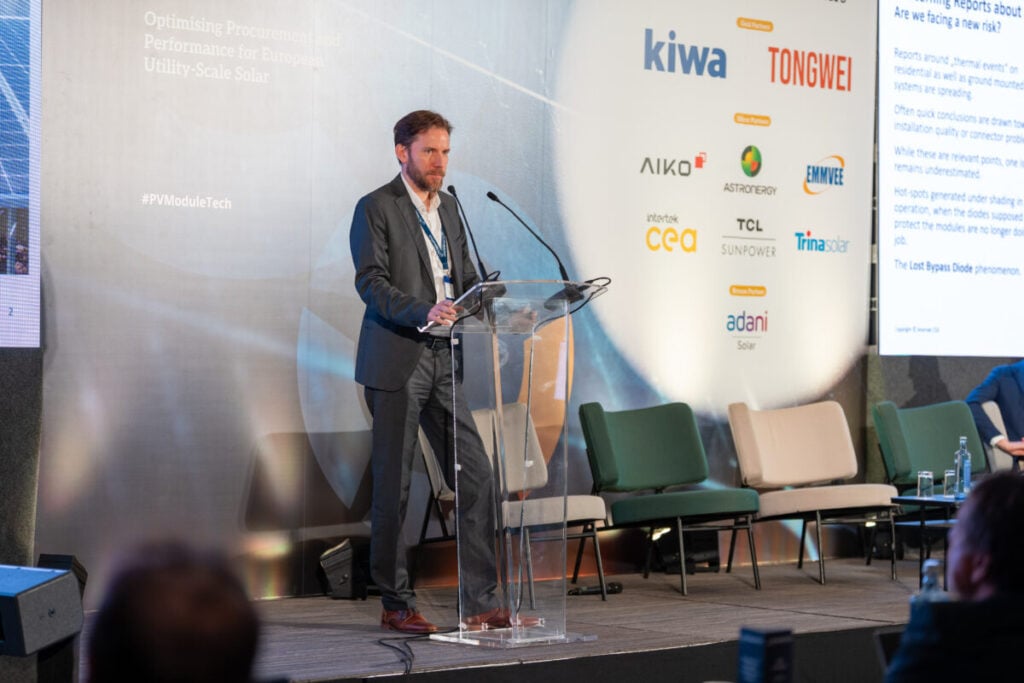
During his presentation, Forniés García added that superior “quality control is recommended” to improve testing practices to meet the demands of modern module innovation and performance.
“We see that there are many suppliers that have a, let’s say, huge UVID [so] we have to do good quality control,” he added.
However, Forniés García acknowledged in his presentation that innovating in the testing space can be challenging due to the costs involved, and even some of the more advanced testing processes that exist at present can be expensive.
“There are many tests to detect UVID—most of them are in qualification programmes [but] those tests are quite expensive,” he said.
“Technical concerns become contractual concerns when they impact either a business interaction, energy yield, degradation and so on,” added Garciandia, suggesting that these costs can be passed on to others involved in a project’s financing, making the issue more complex.
“Contracts should be able to identify those risks [and] mitigate or remove them. How much technical uncertainty are we ready to accept in our contracts, and how do we manage that uncertainty contractually?”
Solar-plus-storage can tackle financial challenges, but questions need answering
Financial uncertainty was another concern addressed by several other speakers at the conference. Adele Zhao, head of product solutions and marketing at Trina Solar, who delivered a presentation early during the summit, said that “project economics are becoming increasingly challenging in certain markets”, which is leading investors to consider adding battery energy storage systems (BESS) to renewable energy generation projects.
“It’s very difficult to be financed, so we have to build hybrid,” she said. While Zhao spoke of the global potential for solar-plus-storage deployments, Ignacio López Martín, partner at venture capital firm Vida Sustainable Ventures, said that this potential is particularly significant in Spain, where high renewable energy penetration and uncertainty about the efficacy of traditional grid infrastructure have encouraged more hybrid deployments.
“There is quite a huge opportunity there,” he said during his presentation. “To manage the standalone projects to be profitable, we also need the capacity market, which is not in place yet. But for the hybridisation case, once you get your solar plant … that helps your returns quite well, and that could actually be a door for the developers and the IPPs.”
However, both Zhao and López Martín suggested that hybrid projects bring a range of questions that need to be answered, particularly from a financial angle.
“How do we make the model work so that the capital trusts in these assets?” asked Zhao. “Solar technology costs have fallen significantly, but project profitability is increasingly under pressure. The challenge now is how to maximise project value and ensure attractive long-term returns.”
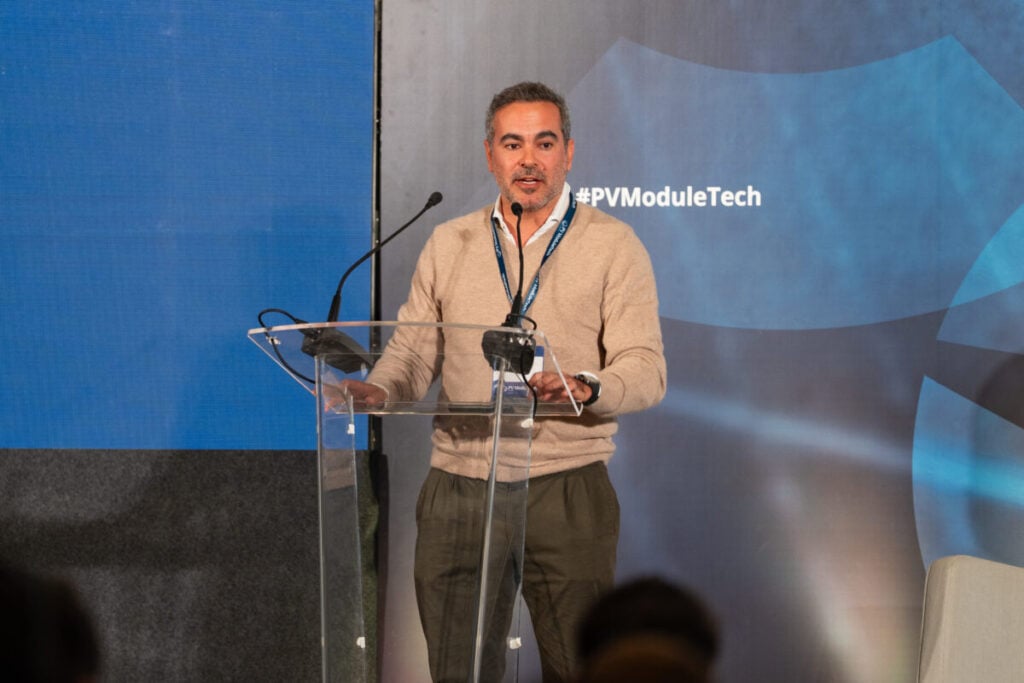
“There are about 20GW ready-to-build hybrid projects that are struggling to be built because of the financing,” added López Martín, speaking about the Spanish market in particular.
“The main challenge here, in my opinion, is that we are facing a big problem with debt from the traditional banks. The solar market was up three years ago, now they are struggling a lot, and all that senior debt doesn’t allow the IPPs and asset owners to refinance and integrate these new models of storage that will actually make the returns on the plants, in the current market conditions, very, very interesting.”
López Martín also argued that leading suppliers of equipment for hybrid projects “are not bankable yet in Spain” due to the relative novelty of the solar-plus-storage industry, compared to the more well-established standalone solar sector.
“They don’t have operating equipment for more than one or two years in the markets, so that makes traditional banks not able to do that [financing],” he said, encouraging developers to build smaller projects first as a proof of concept to make securing finance easier. “The first project, at least [should have] 20-30MW to be relevant and be able to be funded, and do it in good conditions for five years. That will open the door to developers like me and many others in Spain.”
The growing role of non-price criteria in procurement
While many speakers agreed that financing remains a vital component of project development, several others said that ‘non-price criteria’ have become an important part of the procurement piece. In general, this relates to procurement teams considering matters beyond price, such as the quality of components or their countries of origin, and making procurement decisions based on those.
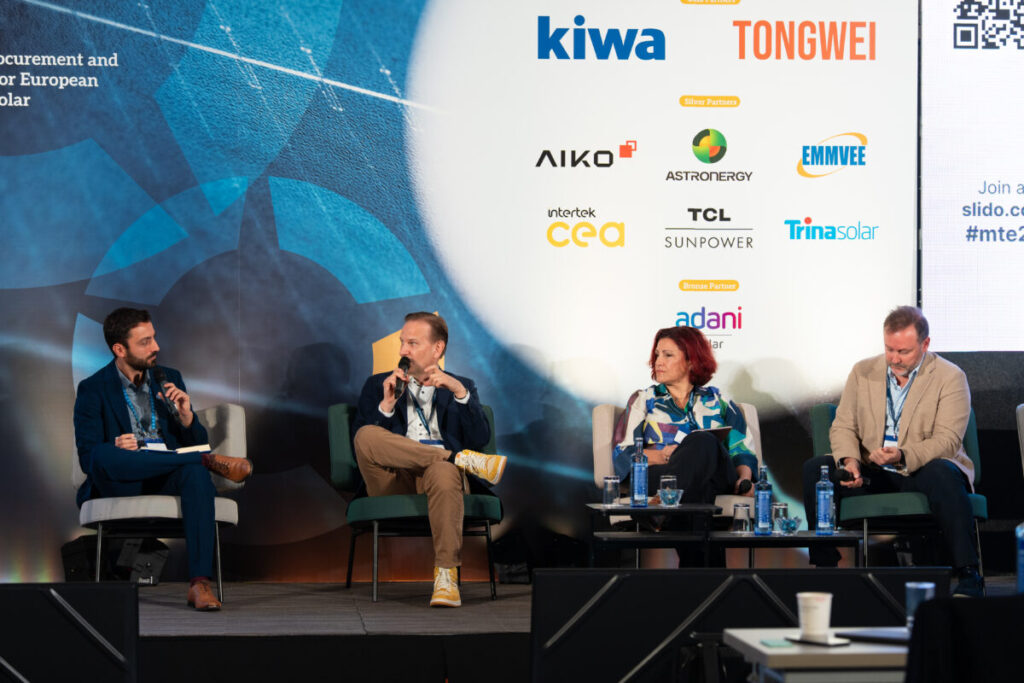
Erik Lohse, head of purchasing and supply chain at Enerparc, said on a panel discussion on the first day of the event that “there’s lot of changes coming” in the way that procurement teams do their business: “It’s not only changes in the product itself, it’s changes in the production process and in the quality process.”
“We are fully vertically integrated we buy each component by ourselves … and I think that’s a very good concept because we always have in mind long-term ownership,” he continued. “If an EPC is buying material, he’s maybe just looking for nameplate power, highest power [and] largest modules, whatever is cheaper.
“It’s a different view, and I think this is a risky view because you just focus on the first years and not on the long-term.”
Elina Bosch, senior analyst at the Becquerel Institute, delivered a presentation in which she argued that the policy landscape in Europe is also encouraging developers to put more emphasis on non-price criteria, saying that regulations “are shaping how procurement is moving from purely a price and a quality question to some other aspects as well”.
These measures include the Net Zero Industry Act (NZIA), which this year drew criticism from SolarPower Europe for being implemented too slowly to support European solar manufacturing, and the proposed Industrial Accelerator Act (IAA) that aims to establish a clear ‘Made in Europe’ definition so that European buyers can have more security when purchasing modules and components from suppliers based on the continent.
These policy initiatives come as European buyers look to reduce their reliance on products made in China, in particular, as this has created a vulnerable supply chain for the European renewable energy sector; Bosch said that “being dependent on a single third country represents an important threat to actually conducting the energy transition”.
“With different EU instruments, which are being or have been put in place, this notion—how procurement is being decided on—extends now well beyond the pure price question,” explained Bosch. “Carbon aspects related to sustainability, carbon content, resilience [and] origin of the equipment, social aspects and security all of that now builds the landscape to navigate through for solar and storage procurement.”

However, she noted that stricter EU compliance regulation could translate to higher costs for buyers in Europe, due to the low prices of producing components in China compared to other regions. The latest figures from sun.store show that module and inverter prices in Europe have increased, as European buyers look to diversify their purchases from Chinese manufacturers, and Bosch presented a number of modelled scenarios for how module prices could change at PV ModuleTech.
“We modelled what would be the price of manufacturing modules under different assumptions for the origin of the different bills of materials that compose a PV module,” Bosch said. “In general, there are some moderate price increases, mainly because beyond a fully China-made module, there are other compliance routes which come at moderate additional prices.”
Bosch went on to say that this increase in prices could simply be the cost of transitioning Europe’s solar procurement sector from one reliant on Chinese products to one where buyers are acquiring products and components from a more diverse range of sources.
“There is a certain price gap at module level and inverter level, but this is just the price of resilience with decoupled socio-economic benefits of having an EU industry that can provide for more of the solar PV and storage markets,” she said.