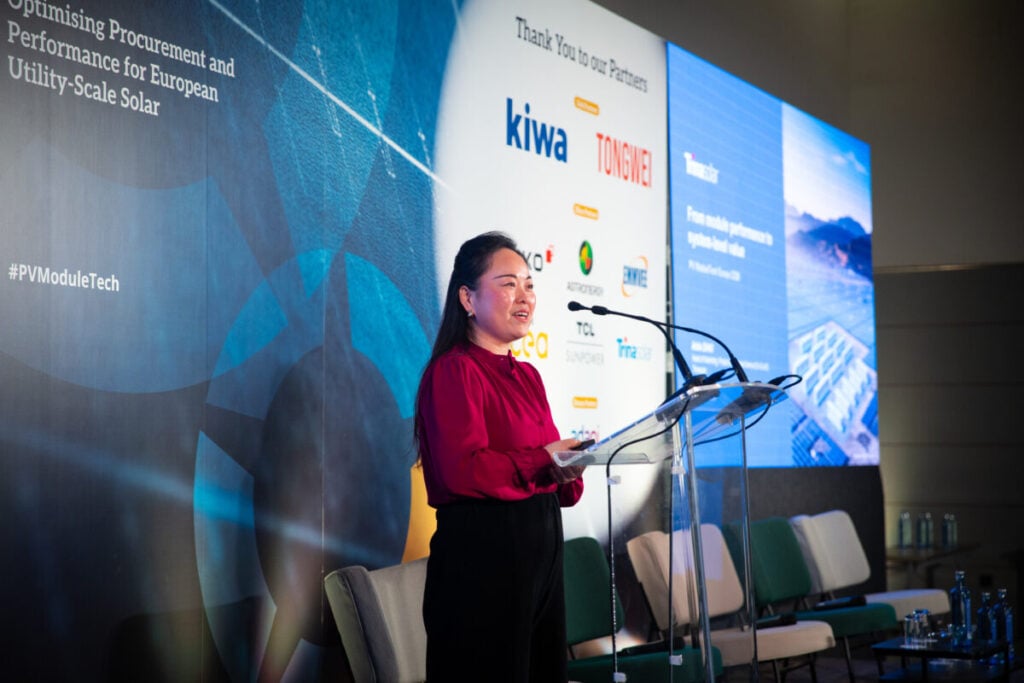
Speakers from Trina Solar and Tongwei announced that their companies are exploring a wide range of module technologies at this morning’s PV ModuleTech Europe conference, hosted by PV Tech publisher Solar Media in Málaga.
Adele Zhao, head of product solutions and marketing at Trina Solar, said she is often asked: “What’s our technology roadmap?”
Try Premium for just $1
- Full premium access for the first month at only $1
- Converts to an annual rate after 30 days unless cancelled
- Cancel anytime during the trial period
Premium Benefits
- Expert industry analysis and interviews
- Digital access to PV Tech Power journal
- Exclusive event discounts
Or get the full Premium subscription right away
Or continue reading this article for free
For the time being, the answer is tunnel oxide passivated contact (TOPCon).
“Trina is heavily focused on TOPCon technology [and] where we are today is already the third generation,” said Zhao. “This is the main technology for us, for the next four or five years”.
However, she noted that she expects to see “more perovskites” in the global solar industry from 2030, and that back contact (BC) is a “very good technology” that has been a focus of the company for “many years”.
“We’ve been trying to bring down the cost [and] work on bigger wafers,” she continued, highlighting how cost remains a limiting factor for manufacturers.
Zhao also expressed confidence that other module technologies could have particular potential outside of utility-scale deployments, where the company’s focus remains on TOPCon. She said that Trina has a “very small volume of BC,” which she expects to be deployed in the residential sector, which was a sentiment echoed by Ranson Tian, pre-sales technical manager at Tongwei, who delivered a presentation after Zhao.
“The technology will obviously be divided between two branches: the first one is for utility-scale … which must be TOPCon technology, said Tian,” who noted that technologies including heterojunction (HJT) could have potential for use in other sectors. “The next branch is for residential, rooftop or floating [where] it’s the monofacial scenarios.”
Tian added that Tongwei will make its decision what technologies it considers the best for these scenarios in the first quarter of next year, and bring its findings to next summer’s Intersolar Europe event.
Alternative technologies and hybrid projects have potential
Exploring the potential and financial viability of a number of alternate module technologies is significant because, as the speakers discussed, ensuring long-term operational performance is a priority for the solar industry.

Zhao pointed to challenges for standalone solar deployments, saying that: “Project economics are becoming increasingly challenging in certain markets, driving greater interest in hybrid PV-plus-BESS (battery energy storage system) projects.”
However, she noted that this can open up a new series of questions and uncertainties, for both asset managers and financiers.
“It’s very difficult to be financed, so we have to build hybrid,” she said. “Are we ready, as an industry, to build all these hybrid [assets]? Is the government ready? Is the grid ready?
“How do we make the model work so that the capital trusts in these assets? Solar technology costs have fallen significantly, but project profitability is increasingly under pressure. The challenge now is how to maximise project value and ensure attractive long-term returns.”
These questions will need to be answered quickly, as BESS deployments in Europe are expected to accelerated at speed. Borja Dalmau, director of storage at UNEF (Unión Española Fotovoltaica), cited SolarPower Europe figures in his presentation that suggest that annual BESS installations will more than double from 52GWh in 2026 to 138GWh by the end of the decade, and said that long-term security is essential to secure project finance.
“Banks are looking for long-term contracts, for example PPAs for PV and in batteries we have [structures like] tolling agreements, all to create bankability,” said Borja.
Solar Media’s PV ModuleTech Europe Conference is current underway in Málaga, Spain. Taking place on 3-4 November 2026, the event is covering the European solar market with a focus on procurement and performance of utility-scale solar plants. This year’s event expands its scope beyond PV modules and includes inverter and battery energy storage systems.