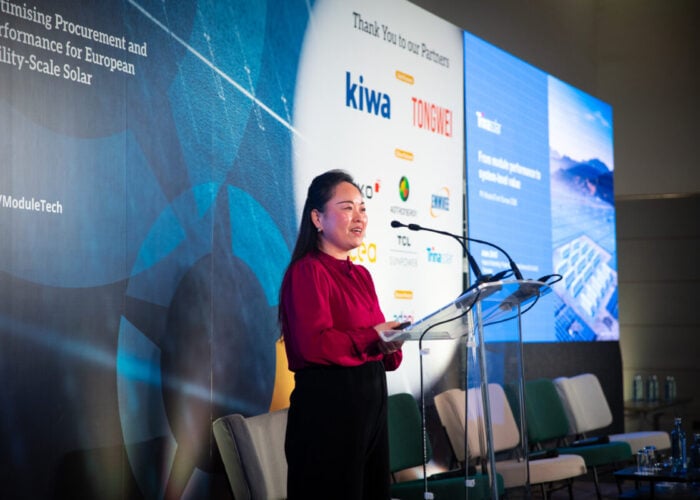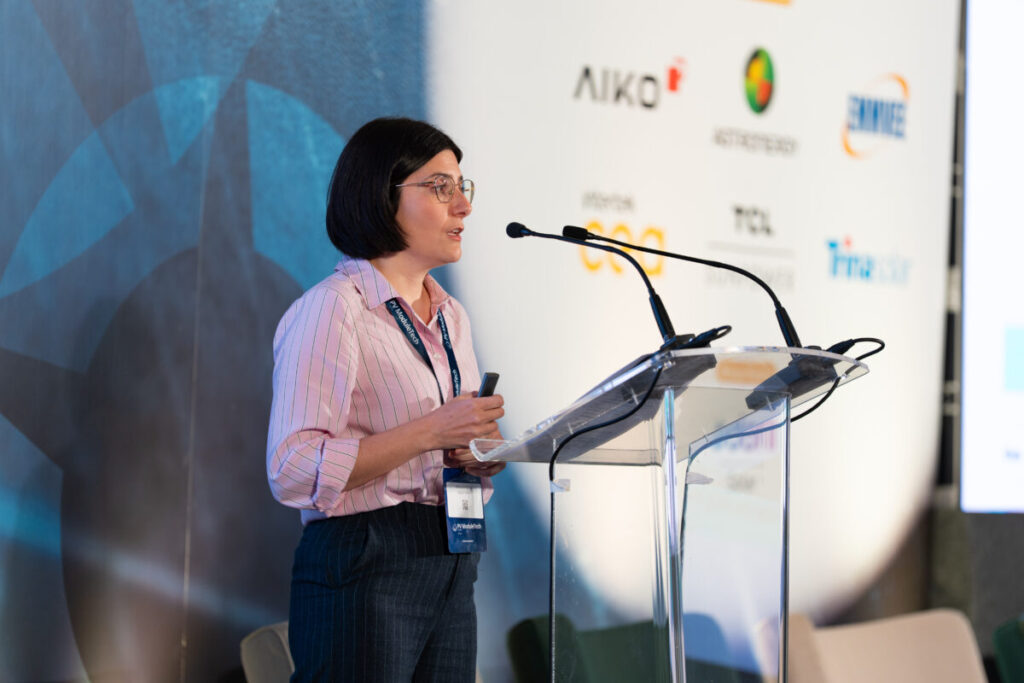
“Technology is moving way faster than our ability to evaluate it,” said Elene Garciandia, head of projects at technical advisor Kiwa PI Berlin at today’s PV ModuleTech Europe event, highlighting the challenges of ensuring solar module performance in an industry where there is a rapid pace of technological innovation.
Garciandia delivered her findings in a presentation at today’s event, hosted by PV Tech publisher Informa Markets in Málaga, and emphasised that, while this does mean that newer technologies are reliable, investors, asset managers and offtakers are increasingly involved in signing contracts for modules and components for which there is less evidence of reliable operation in the long-term.
Try Premium for just $1
- Full premium access for the first month at only $1
- Converts to an annual rate after 30 days unless cancelled
- Cancel anytime during the trial period
Premium Benefits
- Expert industry analysis and interviews
- Digital access to PV Tech Power journal
- Exclusive event discounts
Or get the full Premium subscription right away
Or continue reading this article for free
“The market has moved rapidly from PERC to TOPCon and we’re seeing increasing deployment of BC architectures,” she said. “This doesn’t necessarily mean that these technologies aren’t reliable, but that investors and buyers have to make procurement decisions before all the long-term information is available.”
Steffen Graf, managing director at Indian module manufacturer Emmvee Energy GmbH, who delivered a presentation following Garciandia’s, identified a similar question, asking: “How can we ensure long-term reliability when solar technology is advancing faster than ever before?”
“The technologies are changing every few years, so how do we deliver on a 30-year promise during this technology transition?” he continued. “A module installed today, in 2026, may still be in operation in 2050. The technology used to manufacture that module may not be dominant in five years, but the module itself may be in use in 25 years.”
“Every technology transition introduces new opportunities, but also risks.”
Tackling these risks, particularly the risk that new technologies have less evidence of effective operation in the long-term, requires an emphasis on hiring skilled workers, rather than rushing to deploy sheer volumes of new technologies.
“Our own move into TOPCon cell manufacturing started with this approach,” said Graf, adding: “Rather than focus on installing pure production capacity, we invested in building technical expertise [and] TOPCon manufacturing know-how.”
Technical questions for TOPCon and BC
Garciandia also pointed to TOPCon, noting that the transition from the second to the third generation of the technology is currently underway. She acknowledged that this evolution is not simply an improvement in theoretical module efficiency, but a transition that will bring all manner of “material considerations” and pose new questions for manufacturing processes, such as the use of quarter-cut cells in TOPCon 3.0 and their requirement for additional cutting operations as some of these practical questions that need answering.

Earlier in the day, PV Tech heard that leading manufacturers are considering the future of a range of module technologies, and Garciandia said that other technologies must be investigated with the same depth of technical questions, calling back contact (BC) a “more process sensitive technology” that “involves more manufacturing steps”.
Answering these questions can also be challenging when there can be a disparity between a module’s performance in a testing environment and in the field. Eduardo Forniés García, senior manager of supplier quality at independent power producer (IPP) Sonnedix, delivered a presentation on quality assurance and quality control, making particular reference to ultraviolet-induced degradation (UVID) as a phenomenon that is both impactful on module performance and one that can be difficult to accurately test.
“UVID exists—we have measured it in the laboratory—but apparently outdoors the degradation is much less,” he said. “This is something we can model in our financial model and extrapolate—what is the difference between indoors and outdoors?—and put this into our financing.”
Garciandia also spoke about the potential financial implications of uncertainty surrounding module performance, framing the overall discussion in terms of how much risk parties are prepared to accept when investing in a solar project.
“How much technical uncertainty are we ready to accept in our contracts, and how do we manage those risks contractually?” she asked.
Solar Media’s PV ModuleTech Europe Conference is currently underway in Málaga, Spain. Taking place on 3-4 November 2026, the event is covering the European solar market with a focus on procurement and performance of utility-scale solar plants. This year’s event expands its scope beyond PV modules and includes inverter and battery energy storage systems.