What to expect from mono PERC module development in 2018

Facebook
Twitter
LinkedIn
Reddit
Email
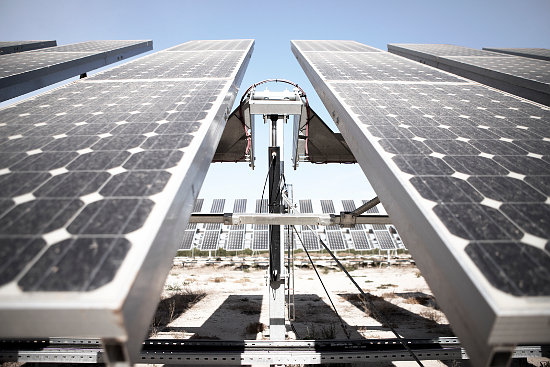
The scope for 72-cell p-mono options to push towards 400W (STC) during 2019-2020 is entirely feasible. Image: ABB

Yesterday on PV-Tech, we explained what to expect from p-type multi c-Si modules during 2017 and 2018, across various p-multi cell configurations. Today, we show a similar analysis, but for p-type mono. 

With market-share gains expected in the next 2-3 years from p-type mono, knowing what can be expected from 60-cell and 72-cell designs is perhaps more appropriate in terms of benchmarking undertaken by n-type and thin-film competitors.

This article requires Premium SubscriptionBasic (FREE) Subscription

Try Premium for just $1

  • Full premium access for the first month at only $1
  • Converts to an annual rate after 30 days unless cancelled
  • Cancel anytime during the trial period

Premium Benefits

  • Expert industry analysis and interviews
  • Digital access to PV Tech Power journal
  • Exclusive event discounts

Or get the full Premium subscription right away

Or continue reading this article for free

The methodology used to generate the graphics was explained in the blog yesterday. The full analysis is adapted from the January 2017 release of our PV Manufacturing & Technology Quarterly report. The themes are set to be discussed at the forthcoming PV CellTech 2017 event in Penang, Malaysia, 14-15 March 2017.

Greater variation in p-mono module power ratings

Compared to yesterday’s analysis and discussion on p-type multi c-Si efficiencies and power ratings, there is a greater delta between the lowest powers today (3BB and 4BB standard p-type mono cells using M0 size wafers) and the highest powers (4BB and 5BB PERC on M2 size wafers).

The following three graphics compare these two groupings for p-type mono modules, noting that there are other p-type options occupying the middle-ground.

The first graphic shows 60-cell average panel powers by year, with the average ratings from the lead variant (5MM PERC on M2) close to 310W (Wp-dc, STC) next year.
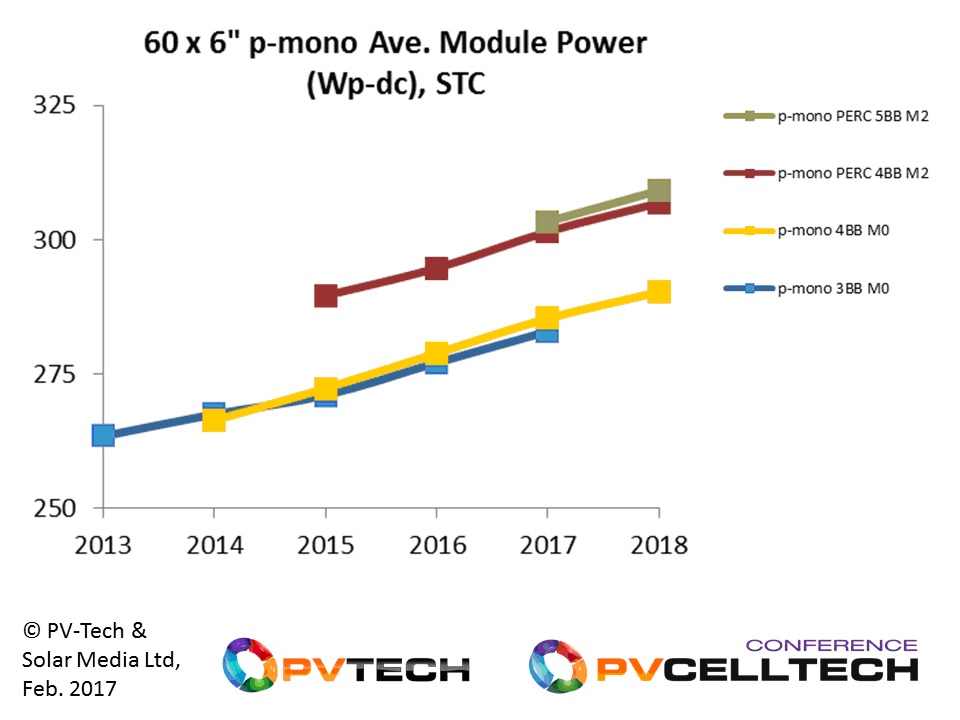
60-cell p-type mono modules were previously the mainstay of small rooftop installations, with 48-cell variants still supplied to certain end-markets such as Japan.

The next graphic shows 72-cell power ratings, where the 5BB PERC on M2 wafer version is forecast to be supplied with average powers approaching 370W (Wp-dc, STC) next year.
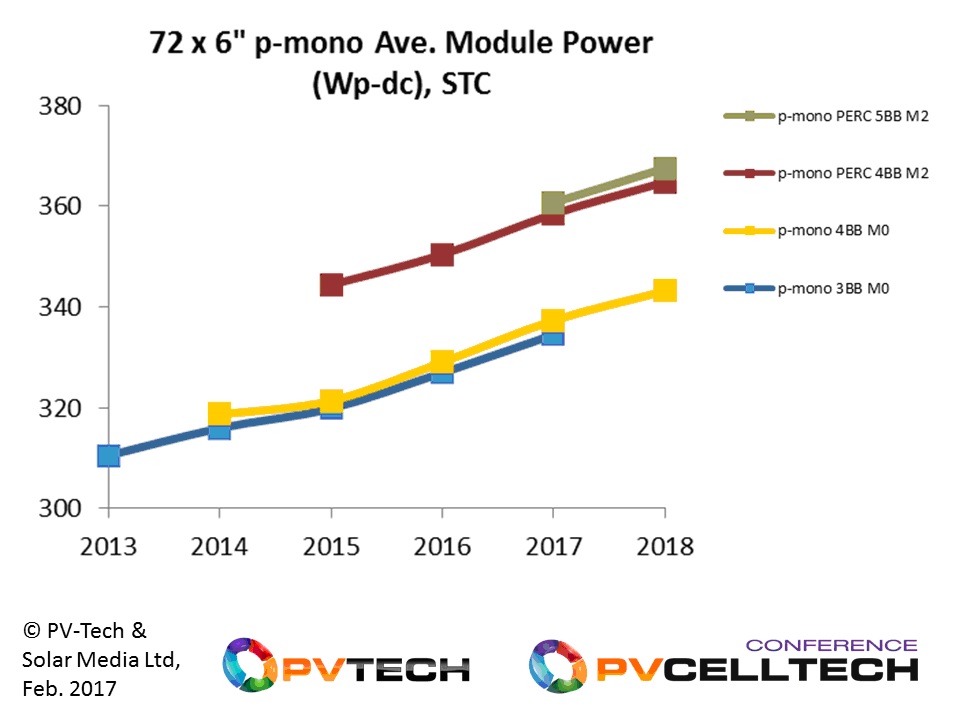
72-cell p-type mono modules are less common in the market today, compared to the industry-standard 72-cell p-type multi that dominate the utility scale markets in some of the leading end-markets, but may see greater adoption going into 2017.

The final graphic shows the above 72-cell variants, but at the elevated temperature of 70 degrees. Here the highest performing panels are operating with average levels close to 300W (Wp-dc).
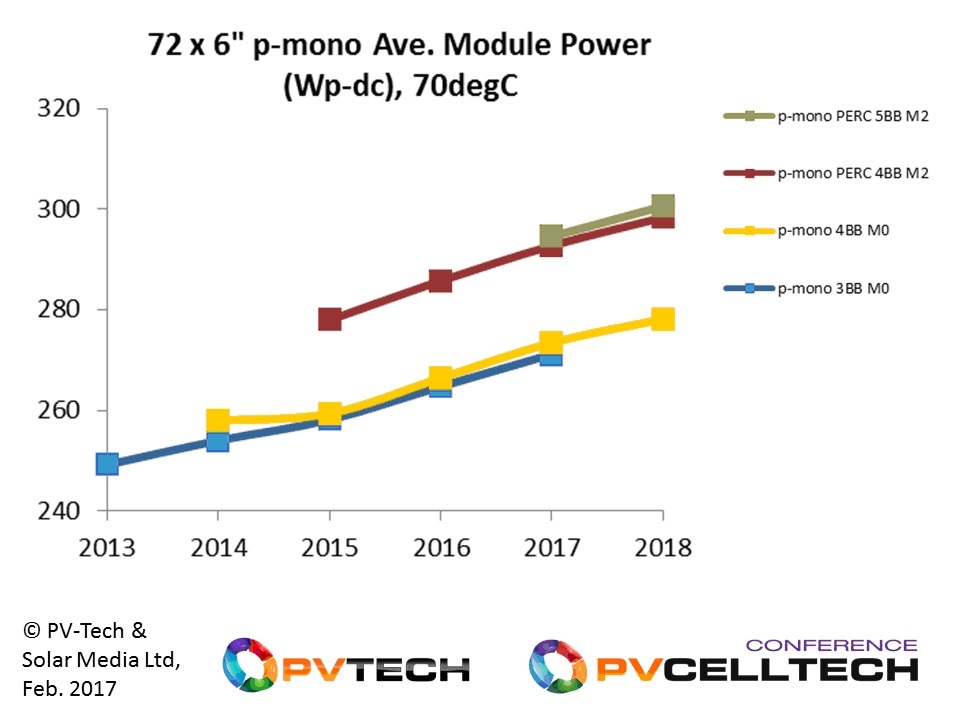
Utility scale benchmarking from 72-cell p-mono modules should be using average power levels close to 300Wp-dc in 2017.

In addition to the higher power levels coming from M2 wafers, and the increasing combination of 4-5BB design using the supply of this larger wafer size, efficiency gains for PERC on mono are more incremental when compared to p-multi module equivalents. This is not uncommon for advanced cell design on mono, compared to multi.

The scope for 72-cell p-mono options to push towards 400W (STC) during 2019-2020 is entirely feasible, if attention returns to the front-surface and selective emitter options.

Company-specific module technology and power ratings are included in the PV Manufacturing & Technology Quarterly report. More comparative data (including n-type and thin-film powers) will be presented at the forthcoming PV CellTech 2017 event in Penang, Malaysia, 14-15 March 2017

To view the latest PV CellTech agenda, please follow this link. To register for the event, click here.

We are also doing our latest free webinar series, titled “Solar PV manufacturing and technology trends; impact of global market drivers” on 15 and 16 February 2017; click here to register to attend one of these webinars.

16 June 2026
Napa, USA
PV Tech has been running PV ModuleTech Conferences since 2017. PV ModuleTech USA, on 16-17 June 2026, will be our fifth PV ModulelTech conference dedicated to the U.S. utility scale solar sector. The event will gather the key stakeholders from solar developers, solar asset owners and investors, PV manufacturing, policy-making and and all interested downstream channels and third-party entities. The goal is simple: to map out the PV module supply channels to the U.S. out to 2028 and beyond.
13 October 2026
San Francisco Bay Area, USA
PV Tech has been running an annual PV CellTech Conference since 2016. PV CellTech USA, on 13-14 October 2026 is our fourth PV CellTech conference dedicated to solar manufacturing in the USA. From polysilicon, wafers, ingots, cells and modules, to critical component suppliers including glass and frames, the event connects every stage of the value chain under one roof. PV CellTech USA also brings together investors, innovators, manufacturers and industry stakeholders to collaborate and strengthen domestic solar manufacturing across the United States.
20 April 2027
Istanbul, Türkiye
PV Tech has been running PV CellTech Conferences since 2016. PV CellTech Global, on 20-21 April 2027, is the meeting place for everyone invested in the growth of PV manufacturing and advancement in cell technologies, which will drive us towards the installed capacity required to power the planet by 2050. This is a gathering of key stakeholders driving capital expenditure and technologies for new PV manufacturing plants across the globe to harness the opportunities the growth of PV represents out to 2050 and beyond. The conference takes place in one conference room, where all senior peers have the same shared experience of learning and unique insight, unmatched anywhere else in the solar industry events calendar.

Read Next

June 5, 2026
The Western Australian government has allocated AU$17.8 million (US$12.7 million) in its 2026-27 State Budget to build the state's capacity to recycle solar modules and embedded batteries, under its Remade in WA programme.
June 4, 2026
The opening of this week’s SNEC show in Shanghai was marked by a shared recognition of the need for China’s PV industry to move beyond unchecked capacity expansion and brutal competition, writes Carrie Xiao.
June 4, 2026
As solar imports to the US face increasing restrictions, domestic manufacturers are racing to build upstream production capability. With 66GW of module capacity chasing just 11GW of domestic cells, the supply chain crunch is reaching a critical inflection point, write Moustafa Ramadan and Joe Hennessy.
June 3, 2026
Chinese solar manufacturer JinkoSolar has launched its 700W Tiger Neo 5.0 module series and a SunTera G5 energy storage system.
Premium
May 29, 2026
PV Talk: Kiwa PVEL's Tristan Erion-Lorico discusses highlights in the 2026 Module Reliability Scorecard, including UVID and delamination.
Premium
May 22, 2026
As trade dynamics shift, could the EU become the next big market for Indian solar suppliers? PV Tech Premium explores the outlook with Wood Mackenzie’s Yana Hryshko and IEEFA’s Charith Konda.

Upcoming Events

Solar Media Events
June 16, 2026
Napa, USA
Media Partners, Solar Media Events
June 30, 2026
Sacramento, California
Media Partners, Solar Media Events
August 25, 2026
São Paulo, Brazil
Media Partners, Solar Media Events
September 1, 2026
Mexico City, Mexico
Media Partners, Solar Media Events
September 9, 2026