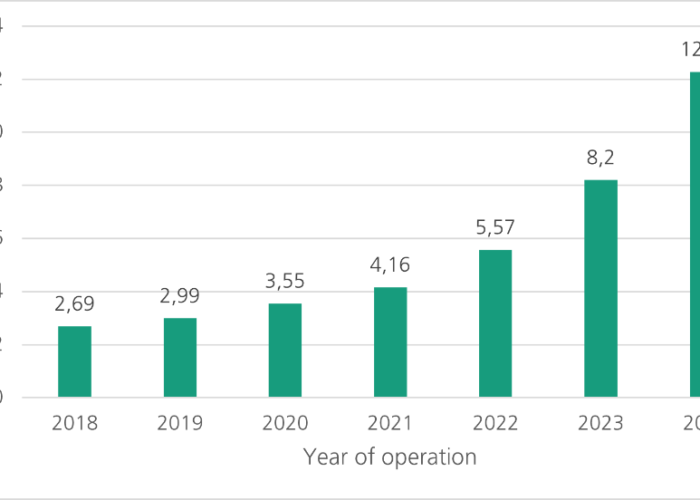
Japan is thought to have installed over 8GW of new photovoltaic (PV) generation capacity during 2014, according to analysis and research firm RTS PV.
PV Tech spoke to Dr Hiroshi Matsukawa at the Tokyo-headquartered company and asked for his estimate of how much PV was installed during the calendar year which has just finished.
Try Premium for just $1
- Full premium access for the first month at only $1
- Converts to an annual rate after 30 days unless cancelled
- Cancel anytime during the trial period
Premium Benefits
- Expert industry analysis and interviews
- Digital access to PV Tech Power journal
- Exclusive event discounts
Or get the full Premium subscription right away
Or continue reading this article for free
“The figures aren’t out yet, but I expect that the figure will exceed 8GW – probably,” Matsukawa said.
When asked about the final quarter of Japan’s financial year, which ends in March, Matsukawa said the dynamic of Japan’s annual PV deployment cycle under its feed-in tariff (FiT) was different to countries such as Britain which are known to experience a spike in installations in the final months of each financial year.
In the example of Britain, projects must be completed within the timeframe allotted in order to qualify for financial support schemes, usually meaning the final quarter of the financial year. This has traditionally led to scenes of PV plants being constructed quickly in challenging or difficult weather conditions as well as making market analysts’ task of accurately predicting shipments, pipelines and deployment more difficult.
“In the case of Japan, the rate of the FiT that PV plants qualify for is set at the time the project itself is approved and the equipment accredited, not when the project is connected to the electrical grid [as is the case in the UK]. So it’s not a last-minute dash to construct and connect as you might see in Germany or the UK,” Matsukawa said.
“In terms of tax incentives, there is just one that finishes in March and there is some influence from that, but it isn’t severe enough to really cause a last-minute dash.”
Matsukawa also explained a note put out by RTS PV and widely reported by industry press before Christmas detailing the deliberations of the Japanese government’s Working Group on Grid Connection. The group had been convened by the Ministry of Economy, Trade and Industry (METI) to deal with a number of utility companies, which are also responsible for the grid, suspending the receipt of applications for new solar projects, citing an inability of the country’s regional grid system to cope with an influx of new PV generation capacity.
Matsukawa said that contrary to some reports which said the working group had ruled that 17.3GW of projects could be cancelled, this figure simply highlighted by how much the total figure of approved PV projects (just under 70GW) in Japan exceeded the available grid capacity figures given to the working group by the electric companies. In Japan, utility companies are responsible for the grid system as well as their own electricity sales.