Newcastle-based printed solar technology company Kardinia Energy has received AU$2.15 million (US$1.51 million) in funding from the Australian government’s Industry Growth Program to accelerate the scale-up of its flexible printed solar technology manufacturing capabilities.
The grant, announced as part of the federal government’s AU$6.9 million investment in manufacturing for printed solar and semiconductor packaging tools, will support Kardinia Energy’s “Scaling Australian-Made Printed Solar for Renewable Energy Growth” project.
Try Premium for just $1
- Full premium access for the first month at only $1
- Converts to an annual rate after 30 days unless cancelled
- Cancel anytime during the trial period
Premium Benefits
- Expert industry analysis and interviews
- Digital access to PV Tech Power journal
- Exclusive event discounts
Or get the full Premium subscription right away
Or continue reading this article for free
The funding aims to transition the company’s innovative technology from university-based proof-of-concept to pilot-scale manufacturing.
In a statement, Kardinia Energy said that the investment “highlights Australia’s position at the forefront of clean energy innovation”.
The company emphasised that this grant represents “a significant milestone in our journey toward commercialisation and reinforces our commitment to providing sustainable, low-cost energy solutions that benefit both local industry and global decarbonisation goals”.
Located at the Newcastle Institute for Energy and Resources, approximately 150km north of Sydney, Kardinia Energy has developed a printed solar technology that differs from traditional silicon-based PV modules.
The company’s modules use carbon-based semi-conducting polymers printed on recyclable PET plastic, materials that are highly abundant and do not require the energy-intensive manufacturing processes associated with silicon solar panel production.
The printed solar modules weigh 300g per square meter and utilise easily sourced, non-silicon-based materials. This enables localised manufacturing that bypasses traditional supply chains and the economic constraints imposed by conventional photovoltaic modules.
Kardinia’s manufacturing cost target is below AU$10 per square metre, with modules weighing less than 0.3kg per square metre.
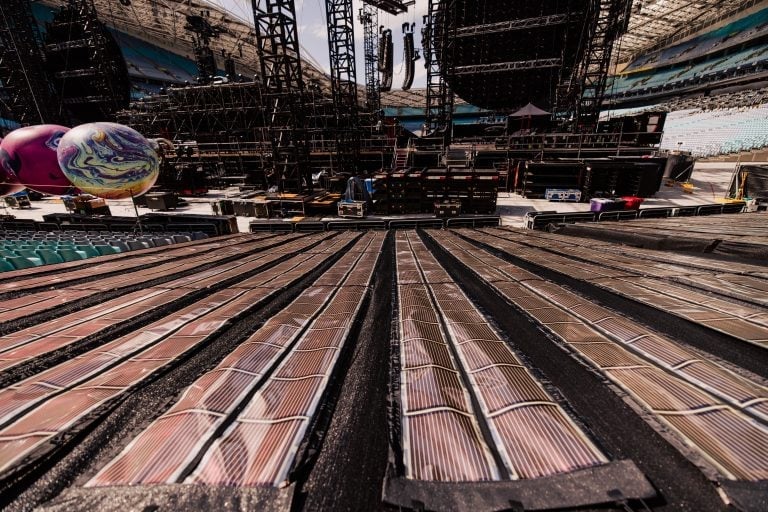
The technology has already gained international attention through its deployment in the entertainment sector. Printed solar technology has been used by British rock band Coldplay during their Music of the Spheres World Tour, with 500 square metres of printed solar cells installed at concert venues to power the band’s C Stage and other ancillary power needs.
The partnership with Coldplay has seen the technology deployed at venues across North America, including performances in Las Vegas, El Paso, Miami, and Foxborough.
Senator Tim Ayres, minister for industry and innovation, described the technology as “extraordinary” with applications across all parts of the energy system.
Australia’s Industry Growth Program
The Industry Growth Program is a key Australian government initiative that supports innovative, high-growth potential small and medium enterprises with advisory services and matched grant funding.
It is designed to help companies commercialise breakthrough technologies and scale their operations to compete in global markets.
Projects funded through the Industry Growth Program must align with Australian government priority areas for the National Reconstruction Fund and contribute to the future development of Australian manufacturing capability.
As such, the Industry Growth Program grant will help increase production throughput and module efficiency, enabling early market demonstrations and customer validation.
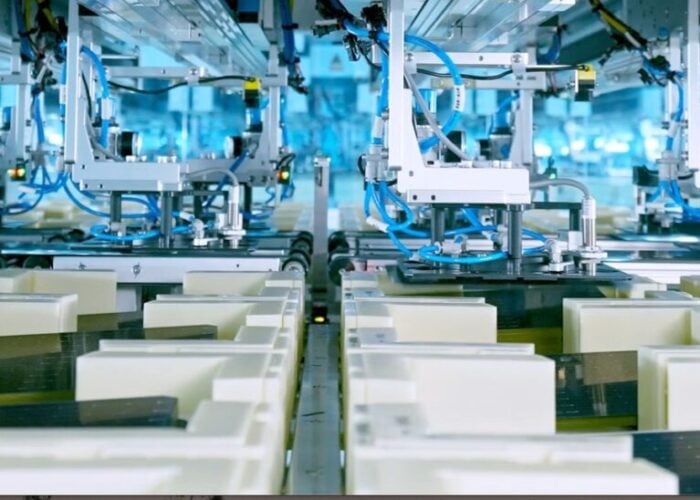
The funding supports the establishment of a pilot manufacturing facility that will use reel-to-reel printing techniques to produce the flexible solar modules designed and manufactured in Newcastle.
Kardinia Energy estimates that more than 4 billion square metres of low-weight-bearing industrial roof space globally cannot support the weight of traditional solar panel arrays.
In Australia alone, this represents 2.4GW of potential energy generation capacity that could be unlocked through the deployment of printed solar technology.
The printed solar technology is being positioned for multiple applications beyond entertainment venues, including industrial rooftops unable to support conventional systems, off-grid power requirements for emergency response and disaster relief, and deployment in regions where low-cost, flexible, and clean electricity solutions are needed.
Unlike traditional solar modules, printed solar modules are fully recyclable and designed for applications where flexibility and low weight are critical.
For readers unaware, Kardinia Energy was founded in 2020 by Professor Paul Dastoor of the University of Newcastle and CEO Anthony Letmon to commercialise the printed solar technology originally developed in university laboratories.
The new funding will allow Kardinia Energy to establish its first large-scale manufacturing facility within 18 months.