Four giant solar ‘wings’ will provide power for the first crewed mission to the Moon in over 50 years, due to launch later today.
The Artemis II mission, scheduled to lift off from the Kennedy Space Center in Florida this evening, will take a crew of four around the Moon and back, testing new life support and other technologies for future deep-space exploration.
Try Premium for just $1
- Full premium access for the first month at only $1
- Converts to an annual rate after 30 days unless cancelled
- Cancel anytime during the trial period
Premium Benefits
- Expert industry analysis and interviews
- Digital access to PV Tech Power journal
- Exclusive event discounts
Or get the full Premium subscription right away
Or continue reading this article for free
Central to NASA’s Artemis II Orion spacecraft is the European-built solar array that will provide its power once in space.
The array features four seven-metre-long solar wings attached to the European Space Module (ESM) built by Airbus for the European Space Agency (ESA). Airbus described the ESM as the “powerhouse” of the spacecraft, providing the propulsion, power, thermal control and the air and water needed for the crew.
During takeoff, the solar arrays will be protected by four “fairing panels” that will shield them from the heat, wind and acoustics of launch. Each wing consists of three hinged panels held in place by restraining cables connected to thermal resistors; when Orion reaches orbit, an electrical current heats the resistors, breaking the cables and allowing the panels to unfold automatically, according to the ESA. Each solar array can rotate on two axes to remain aligned with the sun.
A total of 15,000 gallium arsenide PV cells across the four arrays will generate 11.2kW of power, enough to supply the spacecraft and the new high-speed communication systems.
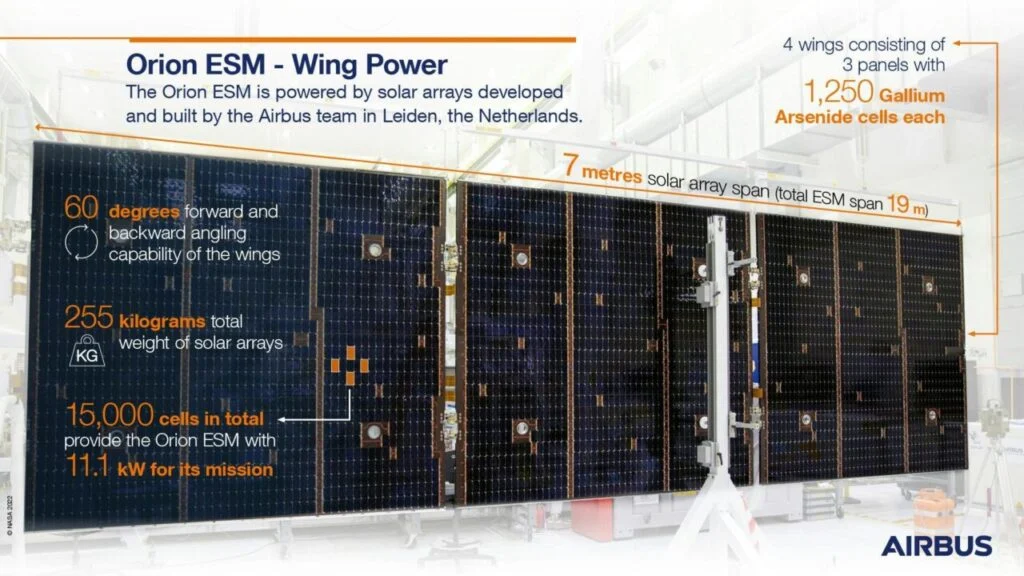
The installation of the solar arrays was completed last year, requiring over a week of work by Airbus and ESA engineers.
According to the ESA, each of the four solar wings is made of three carbon fibre-reinforced panels provided by the American company Northrop Grumman and equipped with PV panels made by Italian firm Leonardo.